

From Servants to Friends — When Jesus Rewrote the Relationship
After verse upon verse of vines, branches, fruit, and fire — Jesus steps out of the metaphor and drops a single sentence that rewrites the whole relationship. 'I no longer call you servants. I have called you friends.' In a culture where the gap between rabbi and disciple was absolute, that was a word worth dying over.
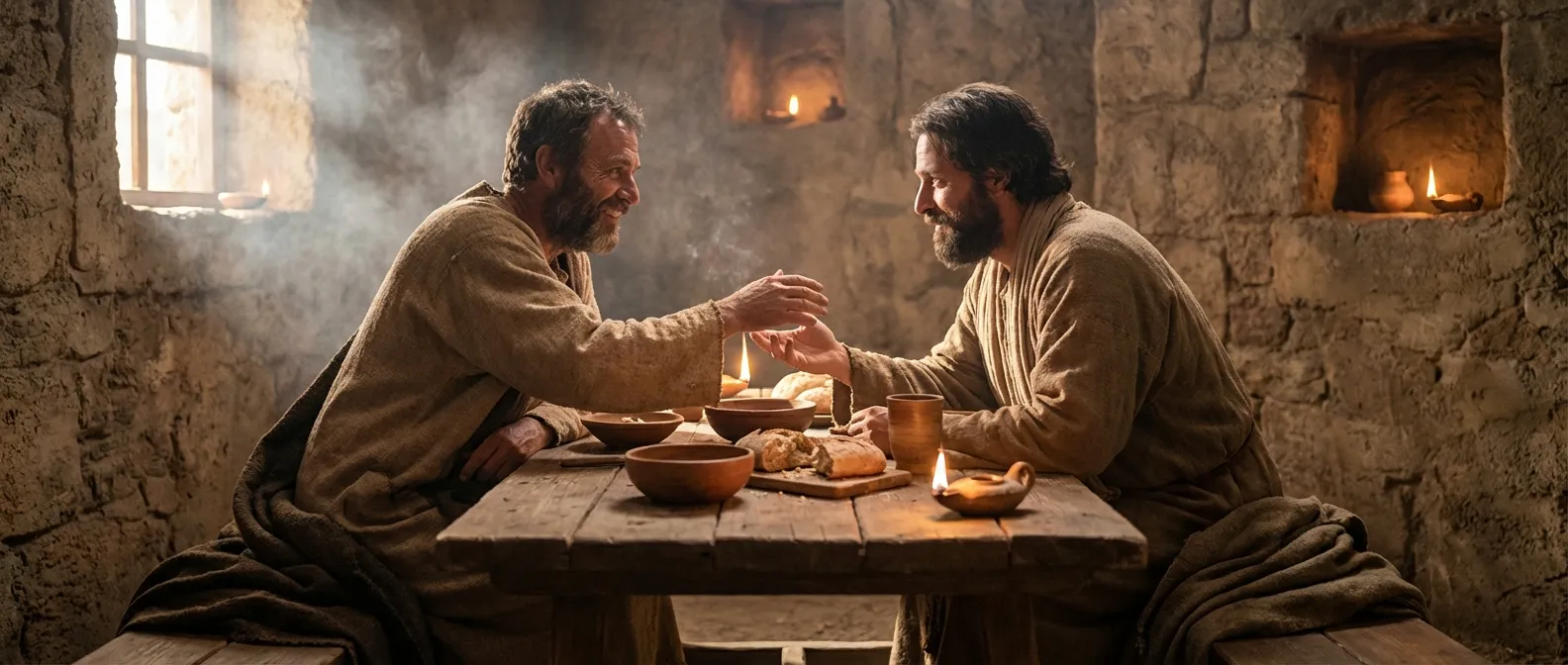
Part 5: From Servants to Friends
Something shifts in John 15:12.
For eleven verses, Jesus has been talking about vines, branches, gardeners, fruit, and fire. It’s agricultural language — organic, natural, but also somewhat impersonal. Branches don’t have conversations with vines. They don’t eat dinner together. They don’t share secrets.
And then Jesus steps completely out of the metaphor and says something so intimate it would have knocked the air out of the room:
No longer do I call you servants, for the servant doesn’t know what his lord does. But I have called you friends, for everything that I heard from my Father, I have made known to you.
I have called you friends.
Not branches. Not servants. Not followers, disciples, students, subordinates, or employees.
Friends.
In a culture where the gap between rabbi and disciple was absolute, where calling God “Father” was already provocative enough to get you killed, Jesus casually redefined the entire relationship between God and humanity with a single word.
And He said it on the night He was about to prove exactly how far that friendship goes.
The Command That Isn’t a Rule
“This is my commandment, that you love one another, even as I have loved you.…”
Notice what Jesus does here. He calls this a “commandment” — but it doesn’t function like one. There’s no penalty clause. No enforcement mechanism. No “or else.”
Instead, He grounds it in something completely different: “as I have loved you.” The standard isn’t a rule book. The standard is a relationship. How has Jesus loved these men? He washed their feet an hour ago. He’s about to die for them in a few hours. That’s the “as.”
This reframes everything. For the entire Old Testament, the relationship between God and humanity was structured around covenant law. Do this. Don’t do that. The Ten Commandments. The ceremonial codes. Six hundred and thirteen rules that defined what faithfulness looked like.
And now Jesus compresses all of it into a single sentence: Love each other the way I’ve loved you.
“…A new commandment I give to you, that you love one another. Just as I have loved you, you also love one another. By this everyone will know that you are my disciples, if you have love for one another.”
He’d said it before — just hours earlier, right after washing their feet. But here in John 15, embedded in the vine passage, it takes on new weight. Because now we know how love happens. It’s not willpower. It’s vine-life. The branch that remains in the vine produces the fruit of love — not as an achievement, but as an overflow.
Love isn’t the assignment given to disconnected branches. Love is what flows through connected ones.
The Definition of Love That Demolishes Every Lesser Version
Greater love has no one than this, that someone lay down his life for his friends.
Jesus states it as a general principle. But everyone at that table would remember, within twenty-four hours, that it wasn’t general at all. It was autobiographical.
Greater love has no one than this — and He was about to demonstrate it.
This is the definition of love that demolishes every lesser version. Love isn’t a feeling. Love isn’t compatibility. Love isn’t doing nice things for people who do nice things for you. Love, at its fullest expression, is laying down your life.
And “laying down your life” isn’t only about dying.
It’s about the daily, unglamorous, costly choice to put someone else’s needs above your own. It’s the parent who gets up at 3 AM — again — with a sick child. It’s the spouse who stays in a hard conversation instead of walking out. It’s the friend who shows up with food when you didn’t ask for help. It’s choosing to remain present when being present costs something.
By this we know love, because he laid down his life for us. And we ought to lay down our lives for the brothers.
John — the disciple who was sitting next to Jesus when He said these words — carried this message for the rest of his life. He’s an old man by the time he writes this letter. And he’s still saying the same thing: We know love because He laid down His life. Now we lay down ours.
That’s the fruit of the vine. Not impressive religious activity. Self-giving love that mirrors the one who first gave Himself.
Friends, Not Servants
You are my friends if you do whatever I command you. No longer do I call you servants, for the servant doesn’t know what his lord does. But I have called you friends, for everything that I heard from my Father, I have made known to you.
Let’s slow down on verse 15, because it’s doing something revolutionary.
“The servant doesn’t know what his lord does.”
This was the normal relationship between a rabbi and his disciples. You followed. You obeyed. You carried his bags and memorized his teachings. But you didn’t question. You didn’t know the why behind the instructions. You were told what to do, and you did it. That was the deal.
Jesus just tore up that deal.
“I have called you friends, for everything that I heard from my Father, I have made known to you.”
Everything. Not the edited version. Not the need-to-know summary. Everything. Jesus is saying: I haven’t held back. I haven’t kept you at arm’s length. I’ve given you the full picture — the Father’s heart, His plan, His reasons — because that’s what friends do.
Servants get instructions. Friends get insight.
Servants know what to do. Friends know why.
And this changes everything about how you relate to God. You’re not a subordinate checking a task list from a boss you barely know. You’re a friend who’s been let into the inner circle. The Creator of the universe has told you what He’s doing and invited you to be part of it — not as labor, but as a companion.
Chosen Before You Chose
You didn’t choose me, but I chose you and appointed you, that you should go and bear fruit, and that your fruit should remain; that whatever you will ask of the Father in my name, he may give it to you.
This verse quietly resolves one of the deepest anxieties any believer carries: Am I really in? Did I choose correctly? Is my faith enough?
“You didn’t choose me, but I chose you.”
The initiative was never yours. You didn’t find God. He found you. You didn’t pick the vine — the vine grew toward you. Before you ever prayed a prayer or walked an aisle or opened a Bible, God was already reaching. Already choosing. Already appointing.
We love him, because he first loved us.
We love because He loved first. We chose because He chose first. We remain because He remained first.
This is the deepest security a branch can have. Not “I’m holding onto the vine tightly enough.” But “the vine chose me, grew toward me, grafted me in, and is sustaining the connection from His side.”
And the purpose of that choosing isn’t just salvation in the by-and-by. It’s fruit in the right now. “I appointed you that you should go and bear fruit.” The choosing has a direction. The friendship has a mission. You weren’t chosen to sit on a shelf. You were chosen to go — and to produce fruit that remains.
The Last Word: Love One Another
“I command these things to you, that you may love one another.…”
The entire passage ends where it began: love.
Jesus started with a gardener tending a vine. He moved to branches producing fruit. He warned about withering. He promised joy. He redefined the relationship from servanthood to friendship. And after all of that — the theology, the metaphors, the warnings, the promises — He lands on the simplest possible instruction:
Love one another.
That’s it. That’s the fruit. That’s the point of the vine, the purpose of the connection, the reason for remaining.
Not doctrine (though doctrine matters). Not programs (though programs serve). Not spiritual experiences (though those are real). Love. Expressed in action. Costly, self-giving, lay-down-your-life love directed at the people around you.
Beloved, let’s love one another, for love is of God; and everyone who loves has been born of God and knows God. He who doesn’t love doesn’t know God, for God is love.
“Everyone who loves has been born of God and knows God.” John says love isn’t just evidence of connection — it’s proof of knowing God. If love is present, God is present. If love is absent, something has disconnected, regardless of how much theology you know.
What This Means for Your Actual Life
Let me get practical for a moment.
If John 15 is right — if remaining in the vine produces fruit, and the primary fruit is love — then the health of your connection to Christ will show up in your relationships before it shows up anywhere else.
In love of the brothers be tenderly affectionate to one another; in honor prefer one another,
doing nothing through rivalry or through conceit, but in humility, each counting others better than himself; each of you not just looking to his own things, but each of you also to the things of others.
This is what vine-connected living looks like on a Tuesday afternoon. Not ecstatic worship experiences (though those are wonderful). Not theological arguments won (though truth matters). But the quiet, daily, costly practice of honoring others above yourself. Looking to their interests. Being tenderly affectionate with people who might not deserve it.
Is that happening in your life? Is love — real, visible, costly love — flowing through you to the people around you?
If yes, the vine is working. The connection is alive. The fruit is growing.
If not, the answer isn’t “try harder.” The answer is the same one it’s been since John 15:4: Remain. Reconnect. Get back to the vine. The love will follow because it always does when the source is flowing.
The Full Picture
Let’s step back and see what Jesus has built across this entire passage.
John 15:1-3 — God is the gardener. He’s invested, intimate, hands-in-the-dirt. He prunes what He loves because He sees what it can become.
John 15:4-5 — Remain. It’s the heartbeat of the passage. Stay connected. Draw life. Apart from the vine, you can do nothing.
John 15:6 — The warning. Branches that stop remaining wither. Not because the vine fails, but because connection is a choice.
John 15:7-11 — The fruit. Prayer is reshaped, desires are aligned, fruit is abundant, and joy — real, deep, unshakeable joy — is the signature mark of a branch that’s drawing from the source.
John 15:12-17 — Love and friendship. The vine metaphor opens into something deeply personal. You’re not a servant following orders. You’re a friend who’s been chosen, loved, entrusted with the Father’s heart, and sent to love others with the same love you’ve received.
From a gardener to a friend. From pruning to purpose. From remaining to love.
That’s John 15. That’s the whole thing.
A Final Word
But God commends his own love toward us, in that while we were yet sinners, Christ died for us.
Before you ever decided to remain, He decided to come. Before you bore any fruit, He bore the cross. Before you loved anyone, He loved you — not when you were lovable, but when you were lost.
The vine didn’t wait for the branches to prove themselves. The vine grew toward them. And is still growing toward them. And will never stop.
Your part is simple — not easy, but simple.
Remain.
Stay connected. Stay dependent. Stay in the conversation. Stay in obedience. Stay in love. Not because you’ll be punished if you leave, but because everything you were made for is found in the vine.
Apart from Him, nothing. In Him, everything.
Walk in love, even as Christ also loved us and gave himself up for us, an offering and a sacrifice to God for a sweet-smelling fragrance.
Walk in love. Like a branch lives in a vine. Like a friend lives in a friendship. Like someone who’s been chosen lives in gratitude.
Remain.
Reflect
-
Jesus calls you a friend, not a servant. Does your relationship with God feel more like friendship or servanthood? What would need to shift for it to feel like what Jesus described?
-
“Greater love has no one than this.” Who in your life is God calling you to love sacrificially? What would “laying down your life” look like in that relationship — not in death, but in daily practice?
-
“You didn’t choose me, but I chose you.” How does it change your sense of security to know the initiative started with God? Does this free you from the anxiety of “am I doing enough”?
-
Look at the Galatians 5 fruit list again: love, joy, peace, patience, kindness, goodness, faithfulness, gentleness, self-control. Which ones are most present in your life? Which ones are most absent? What does that tell you about your current connection to the vine?
-
As you finish this series, what’s the one thing that’s going to stick with you? Not five things. One. What’s the single truth from John 15 that you need to carry into tomorrow?
A Prayer to Close the Series
God — the Gardener, the Vine, the Friend —
I don’t want to be a disconnected branch. I don’t want to live on fumes, producing nothing, drifting farther from the source of everything I need.
Prune me. Even though it hurts. Even though I won’t understand every cut. I trust that Your shears are held by hands that know me, love me, and refuse to waste what You see in me.
Help me remain. Not once — daily. Not as a concept — as a practice. In Your word, in obedience, in dependence, in love.
And let the fruit come. Not for my glory — for Yours. Love, joy, peace, patience. The evidence that I’m connected. The proof that You’re real.
You called me friend. Let me live like one.
In the name of the true Vine — Amen.