

One Fruit, Nine Flavors — What Actually Grows When You're Connected to the Vine
Galatians 5:22-23 has been printed on enough bookmarks and coffee mugs to paper a small church. Love, joy, peace, patience, kindness, goodness, faithfulness, gentleness, self-control. But there's a grammatical detail sitting in the Greek that changes how the whole list works: fruit — singular. Not nine achievements. One life, expressed nine ways.
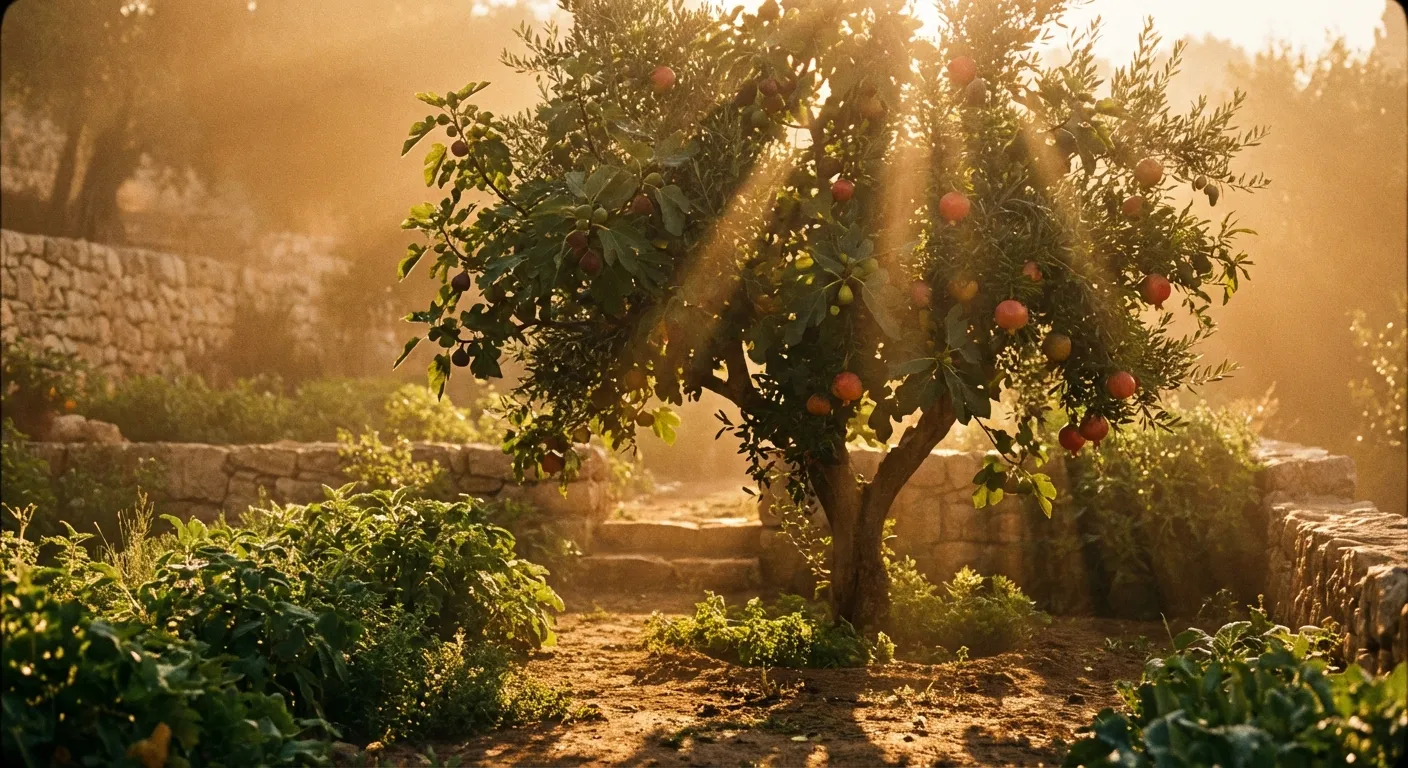
Part 3: The Fruit of the Spirit
Take a deep breath. You’ve earned it.
After the unflinching mirror of Part 2 — fifteen works of the flesh, each one hitting closer to home than we’d like — Paul pivots. He turns from what’s growing in the dark to what’s growing in the light. And the contrast is so stark, so beautiful, so alive that you can almost feel the temperature of the letter change.
But the fruit of the Spirit is love, joy, peace, patience, kindness, goodness, faith,
gentleness, and self-control. Against such things there is no law.
Nine words. Nine characteristics. One of the most famous passages in the New Testament, printed on bookmarks and coffee mugs and cross-stitched pillows in church nurseries everywhere.
And almost everyone reads it wrong.
The Singular That Rewrites the Whole List
Here’s the thing you need to see before we go any further — the grammatical detail that demolishes most of what you’ve been taught about spiritual growth.
Paul says “the fruit of the Spirit.” Not “the fruits of the Spirit.” Fruit. Singular. One fruit, expressed nine ways.
In Greek it’s karpos — singular. He doesn’t switch to a plural form. He doesn’t say “the fruits are love, joy, peace…” He says “the fruit is.” One thing. One life. One organic, unified expression of the Spirit’s presence in a human life.
Why does this matter?
Because if these were nine separate fruits, you could specialize. You could be the “patience person” while someone else handles joy. You could major in kindness and minor in self-control. You could have three or four and figure the rest would come eventually.
But that’s not how Paul frames it. These nine characteristics aren’t separate products you assemble independently. They’re one life — the life of the Spirit — expressed through nine facets. Like a single beam of light passing through a prism and splitting into a spectrum of colors. The colors are distinct, but they come from the same source.
You don’t pick and choose fruit any more than a branch picks and chooses which nutrients to pull from the vine. The vine’s life flows in, and all of it comes. Love and patience. Joy and self-control. Peace and faithfulness. It’s a package deal. Because the source is singular, the fruit is singular.
And this means something profoundly liberating: you don’t have to manufacture nine separate virtues. You have to stay connected to one vine.
Love: The Root of Everything
He who doesn’t love doesn’t know God, for God is love.
Paul starts with love, and that’s not alphabetical. It’s architectural. Love is the foundation. Every other characteristic on this list is love expressed in a different context.
What is patience? Love under pressure. What is kindness? Love in action. What is gentleness? Love in power. What is self-control? Love with boundaries.
They’re all love. Just love wearing different clothes depending on the situation.
Love is patient and is kind. Love doesn’t envy. Love doesn’t brag, is not proud,
doesn’t behave itself inappropriately, doesn’t seek its own way, is not provoked, takes no account of evil;
doesn’t rejoice in unrighteousness, but rejoices with the truth;
bears all things, believes all things, hopes all things, and endures all things.
Love never fails. But where there are prophecies, they will be done away with. Where there are various languages, they will cease. Where there is knowledge, it will be done away with.
Paul’s famous “love chapter” isn’t a separate topic from the fruit of the Spirit. It’s a detailed expansion of the first item on the list. Love is patient — there’s patience. Love is kind — there’s kindness. Love isn’t self-seeking — there’s self-control. Love bears all things, believes all things — there’s faithfulness.
It’s all one thing. One life. One vine.
And here’s what makes this different from every self-help list of virtues: the source isn’t you.
You cannot manufacture genuine, 1 Corinthians 13 love. I don’t care how hard you try. I’ve tried. You can grit your teeth and be nice to someone who irritates you for about seventy-two hours, and then the flesh takes over and you’re back to silent resentment or passive-aggressive comments.
But the fruit of the Spirit — the love that is patient and kind and doesn’t keep a record of wrongs — that comes from the vine. It flows through the branch. It grows not because the branch decided to be loving, but because the branch is connected to a source of love that is infinite, unconditional, and unfailing.
“…By this everyone will know that you are my disciples, if you have love for one another.”
This is how the world knows. Not by our doctrine. Not by our buildings. Not by our conferences or podcasts or Instagram accounts. By our love. And that love is the fruit of remaining.
Joy: The Signature of Connection
Joy is second on the list, and I think that’s intentional. Because if love is the root, joy is the first thing that blooms.
Rejoice in the Lord always! Again I will say, “Rejoice!”
“Rejoice in the Lord always.” Paul wrote this from prison. I keep coming back to that because it’s absurd. A man in chains telling free people to rejoice. A man who’s lost everything telling comfortable people that joy is the norm.
Unless joy isn’t about circumstances.
And that’s exactly the point. Joy — the Spirit’s kind — is not happiness. Happiness is a response to what’s happening. Joy is a response to who’s holding you. Happiness says “things are going well.” Joy says “God is still God” — and means it on the worst day of your life.
We talked about this in our “Remain in Me” series, and it’s the same truth from a different angle. In John 15:11, Jesus said He wanted His joy to be in the disciples and their joy to be complete. Now Paul reveals that this joy isn’t something Jesus gives to connected branches — it’s something that grows in connected branches. It’s fruit. Natural, organic, inevitable fruit of remaining in the vine.
If you want more joy, the answer isn’t to chase happier circumstances. It’s to stay closer to the vine. The joy will come. Because it always does when the source is flowing.
Peace: The Quiet That Doesn’t Make Sense
And the peace of God, which surpasses all understanding, will guard your hearts and your thoughts in Christ Jesus.
The peace of God surpasses all understanding. That’s not poetic exaggeration. That’s a literal description. Spirit-grown peace doesn’t make sense. It shows up in situations where every rational analysis says you should be falling apart.
The doctor says the word “malignant” and you feel… held. The bank account is empty and you feel… provided for. The relationship ended and you feel… not abandoned.
This peace is not denial. It’s not pretending everything is fine when it isn’t. It’s the deep, settled assurance that the vine is holding you — even when the storm is shaking every branch on the tree. It’s knowing, in a place deeper than your anxious thoughts can reach, that God is sovereign and good and present and enough.
Peace I leave with you. My peace I give to you; not as the world gives, I give to you. Don’t let your heart be troubled, neither let it be fearful.
Jesus distinguishes His peace from the world’s peace. The world’s peace requires everything to be okay. Jesus’ peace persists when nothing is okay. That’s because it comes from a different source — not from circumstances lining up, but from the vine’s life flowing steadily through the branch, regardless of the weather.
You can’t think your way into this peace. You can’t meditate your way there (though meditation helps). You can’t self-talk your way into it with positive affirmations. This peace is fruit. It grows. In connected branches. Over time. Not overnight — but inevitably.
Patience: Love That Doesn’t Give Up
Be patient therefore, brothers, until the coming of the Lord. Behold, the farmer waits for the precious fruit of the earth, being patient over it, until it receives the early and late rain.
The farmer waits for the precious fruit. Patiently. Not passive-aggressively. Not with a countdown clock and a list of complaints. Patiently.
Patience — makrothumia in Greek, literally “long-suffering” — is the ability to endure delay, hardship, or provocation without retaliating. It’s love’s response to the person who tests you. The coworker who takes credit for your work. The friend who always cancels. The family member who says the same hurtful thing at every holiday dinner.
The flesh says: I’ve had enough. I’m done. You had your chance.
Patience says: I’m still here. I haven’t given up on you.
And here’s the beautiful irony: patience with others is only possible when you’ve experienced God’s patience with you. When you realize how long God waited for you — how many times you wandered, ignored, drifted, and He didn’t give up — suddenly extending that same patience to the annoying person in your life doesn’t seem so impossible.
Or do you despise the riches of his goodness, forbearance, and patience, not knowing that the goodness of God leads you to repentance?
God’s kindness leads to repentance. Not His impatience. Not His ultimatums. His kindness. His patience. He modeled it first — toward you. Now the vine pushes that same long-suffering through the branch and into your relationships.
Kindness and Goodness: Love in Work Clothes
I’m grouping these together because they’re siblings.
Kindness (chrēstotēs) is the disposition — the warmth, the approachability, the genuine caring about another person’s wellbeing. It’s the way you make someone feel when they’re around you. Not impressed. Not intimidated. Not judged. Welcome.
Goodness (agathōsunē) is kindness with hands and feet. It’s the action that follows the disposition. If kindness is the impulse, goodness is the follow-through. It’s the meal that shows up at the door. The text that says “I’m thinking about you.” The hand that reaches into the pocket for someone else’s need.
Together, they’re love wearing work clothes. Love that doesn’t just feel things but does things. Love that isn’t content to sympathize from a distance but gets involved, gets inconvenienced, gets dirty.
And they’re fruit. Not resolutions. Not New Year’s commitments to “be a better person.” They’re the natural overflow of a life connected to a source of inexhaustible kindness and goodness. The vine is kind. The vine is good. And when the vine’s life flows through the branch, kindness and goodness are what come out.
Faithfulness: Love That Shows Up
Now faith is assurance of things hoped for, proof of things not seen.
Faithfulness — pistis — shows up in most translations as “faith” in Hebrews 11 and “faithfulness” in Galatians 5. And both meanings matter.
As a fruit of the Spirit, faithfulness is reliability. It’s the person who says they’ll be there and then is there. Not just when it’s convenient. Not just when the relationship is fun. Always. Through the boring parts. Through the hard parts. Through the part where everyone else has left and you’re still standing.
Faithfulness isn’t dramatic. It’s not the heroic rescue. It’s the daily showing up. The tenth year of a marriage. The thousandth prayer for the same person. The unglamorous, unphotographable persistence of someone who made a commitment and intends to keep it.
The flesh is fickle. It chases novelty. It gets bored. It starts things it doesn’t finish and makes promises it doesn’t keep. Faithfulness is the antidote — and it’s fruit, not willpower. It grows in branches that are connected to the most faithful being in existence.
God has never broken a promise. Not one. In thousands of years of human history, through every conceivable failure on our part, He has remained faithful. And when that faithfulness flows through the vine into the branch, what comes out is a person who can be counted on.
Gentleness: Love in Power
doing nothing through rivalry or through conceit, but in humility, each counting others better than himself;
each of you not just looking to his own things, but each of you also to the things of others.
Gentleness (prautēs) is not weakness. This is crucial. The Greek word was used for a war horse that had been trained — a powerful animal under complete control. Not lacking strength. Channeling strength.
Gentleness is what love looks like when you have the power to crush someone and you choose not to. It’s the parent who could scream but speaks calmly. The boss who could humiliate but corrects privately. The friend who could say “I told you so” but says “I’m sorry that happened.”
The flesh equates power with dominance. Gentleness equates power with restraint. And the difference between those two equations produces two entirely different kinds of human beings.
In a culture that celebrates the takedown, the clapback, the mic-drop moment — gentleness looks like failure. It looks like you’re letting people walk all over you. But it’s actually the highest expression of strength, because it requires more power to restrain yourself than to let loose. Any fool can explode. It takes the Spirit to be gentle.
Self-Control: Love That Says “Not Now”
Paul ends the list with enkrateia — self-control — and I think the placement is deliberate.
Self-control is last not because it’s least important, but because it’s the visible container for everything else. Love without self-control is sentimentality. Joy without self-control is mania. Peace without self-control is apathy. Every other fruit needs this one to be expressed rightly.
For God didn’t give us a spirit of fear, but of power, love, and self-control.
God gave us a spirit of power, love, and self-discipline. Not fear. Not chaos. Not the helpless feeling of being dragged around by your appetites. Discipline. Control. The ability to say “yes” to the right things and “no” to the wrong things — not from gritted teeth, but from the Spirit’s quiet strength.
Self-control is the fruit that looks the most like effort. That’s why people confuse it with willpower. But there’s a critical difference: willpower is you restraining yourself. Self-control as fruit of the Spirit is the vine’s life restraining the flesh’s impulses through you. One is exhausting. The other is sustainable. One burns out by Thursday. The other lasts a lifetime.
The distinction matters practically. If your self-control is running on willpower, you’ll white-knuckle your way through a few weeks and then crash. If your self-control is fruit — growing from a connection to the vine — it’s renewable. It replenishes. Because the source never runs dry.
What the Fruit Is Not
Let me be clear about a few things this passage is not saying:
The fruit is not your personality. Some people are naturally easygoing, and they think that’s patience. Some people are naturally warm, and they think that’s love. But natural temperament is not spiritual fruit. The fruit of the Spirit grows in every personality type — including the naturally intense, the naturally anxious, the naturally sharp-edged. You don’t have to become a different personality. The vine produces its fruit through your personality, not instead of it.
The fruit is not your achievement. You can’t hustle your way into producing it. You can’t discipline yourself into lovejoyepeacepatiencekindnessgoodnessfaithfulnessgentlenessself-control through sheer effort. That’s not how fruit works. Fruit is grown, not built. Produced, not manufactured. It’s the result of connection, not ambition.
The fruit is not instant. Fruit takes time. Seasons. Years. If you connected to the vine last Tuesday and you’re wondering why you still lost your temper on Wednesday, that’s normal. Growth is slow. Maturation is gradual. The farmer doesn’t plant seeds and then yell at the dirt the next morning for not producing a harvest.
The fruit is not uniform. Different branches, different growth rates. Different seasons, different emphases. You might be in a season where patience is growing rapidly while self-control is still emerging. That’s fine. The vine knows what it’s doing. Trust the gardener.
Against Such Things There Is No Law
Paul ends the fruit list with a line so understated it’s easy to miss:
gentleness, and self-control. Against such things there is no law.
“Against such things there is no law.”
This is Paul’s quiet mic drop. He’s spent the whole letter arguing that the law can’t produce righteousness — that rule-following doesn’t create the life God wants. And now he says: look at what the Spirit produces. Love, joy, peace, patience, kindness, goodness, faithfulness, gentleness, self-control. What law could improve on this? What rule could add to it? What regulation could make it better?
The Spirit produces everything the law was aiming at — and more. Not through external compulsion, but through internal transformation. Not by demanding compliance, but by changing the source.
A branch connected to the vine doesn’t need a law that says “produce grapes.” It produces grapes because that’s what vine-connected branches do. The fruit is the proof that the law was never the point. The vine was the point. And the vine does what the law never could.
I am the vine. You are the branches. He who remains in me and I in him bears much fruit, for apart from me you can do nothing.
Apart from the vine, nothing. Connected to the vine, much fruit. That’s it. That’s the whole system. And the fruit that proves the connection — the love, the joy, the peace, all nine flavors of a single life — is the evidence that you’re not running on your own power anymore.
“In this my Father is glorified, that you bear much fruit; and so you will be my disciples.…”
The Father is glorified by your fruit. Not by your effort. Not by your impressive moral performance. By the fruit that grows naturally in a branch that stays connected to the vine.
Reflect
-
Which of the nine characteristics feels most present in your life right now? Which feels most absent? Instead of beating yourself up about what’s missing, ask: what does the absence tell you about your connection to the vine?
-
“The fruit of the Spirit is…” — singular. How does this change the way you approach spiritual growth? If it’s one fruit, not nine separate goals, what does that simplify for you?
-
Think about the difference between “manufactured” and “grown.” Where in your life have you been trying to produce spiritual fruit through willpower? What would it look like to stop manufacturing and start remaining?
-
Read 1 Corinthians 13:4-8 alongside the fruit list. How are they saying the same thing? If love is the root, how does that change the way you pursue the other eight characteristics?
-
“Against such things there is no law.” Paul says the Spirit produces what the law never could. Is there an area of your life where you’ve been trying to obey your way into transformation instead of remaining your way into it? What’s the difference — and what would it look like to shift?
Coming Up Next
Paul has shown us the fruit. Beautiful, organic, vine-grown fruit that can’t be manufactured by human effort.
But here’s the question that should be nagging you: How? How do I actually live this? If it’s not effort and it’s not trying harder and it’s not white-knuckling my way through nine virtues — then what is it?
Paul’s answer is in Galatians 5:16-18 and 25-26, and it’s both the simplest and most radical thing he says in the whole chapter: Walk by the Spirit. Not try. Walk. Not perform. Be.
The difference between those two things might be the most important distinction in the Christian life.
Next: “Being vs. Trying — Why Walking by the Spirit Isn’t What You Think”