

God Isn't a Landlord — He's a Gardener on His Knees in the Dirt
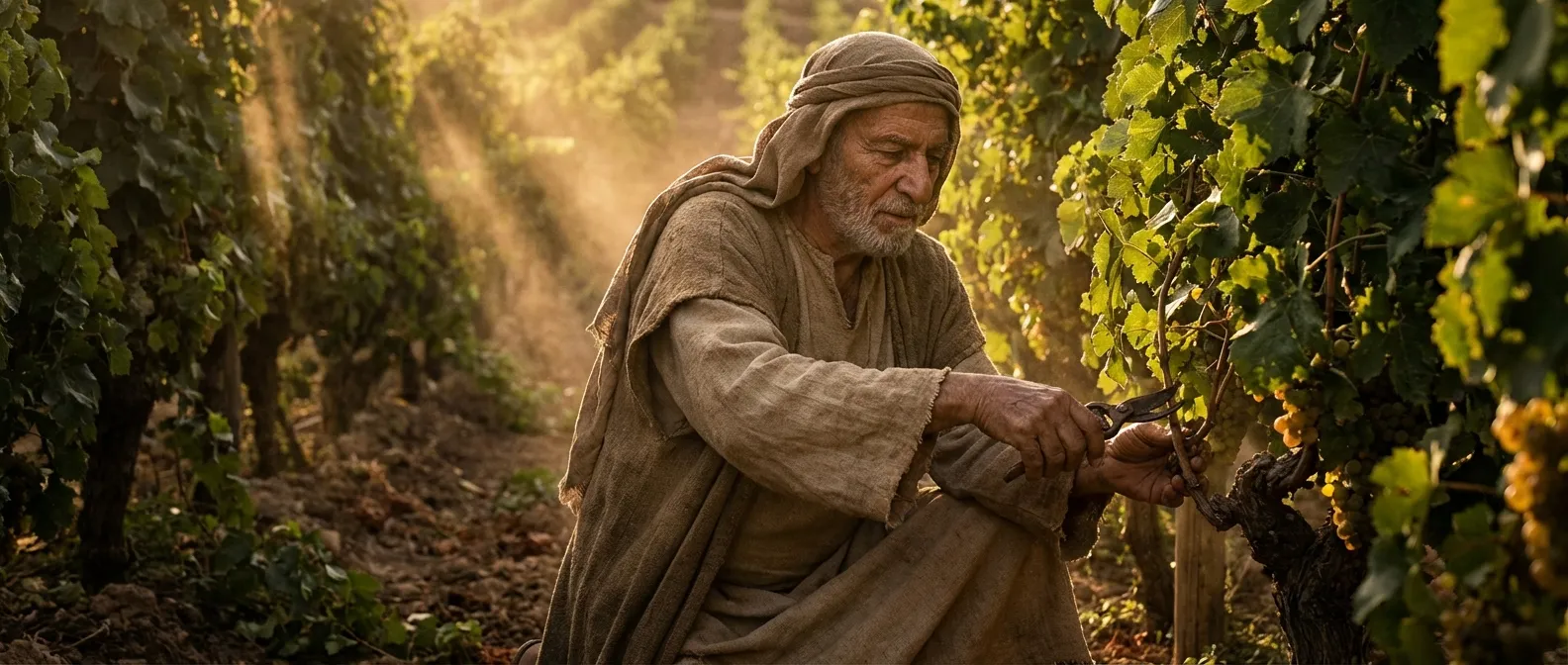
Jesus opens John 15 with a metaphor drawn straight out of Israel's long history with God — but with one word that reframes the whole thing. God isn't managing a vineyard from a distance. He's crouched in the soil, pruning what He loves. What the first three verses of the vine passage reveal about how God actually tends you.
Part 1: The Gardener and the Vine
Picture the scene.
It’s Thursday night. The last supper is over. The bread has been broken, the wine poured, the feet washed. Judas has slipped out into the dark. In a few hours, soldiers will come with torches and swords. By Friday afternoon, the man sitting at the center of this table will be dead.
And in the middle of all that — in the compressed, electric space between a final meal and an arrest — Jesus starts talking about gardening.
Not warfare. Not escape plans. Not the theological framework for the atonement He’s about to accomplish. He talks about vines and branches and a farmer who prunes things.
Why?
Because what He’s about to say in John 15 isn’t a theological sidebar. It’s the operating manual for every relationship with God that would follow His death and resurrection. It’s how the whole thing works.
And it starts with a detail most people read right past.
The Farmer in the Dirt
“I am the true vine, and my Father is the farmer.…”
Two identities. Jesus is the vine. The Father is the farmer.
Not the owner. Not the CEO. Not the landlord who collects rent and sends an eviction notice when you miss a payment. The farmer. The Greek word is georgos — literally, “one who works the earth.” It’s a hands-in-the-soil word. A calloused-knees word.
This matters more than you think.
Most of us carry an image of God that looks something like a manager. He sets the rules, monitors compliance, and intervenes when things go sideways. He’s up there; we’re down here. He’s watching; we’re performing.
But Jesus doesn’t introduce His Father as a supervisor. He introduces Him as a gardener. Someone who gets up before dawn and walks the rows. Someone who knows each plant by sight. Someone whose hands smell like earth because that’s where He spends His time.
The first thing Jesus wants you to know about John 15 is this: God is not distant from your growth. He’s intimate with it.
He’s not checking on you from the porch. He’s crouching next to you in the dirt, examining every branch, every bud, every place where fruit might form. And He’s doing it not because He’s inspecting you for defects — but because He’s invested in what you become.
A Vine with History
Jesus didn’t pull this metaphor out of nowhere. His listeners would have recognized it instantly — because Israel had been called God’s vine for centuries.
You brought a vine out of Egypt. You drove out the nations, and planted it.
What could have been done more to my vineyard, that I have not done in it? Why, when I looked for it to yield grapes, did it yield wild grapes?
Yet I had planted you a noble vine, a pure and faithful seed. How then have you turned into the degenerate branches of a foreign vine to me?
Israel is a luxuriant vine that produces his fruit. According to the abundance of his fruit he has multiplied his altars. As their land has prospered, they have adorned their sacred stones.
The vine was the metaphor for God’s people. He planted them, watered them, built a wall around them, and expected fruit. And the consistent heartbreak of the Old Testament is that the vine kept going wild. God invested everything, and the fruit never came — or came rotten.
So when Jesus says “I am the true vine” — emphasis on true — He’s making a staggering claim. He’s not just offering a nice illustration. He’s saying: I am what Israel was always supposed to be. The faithful vine. The one that actually produces what the Father intended.
And then He says something that reframes every believer’s relationship to God: You’re the branches. Connected to Me. And my Father — the same gardener who planted, watered, and wept over Israel for millennia — He’s tending you now.
Same gardener. Same investment. Same intimate, hands-in-the-dirt attention. But this time, the vine holds.
The Verse We’d Rather Skip
Every branch in me that doesn’t bear fruit, he takes away. Every branch that bears fruit, he prunes, that it may bear more fruit.
Let’s not skip past this.
Two categories of branches. Both are “in” the vine. Both are connected. But they get very different treatment.
The branch that doesn’t bear fruit: He takes away.
The branch that does bear fruit: He prunes.
Neither one sounds fun.
If you’re not bearing fruit, you get removed. If you are bearing fruit, you get cut. The branch that’s doing everything right gets the knife too — just for a different reason.
This is where a lot of people hit a wall with John 15. It doesn’t sound like the gentle, encouraging Jesus they’ve constructed in their minds. It sounds like a God who’s impossible to please.
But here’s what pruning actually is — and I think understanding this changes everything.
What Pruning Looks Like (And What It Doesn’t)
If you’ve never tended a grapevine, here’s what you need to know: pruning is not punishment. It’s investment.
A grapevine’s natural tendency is to grow in every direction. It sends out shoots and suckers and runners, chasing sunlight, spreading wide, looking impressively leafy — and producing almost no grapes. The energy goes into growth instead of fruit.
A good farmer walks the rows and cuts back the excess. Not the dead wood — the living wood. The green, healthy shoots that are growing vigorously but pulling resources away from the clusters that could actually ripen.
From the branch’s perspective (if branches had perspectives), this looks like destruction. I was growing! I was thriving! Why are you cutting me?
From the farmer’s perspective, it’s the most loving thing he can do. He’s not trying to reduce the vine. He’s trying to focus it. Every cut says: I believe you can produce something extraordinary, and I’m removing everything that would prevent it.
God doesn’t prune you because you’re failing. He prunes you because you have potential He refuses to waste.
Pruning in Real Life
So what does divine pruning actually look like?
It looks like the job you lost that forced you to depend on God in ways your salary never required.
It looks like the relationship that ended — the one that was comfortable and consuming and slowly pulling you away from the vine without you noticing.
It looks like the ministry opportunity that fell through, the plan that collapsed, the dream that died. Not because God is cruel. But because something was growing in you that looked healthy but was stealing energy from the fruit He was trying to produce.
Paul understood this:
Not only this, but we also rejoice in our sufferings, knowing that suffering produces perseverance; and perseverance, proven character; and proven character, hope;
Suffering → perseverance → proven character → hope. That’s the pruning cycle. It’s not random pain. It’s directed removal — a gardener’s intentional cut that produces something the untouched branch never could.
The author of Hebrews says it even more directly:
All chastening seems for the present to be not joyous but grievous; yet afterward it yields the peaceful fruit of righteousness to those who have been trained by it.
“No discipline seems pleasant at the time.” That’s the understatement of the Bible. Pruning is painful. It’s confusing. It feels like loss — because it is loss. You’re losing something real. Something alive.
But the farmer isn’t watching you suffer from a distance. He’s the one holding the shears, and every cut is calculated by someone who knows exactly what you’re capable of producing.
Already Clean
After the stark reality of verse 2, Jesus says something unexpectedly tender:
You are already pruned clean because of the word which I have spoken to you.
Already pruned clean. Already. Not “once you get your act together.” Not “after you pass the next test.” Already. Because of His word.
This is Jesus looking at eleven confused, frightened men on the worst night of their lives and saying: You’re not starting from zero. My words have already been working in you. The pruning has already begun.
There’s a progression here that’s easy to miss:
Verse 1: God is the gardener — He’s involved, He’s invested, He’s close. Verse 2: He prunes — growth requires cutting, and cutting requires trust. Verse 3: You’re already in process — the word of Christ has been shaping you whether you recognized it or not.
Before Jesus tells them to remain (that’s coming in verse 4), He reminds them of where they already are. Connected. Being tended. In the hands of a gardener who hasn’t walked away.
This is the foundation for everything that follows. You can’t “remain” somewhere you’ve never been. And Jesus is saying: You’re already here. You’re already connected. Now — stay.
A Gardener, Not a Landlord
Here’s the thing about gardeners that landlords don’t understand: a gardener’s success is measured by what grows, not by what gets evicted.
A landlord wants compliant tenants. A gardener wants flourishing plants. The whole orientation is different. The landlord asks: Are you following the rules? The gardener asks: Are you bearing fruit?
And when the answer is “not yet” or “not enough,” the gardener doesn’t reach for an eviction notice. He reaches for the pruning shears. He adjusts the soil. He redirects the water. He moves the vine into better light. He does whatever it takes to get the life that’s already inside to push through and produce.
That’s your God. That’s the Father Jesus is introducing in John 15:1.
Not a distant manager. Not an impatient boss. A farmer who chose to plant you, who monitors you daily, who prunes you because He sees what you could become — and who has already been working on you through His word, whether you noticed or not.
The question isn’t whether God is involved in your life. He’s been involved since before you were born. The question John 15 is about to ask is much simpler, much harder, and much more personal:
Will you stay connected?
Reflect
-
How do you picture God? Be honest. Is He a landlord checking compliance, or a gardener invested in your growth? Where did that picture come from?
-
Can you identify a season of pruning in your life? A loss, a closed door, a painful removal that — looking back — made space for something better? What was cut? What grew in its place?
-
Is there something in your life right now that feels like pruning? Something being taken or reduced that you thought was healthy? What if God isn’t punishing you — what if He’s focusing you?
-
Read John 15:3 again. Jesus says you are “already pruned clean” because of His word. What does it mean that the process has already started? How does that change the way you approach growth — as something you initiate or something you cooperate with?
-
What’s the difference between God pruning you and God punishing you? How can you tell which one you’re experiencing?
Coming Up Next
Jesus has introduced the gardener. He’s explained the pruning. And He’s told His disciples they’re already in the vine.
But in verses 4-5, He’s about to say a word that will appear eleven times in this passage. A word that turns the entire Christian life into a single, daily, relentless choice.
The word is remain.
And what it actually means — not as theology, but as Tuesday-morning practice — might surprise you.
Next: “What ‘Remain’ Actually Means — And Why It’s Harder (and Simpler) Than You Think”