

The Prayer That Called Down Fire — When Elijah Dared God to Show Up
He was outnumbered 850 to 1. The king wanted him dead. An entire nation had abandoned God for a statue. And instead of running, Elijah poured water on his own altar and told God to light it up. His prayer was two verses long. What happened next split history in half.
📖 Passage: 1 Kings 18
Before You Begin
Read 1 Kings 18 — the whole chapter. Read it like a screenplay, because that’s what it is: the most dramatic showdown in the Old Testament. One prophet against 850. One God against a nation’s worth of idols. A drought-scorched mountain, a crowd holding its breath, and a man crazy enough to pour water on his own sacrifice before asking God to burn it.
Then read Elijah’s actual prayer in verses 36–37. It’s shockingly short — sixty-three words in English. After all that buildup, all that drama, all that mockery and showmanship, Elijah’s prayer barely fills two verses.
As you read, ask yourself: What kind of person talks to God like that — not begging, not bargaining, but calmly stating what needs to happen and trusting that it will?
The World Before the Fire
To understand what Elijah did on Mount Carmel, you have to understand what Israel had become.
It was approximately 870 BC. The northern kingdom of Israel had cycled through bad kings for decades, but Ahab was the worst of all of them — and it wasn’t close:
Ahab the son of Omri did that which was evil in Yahweh’s sight above all that were before him.
Then he married Jezebel, a Phoenician princess who worshipped Baal — the Canaanite storm god, the fertility deity whose priests promised rain and harvest in exchange for worship that included cult prostitution and, at its worst, child sacrifice.
Jezebel didn’t just bring her religion with her. She imposed it. She funded 450 prophets of Baal and 400 prophets of Asherah from the royal treasury (1 Kings 18:19). She systematically hunted down and killed the prophets of the LORD:
for when Jezebel cut off Yahweh’s prophets, Obadiah took one hundred prophets, and hid them fifty to a cave, and fed them with bread and water.)
Let that sink in. The prophets of the living God were hiding in caves while the prophets of a carved statue ate at the queen’s table. The official religion of Israel — the nation God had rescued from Egypt, led through the wilderness, and planted in a land flowing with milk and honey — was Baal worship.
And the people? They went along with it. Not all of them, but enough. They hedged their bets. They worshipped at Baal’s altars in the morning and whispered prayers to Yahweh at night. They didn’t reject God outright — they just added options. A spiritual buffet. A little Baal for the crops, a little Yahweh for tradition.
Elijah came near to all the people, and said, “How long will you waver between the two sides? If Yahweh is God, follow him; but if Baal, then follow him.” The people didn’t say a word.
That question hadn’t been asked yet. But it was coming.
Reflection Questions
- Israel didn’t abandon God in one dramatic moment — they drifted. Where have you seen that slow drift in your own life or in the culture around you?
- Jezebel funded 850 false prophets while God’s prophets hid in caves. How does that feel? Does God always give His people the visible upper hand?
Three and a Half Years of Silence
Before Mount Carmel, there was the drought.
Elijah’s introduction in Scripture is one of the most abrupt entrances in the entire Bible:
Elijah the Tishbite, who was one of the settlers of Gilead, said to Ahab, “As Yahweh, the God of Israel, lives, before whom I stand, there shall not be dew nor rain these years, but according to my word.”
No backstory. No genealogy. No call narrative. One verse, and Elijah steps onto the stage of biblical history with a declaration that would reshape the nation.
Think about what he said — and to whom he said it. He walked into the palace of the most powerful man in Israel and told him: the sky is shutting. No rain. No dew. Not until I say so.
And here’s the thing that makes this more than prophetic bravado: Baal was supposed to be the storm god. Baal’s entire value proposition was rain, fertility, and harvest. The priests of Baal told the people: worship him, and the rains come. Reject him, and your fields die.
So when Elijah declared a drought in God’s name, he wasn’t just announcing a weather event. He was issuing a direct challenge to Baal’s core competency. He was saying: Your storm god can’t make it rain. Mine can make it stop.
For three and a half years, not a drop fell (Luke 4:25, James 5:17). Springs dried up. Crops failed. Animals died. The famine was so severe that Ahab personally went searching for grass to keep his horses alive (1 Kings 18:5).
And the whole time, every cloudless morning was a silent sermon: Baal is not providing. Your god is failing. The God you abandoned is the one holding the faucet.
God sustained Elijah through the drought — first by ravens at the Brook Cherith (1 Kings 17:4-6), then through a destitute widow in Zarephath whose flour jar never ran empty (1 Kings 17:14-16). God always takes care of His people, but He rarely does it the way we’d expect.
After three and a half years of divine silence and national suffering, God spoke to Elijah:
After many days, Yahweh’s word came to Elijah, in the third year, saying, “Go, show yourself to Ahab; and I will send rain on the earth.”
The drought was about to break. But not with a weather forecast. With a showdown.
Reflection Questions
- God used the drought to expose Baal’s impotence. Have you ever experienced a season of “drought” that ultimately revealed what was false in your life?
- Elijah was sustained by ravens and a widow — not by spectacular provision, but by strange, humble, unexpected means. How has God provided for you in ways that didn’t look like provision at first?
The Question Israel Had Been Dodging
Elijah sent word to Ahab: meet me on Mount Carmel. Bring your prophets. Bring the people. Everybody shows up.
Mount Carmel rises about 1,700 feet above the Mediterranean coast in northern Israel. It’s visible for miles. Elijah chose the stage intentionally — this wasn’t happening in a back room or a quiet temple. This was public. National. Unavoidable.
When the crowd assembled — hundreds of false prophets, the king himself, and the people of Israel watching from the hillside — Elijah said nine words that cut through three and a half years of evasion:
Elijah came near to all the people, and said, “How long will you waver between the two sides? If Yahweh is God, follow him; but if Baal, then follow him.” The people didn’t say a word.
The Hebrew word for “waver” is pasach — it means to limp, to hobble, to stagger back and forth like a person with an injured leg. Elijah is saying: You look ridiculous. You’re limping between two altars, hedging every bet, committing to nothing.
Choose.
And the people’s response?
Elijah came near to all the people, and said, “How long will you waver between the two sides? If Yahweh is God, follow him; but if Baal, then follow him.” The people didn’t say a word.
Silence. They couldn’t bring themselves to choose Baal publicly — some part of them still remembered the God of their fathers. But they also couldn’t bring themselves to choose Yahweh — that would mean giving up the comfortable syncretism they’d been living in.
So they stood there. Silent. Frozen between what they knew was true and what they’d grown comfortable with.
That silence is one of the most haunting sounds in Scripture. It’s the sound of a culture that knows the truth but won’t say it. It’s the sound of people who’ve been on the fence so long they’ve forgotten there are two sides.
And it’s a silence a lot of us know. The silence of knowing what’s right but not committing. Of believing in God on Sunday and living as if He’s optional on Monday. Of hedging. Of keeping our options open. Of wavering.
Elijah didn’t argue. He didn’t beg. He proposed a test.
Then Elijah said to the people, “I, even I only, am left as a prophet of Yahweh; but Baal’s prophets are four hundred fifty men. Let them therefore give us two bulls; and let them choose one bull for themselves, and cut it in pieces, and lay it on the wood, and put no fire under; and I will dress the other bull, and lay it on the wood, and put no fire under it. You call on the name of your god, and I will call on Yahweh’s name. The God who answers by fire, let him be God.” All the people answered, “What you say is good.”
Simple. Elegant. Undeniable.
No tricks. No loopholes. Two altars, two sacrifices, two prayers. The god who sends fire wins. The one who doesn’t isn’t real.
The people finally spoke:
“…You call on the name of your god, and I will call on Yahweh’s name. The God who answers by fire, let him be God.” All the people answered, “What you say is good.”
They were ready to watch. They just weren’t ready to choose — yet.
Reflection Questions
- “How long will you waver between two opinions?” If Elijah asked you that today, what two things would he be pointing at?
- The people said nothing. What truths in your life have you been silent about — not denying, but not committing to either?
- Why is “hedging” so comfortable? What would it cost you to choose fully?
Six Hours of Shouting at a Statue
Elijah let them go first. Advantage: home team. Let the 450 prophets of Baal — with their rituals, their experience, their confident theology — take the first shot.
They took the bull which was given them, and they dressed it, and called on the name of Baal from morning even until noon, saying, “Baal, hear us!” But there was no voice, and nobody answered. They leaped about the altar which was made.
Morning till noon. Six hours of shouting. Six hours of ritual dancing. Six hours of increasingly frantic appeals to a god who was funded by the queen, sanctioned by the king, and endorsed by the cultural establishment.
Nothing.
And then Elijah did something extraordinary. Something that must have enraged the prophets and confused the crowd. He started trash-talking:
At noon, Elijah mocked them, and said, “Cry aloud, for he is a god. Either he is deep in thought, or he has gone somewhere, or he is on a journey, or perhaps he sleeps and must be awakened.”
The Hebrew here is even more biting than most English translations suggest. “Busy” is sometimes translated as “relieving himself” — Elijah may have been suggesting that Baal was in the bathroom. This isn’t polite theological debate. This is a prophet standing in front of nearly a thousand hostile men and mocking their god to their faces.
Why?
Because Elijah wasn’t just being sarcastic. He was making a point the people needed to see. A real god doesn’t need to be woken up. A real god doesn’t get distracted. A real god doesn’t miss your call because he’s traveling. The very idea that a deity could be unavailable is absurd — and Elijah wanted every person on that mountain to feel the absurdity in their gut.
Compare this with the God Elijah served:
Behold, he who keeps Israel will neither slumber nor sleep.
It will happen that before they call, I will answer; and while they are yet speaking, I will hear.
The prophets of Baal responded to the mockery with desperation:
They cried aloud, and cut themselves in their way with knives and lances until the blood gushed out on them.
They bled for a god who couldn’t hear them. They mutilated their own bodies trying to get the attention of a statue. This is what false worship always costs — it takes more and more of you and gives nothing back.
When midday was past, they prophesied until the time of the evening offering; but there was no voice, no answer, and nobody paid attention.
Three devastating negatives stacked on each other: no response, no one answered, no one paid attention. The most comprehensive silence in Scripture. All day. Every technique. Every prayer. Every drop of blood.
Nothing.
Reflection Questions
- Elijah’s mockery seems harsh, but it served a purpose — exposing the absurdity of worshipping what cannot respond. What “gods” in our culture today demand everything and deliver nothing?
- The prophets of Baal “slashed themselves” — giving more and more of themselves to something that couldn’t give back. Where have you seen that pattern in your own life? Performance at work? Relationships? Social media approval?
- What’s the difference between persistence in prayer and frantic desperation? How can you tell which one you’re living in?
The Man Who Brought Water to a Fire Fight
Now it’s Elijah’s turn. And what he does next is one of the most audacious acts of faith in the Bible.
First, the setup:
Elijah said to all the people, “Come near to me!”; and all the people came near to him. He repaired Yahweh’s altar that had been thrown down.
There had been an altar of the LORD on Carmel. Israel had torn it down. Elijah rebuilt it — a physical parable of what God was about to do with the nation.
Elijah took twelve stones, according to the number of the tribes of the sons of Jacob, to whom Yahweh’s word came, saying, “Israel shall be your name.” With the stones he built an altar in Yahweh’s name. He made a trench around the altar large enough to contain two seahs of seed.
Twelve stones. Not ten — which was the number of tribes in the northern kingdom. Twelve. Elijah was making a statement: God hasn’t given up on any of you. This altar represents the whole nation, not just the political reality. God’s covenant isn’t broken just because you broke faith.
He dug a trench around the altar. He arranged the wood. He laid the bull on top. And then:
He put the wood in order, and cut the bull in pieces and laid it on the wood. He said, “Fill four jars with water, and pour it on the burnt offering and on the wood.” He said, “Do it a second time;” and they did it the second time. He said, “Do it a third time;” and they did it the third time. The water ran around the altar; and he also filled the trench with water.
Twelve jars of water. During a three-and-a-half-year drought. When water was more precious than gold, Elijah poured it on the sacrifice until the altar was soaked, the wood was soaked, the trench was overflowing.
Why?
Because Elijah wanted to eliminate every possible explanation except God.
This wasn’t a fair test anymore. It wasn’t even a hard test. It was an impossible test — by design. Elijah stacked the deck against himself because he knew who was dealing.
There’s a theology in those jars of water. Elijah was saying to the crowd, to Ahab, to the prophets of Baal, and to history itself: My God doesn’t need favorable conditions. My God doesn’t need dry kindling. My God doesn’t need you to make it easier for Him. My God works best when the situation is hopeless, the odds are absurd, and every rational explanation has been eliminated.
This is the same God who:
- Told Gideon to reduce his army from 32,000 to 300 before fighting the Midianites (Judges 7)
- Made the Israelites march around Jericho for seven days instead of just storming the walls (Joshua 6)
- Chose a shepherd boy with a sling to face the giant in full armor (1 Samuel 17)
God has a pattern: He removes every possible source of human credit before He acts. Not because He’s playing games, but because He wants the result to be unmistakable. When the fire falls, nobody gets to say, “Well, the wood was dry” or “The sun must have hit it right.”
but God chose the foolish things of the world that he might put to shame those who are wise. God chose the weak things of the world that he might put to shame the things that are strong.
Reflection Questions
- Elijah poured water on his own altar. Is there a situation in your life where God seems to be making things harder instead of easier — and could that be intentional?
- God consistently removes human advantages before acting. Why? What does that teach us about His priorities?
- What would it look like for you to stop trying to “help God out” and instead trust Him with the impossible version of your situation?
Sixty-Three Words, and Fire Fell
The altar is soaked. The trench is full. Every eye on the mountain is locked on Elijah. The prophets of Baal have gone hoarse. The crowd is holding its breath. The afternoon sun is hanging low.
And Elijah prayed.
At the time of the evening offering, Elijah the prophet came near and said, “Yahweh, the God of Abraham, of Isaac, and of Israel, let it be known today that you are God in Israel and that I am your servant, and that I have done all these things at your word. Hear me, Yahweh, hear me, that this people may know that you, Yahweh, are God, and that you have turned their heart back again.”
That’s it. That’s the whole prayer.
No shouting. No dancing. No blood rituals. No six-hour performance. No elaborate ceremony. Just a man standing before a wet altar, speaking to his God like someone who knows him.
Let’s unpack what’s inside those sixty-three words.
”LORD, the God of Abraham, Isaac and Israel”
Elijah starts with identity — not his own, but God’s. He invokes the covenant name. He connects this moment to the unbroken chain of promise that goes back two thousand years to Abraham’s tent, to Isaac on the altar, to Jacob wrestling at Peniel.
He’s reminding the crowd — and perhaps reminding himself — that this God isn’t new. He isn’t untested. He has a track record measured in millennia.
”Let it be known today that you are God in Israel”
This is the core petition: revelation. Elijah isn’t asking for fire because he needs a miracle. He’s asking for fire because the people need to see. The whole point of the showdown isn’t to prove something to Elijah — he already knows. It’s to prove something to a nation that’s forgotten.
”And that I am your servant and have done all these things at your command”
This is critical. Elijah doesn’t want credit. He wants the people to know he’s not a rogue operator. He’s not freelancing. Everything — the drought, the confrontation, the water on the altar — was God’s idea, executed through God’s servant.
Real authority doesn’t need to be asserted. It needs to be recognized. Elijah isn’t defending his reputation; he’s clarifying the chain of command.
”Answer me, LORD, answer me”
The repetition isn’t panic — it’s passion. The doubling intensifies the request. In Hebrew rhetoric, saying something twice gives it the force of absolute urgency: this matters. This is the moment. Now.
”So these people will know that you, LORD, are God, and that you are turning their hearts back again”
And here is the most beautiful phrase in the prayer. Not “so these people will be punished.” Not “so they’ll fear you.” Not “so they’ll know I was right.”
So they’ll know you are turning their hearts back.
Elijah didn’t pray for vindication. He prayed for restoration. He didn’t want the crowd humiliated — he wanted them home. The whole point of fire from heaven wasn’t judgment. It was an invitation. God was turning their hearts. God was reaching out. The fire was a love letter written in flame.
This reframes the entire showdown. It wasn’t God versus Baal. It was God pursuing His children. The fire wasn’t wrath — it was the lengths to which God would go to get their attention. Like a father standing in the middle of a highway, waving his arms, screaming at his wandering child: Come back! I’m right here! Come HOME!
Yahweh appeared of old to me, saying, “Yes, I have loved you with an everlasting love. Therefore I have drawn you with loving kindness.…”
Reflection Questions
- Elijah’s prayer was sixty-three words after Baal’s prophets prayed for hours. What does that tell you about the relationship between prayer length and prayer power?
- Elijah prayed for the people’s restoration, not their punishment. When you pray about people who’ve turned away from God, what are you asking for?
- “You are turning their hearts back again.” God was already at work before the fire fell. Where might God already be working in a situation you’re praying about?
Fire
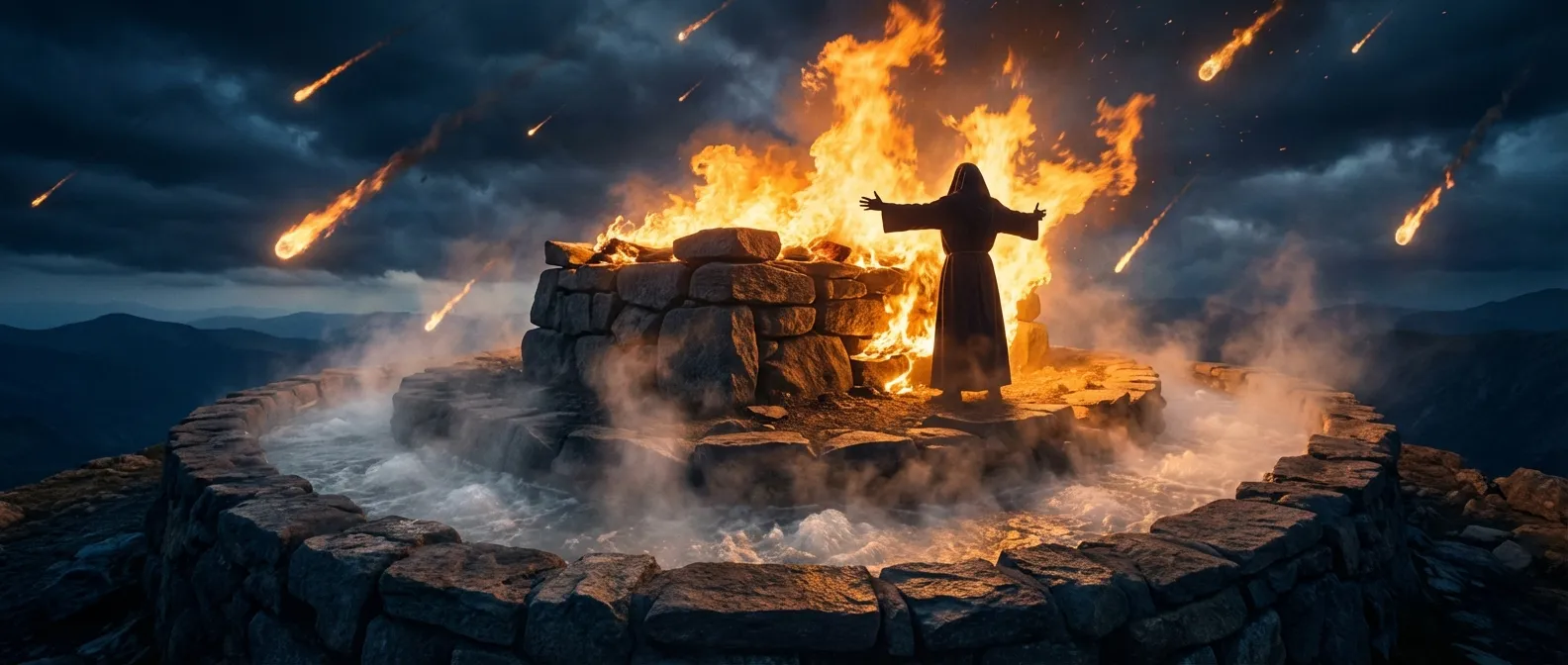
Then Yahweh’s fire fell and consumed the burnt offering, the wood, the stones, and the dust; and it licked up the water that was in the trench.
Read that verse again slowly.
The fire didn’t just light the sacrifice. It consumed the wood. It consumed the stones. It consumed the soil. It consumed the water in the trench. Everything — the offering, the structure, the earth itself — was eaten by fire from heaven.
This wasn’t a campfire. This wasn’t spontaneous combustion. This was a thermonuclear response to a two-verse prayer. God didn’t just answer — He answered so overwhelmingly that nothing was left. Not even the altar. Not even the dirt it stood on.
God doesn’t do “barely enough.” When He shows up, He shows up so completely that every alternative explanation is vaporized along with the stones.
The crowd’s response was immediate and unanimous:
When all the people saw it, they fell on their faces. They said, “Yahweh, he is God! Yahweh, he is God!”
Yahweh hu ha’Elohim. The LORD — He is God. They said it twice, echoing Elijah’s doubled “Answer me.” The nation that had been silent when Elijah asked them to choose finally found their voice.
They didn’t fall down because Elijah argued convincingly. They didn’t fall down because of a compelling presentation. They fell because they saw. The fire did what words couldn’t: it cut through years of apathy, compromise, and comfortable idolatry and replaced it with undeniable, face-in-the-dirt awe.
This is what happens when God shows up. You don’t need convincing. You don’t need an explanation. You just know. Every defense drops. Every excuse evaporates. Every fence you’ve been sitting on becomes suddenly, absurdly irrelevant.
“Be still, and know that I am God. I will be exalted among the nations. I will be exalted in the earth.”
And here’s the detail that brings it full circle: the word Carmel means “garden” or “vineyard of God.” The mountain where fire fell was God’s own garden — overgrown, neglected, given over to false worship. But God came back for it. He reclaimed it with fire. He burned away everything false until all that was left was the truth: The LORD — He is God.
Reflection Questions
- The fire consumed not just the sacrifice but the stones, the soil, and the water. What does it mean that God’s response went far beyond what was necessary?
- The people said “The LORD — He is God!” Have you had a moment in your life where God’s reality became undeniable — not an idea you believed, but a truth you knew?
- Carmel means “garden of God.” Has God ever reclaimed territory in your heart that you’d given over to something else?
After the Fire: The Sound of Rain
The fire was spectacular. But what happened next was quiet — and in some ways, more miraculous.
Elijah turned to Ahab and said:
Elijah said to Ahab, “Get up, eat and drink; for there is the sound of abundance of rain.”
There were no clouds. There was no rain. The sky was empty, the same scorched blue it had been for three and a half years. But Elijah heard rain.
He climbed to the top of Carmel, bent down to the ground with his face between his knees, and sent his servant to look toward the sea. The servant came back:
He said to his servant, “Go up now and look toward the sea.” He went up and looked, then said, “There is nothing.” He said, “Go again” seven times.
Elijah said, “Go back.”
Seven times. Seven times the servant climbed to the summit and scanned the horizon. Six times: nothing. Not a wisp. Not a suggestion of a cloud. Just burning sky over a dead landscape.
The seventh time:
On the seventh time, he said, “Behold, a small cloud, like a man’s hand, is rising out of the sea.” He said, “Go up, tell Ahab, ‘Get ready and go down, so that the rain doesn’t stop you.’”
That was enough.
On the seventh time, he said, “Behold, a small cloud, like a man’s hand, is rising out of the sea.” He said, “Go up, tell Ahab, ‘Get ready and go down, so that the rain doesn’t stop you.’” In a little while, the sky grew black with clouds and wind, and there was a great rain. Ahab rode, and went to Jezreel.
Three and a half years of drought. Broken by a prayer, preceded by a fire, announced by a cloud the size of a fist.
There’s something here about the rhythm of faith that’s easy to miss. The fire was instantaneous — one prayer, one response, no waiting. But the rain required patience. Seven trips to the summit. Six empty horizons. The same man who had just called fire from heaven had to wait, and look, and wait, and look, and trust that what God said was coming was actually coming.
Faith is not a single moment of spectacular belief. It’s spectacular belief followed by patient trust in the details. Elijah had the fire. He still had to wait for the rain. The breakthrough and the follow-through require different kinds of faith — and God asks for both.
Let’s not be weary in doing good, for we will reap in due season if we don’t give up.
Sometimes God answers with fire. And sometimes, after the fire, He asks you to climb the hill seven times and look for a cloud the size of a hand.
Reflection Questions
- Elijah heard rain before he saw it. What has God spoken over your life that you haven’t seen yet? Can you trust the “sound” before the evidence?
- Seven times the servant went to look. How do you maintain faith when God says “it’s coming” but the horizon is empty?
- What’s the difference between the faith that calls fire and the faith that waits for rain? Which one is harder for you?
What Elijah Teaches Us About Prayer
Let’s pull back and look at what Elijah’s prayer — this ridiculously short, world-splitting prayer — teaches us about how to talk to God.
1. It was grounded in God’s character, not Elijah’s
The prayer begins with who God is (“God of Abraham, Isaac and Israel”) not with who Elijah is. Elijah doesn’t mention his credentials, his faithfulness during the drought, or his bravery in confronting Ahab. He anchors everything in God’s covenant identity.
Effective prayer is God-centered, not self-centered. You don’t earn answers by being impressive. You receive them because God is faithful.
2. It was born from obedience, not impulse
“I have done all these things at your command.” Elijah didn’t invent this showdown. God told him to go. The prayer had power because it was rooted in obedience — Elijah was standing where God told him to stand, doing what God told him to do.
If you remain in me, and my words remain in you, you will ask whatever you desire, and it will be done for you.
Bold prayer follows close obedience. You can’t run from God all week and expect Mount Carmel on Sunday.
3. It was for God’s glory, not Elijah’s reputation
“Let it be known that you are God.” Not “let them know I was right.” Not “prove that I’m your prophet.” Elijah wanted God vindicated, not himself.
The most powerful prayers are the ones where you aren’t the point.
4. It was motivated by love, not vengeance
“You are turning their hearts back.” Elijah loved these people. He was angry — righteous anger at what Baal worship had done to his nation — but underneath the anger was a broken heart for people who’d wandered from the God who loved them.
Prayer motivated by “prove me right” hits the ceiling. Prayer motivated by “bring them home” touches the throne.
5. It was short, specific, and confident
Sixty-three words. No hedging. No “if it be thy will maybe perhaps.” Elijah knew what God wanted, and he asked for it directly. There’s a time for long, anguished prayers (David in Psalm 51). And there’s a time for short, bold declarations.
The key isn’t length. It’s alignment. When your request matches God’s will, you don’t need many words.
In praying, don’t use vain repetitions as the Gentiles do; for they think that they will be heard for their much speaking.
Reflection Questions
- Which of these five lessons do you most need right now? Why?
- Is your prayer life more like the prophets of Baal (long, frantic, performance-driven) or more like Elijah (rooted, specific, God-centered)?
- What would change in your prayer life if you prayed from obedience rather than from impulse?
This Week’s Practice
Elijah teaches us that audacity in prayer isn’t arrogance — it’s trust so deep that it looks crazy from the outside. This week:
-
Monday — Read 1 Kings 18 again. This time, notice what Elijah did before the prayer: he rebuilt the altar, he obeyed, he prepared. What needs rebuilding in your life before you ask God for fire?
-
Tuesday — Write down the “Baal altars” in your life — the things you’ve been hedging your bets with, the backup plans that keep you from fully committing to God. Be specific. Then, figuratively: pour water on them. Tell God you’re done hedging.
-
Wednesday — Pray Elijah’s prayer (1 Kings 18:36-37) out loud, but replace the specifics with your own. “LORD, let it be known today that You are God in [my family / my workplace / my situation], and that I am Your servant, and that You are turning hearts back to You.”
-
Thursday — Practice “seven times” faith. Pick something you’ve been praying for and look for it again — actively, expectantly. Scan the horizon. Look for the cloud the size of a fist. Don’t give up on trip six.
-
Friday — Fast a meal. Not as performance, but as a declaration: I need God more than food. Use the time you would have spent eating to pray — not with many words, but with Elijah’s confidence: You are God. Show up.
-
Weekend — Worship audaciously. In your car, in your living room, wherever. Turn it up. Sing it out. Dance if you need to. Not to earn anything — but because the God who answered by fire is your God, and that’s worth making noise about.
Coming Up Next: The Prayer in the Garden
We’ve heard a prayer of desperation (Hannah). A prayer of devastation (David). A prayer of audacious faith (Elijah). Each one revealed a different face of how humans talk to God when everything is on the line.
But there’s one prayer left. The most important one ever prayed. And it wasn’t prayed from a temple, a palace, or a mountaintop.
It was prayed in a garden, at night, alone, by a man sweating blood.
Jesus knew what was coming. The arrest. The trial. The nails. The full weight of every sin ever committed, crushing down on the only person who had never committed one. He could have stopped it. He had the power to walk away, call ten thousand angels, and let humanity face the consequences of its own rebellion.
Instead, He knelt in the dirt and prayed the three hardest words in human history: “Not my will.”
Some prayers call fire from heaven. This one absorbed it.
Next: “The Prayer That Saved the World — When Jesus Chose the Cross”