

The Prayer That Saved the World — When Jesus Chose the Cross
He could have walked away. He had the power to stop it — every nail, every lash, every breath of agony. Instead, in a garden at midnight, sweating blood, Jesus prayed three words that split eternity in half: 'Not my will.' This is the prayer every other prayer depends on.
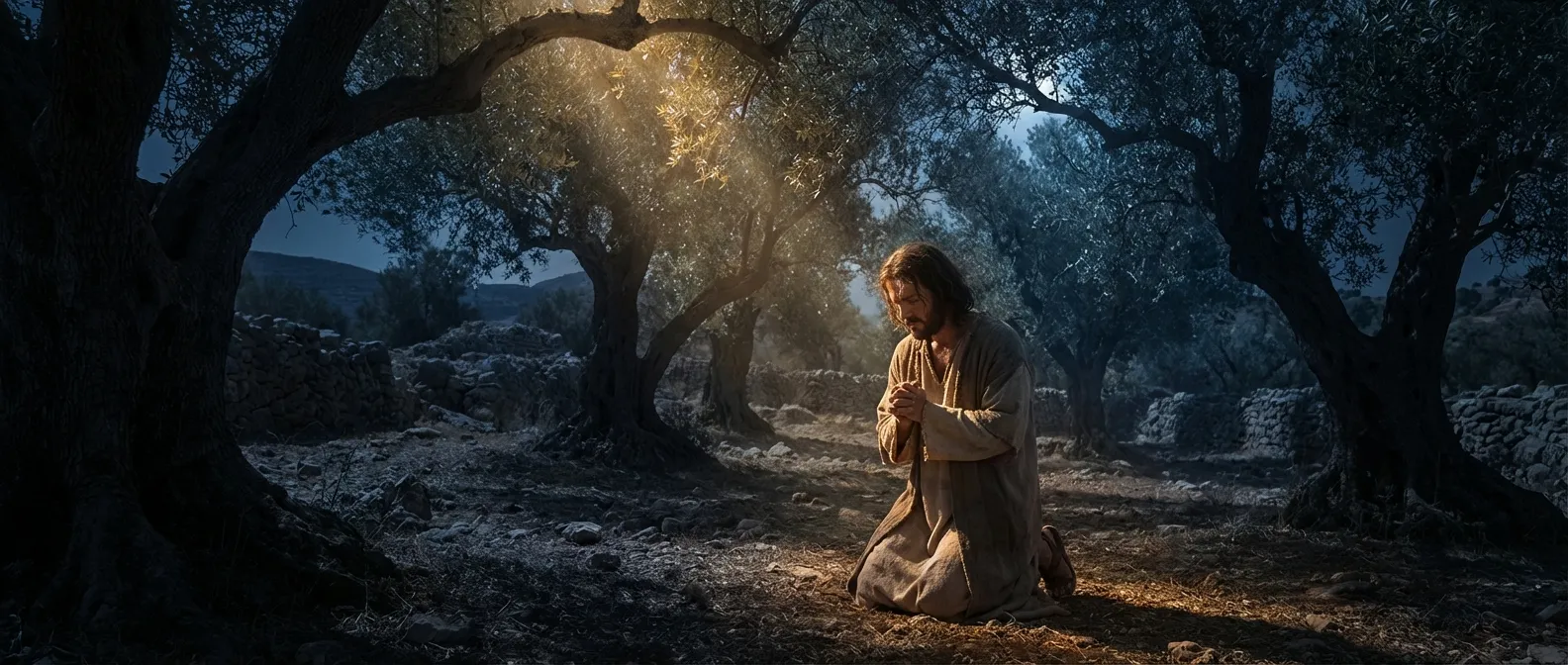
📖 Passage: Luke 22:39-46
Before You Begin
Read Luke 22:39-46 slowly. Then read it again in Matthew 26:36-46 and Mark 14:32-42 — the three accounts overlap but each reveals details the others don’t. Matthew records Jesus praying three times. Mark captures His raw opening word: Abba — Daddy. Luke, the physician, is the only one who mentions the sweat like drops of blood and the angel who came to strengthen Him.
Then sit with this: the Son of God — the one through whom galaxies were spoken into existence, the one who calmed storms by talking to them, the one who called Lazarus out of a sealed tomb with a single word — fell face-down in the dirt and begged His Father to find another way.
What kind of suffering makes God weep?
Hold that question. We’re going to need it.
Where Every Other Prayer Leads
We’ve traveled a road through this series.
Hannah knelt in a temple and poured out a desperation so raw that the priest thought she was drunk (1 Samuel 1). Her prayer taught us that God meets us in our lowest moments — that brokenness isn’t a disqualification for prayer, it’s a prerequisite.
David fell face-down after the worst failure of his life and begged for mercy he didn’t deserve (Psalm 51). His prayer taught us that God doesn’t want our performance — He wants our honesty. A broken spirit. A contrite heart. The sacrifice God will never refuse.
Elijah stood on a mountain, outnumbered and outfunded, poured water on his own altar, and dared God to light it up (1 Kings 18). His prayer taught us that audacity rooted in obedience can call fire from heaven — and that God’s dramatic answers are really love letters to wandering children.
Each of those prayers was extraordinary. Each one moved the hand of God. Each one altered the trajectory of a life, a family, or a nation.
But every one of them depended on what happened in a garden called Gethsemane.
Hannah’s answered prayer? It mattered because it was part of a covenant God was keeping — a covenant that found its ultimate fulfillment in Jesus. David’s forgiveness? It was possible because Someone else would eventually bear the full penalty David deserved. Elijah’s fire? It pointed forward to a God who would go to even more extreme lengths to bring His people home — not fire from heaven, but blood on a cross.
Every prayer ever answered traces its power back to one garden, one night, one man, and three words: Not my will.
For however many are the promises of God, in him is the “Yes.” Therefore also through him is the “Amen”, to the glory of God through us.
Reflection Questions
- Looking back at the prayers in this series, what threads connect them? What do Hannah, David, and Elijah all have in common when they approach God?
- What does it mean that every answered prayer ultimately depends on what Jesus did? How does that change how you think about your own prayer life?
The Last Supper Before the Last Prayer
To understand Gethsemane, you need to understand the hours that preceded it. The weight Jesus carried into that garden didn’t appear out of nowhere — it had been building all evening.
It was Thursday night. Passover. The meal that commemorated Israel’s liberation from Egypt — the night the angel of death “passed over” every home marked with lamb’s blood on the doorframe (Exodus 12). For 1,400 years, Jewish families had killed a lamb and remembered that blood was the price of freedom.
Now, in an upper room in Jerusalem, the Lamb sat down with His disciples and reinterpreted the entire meal:
He took bread, and when he had given thanks, he broke and gave it to them, saying, “This is my body which is given for you. Do this in memory of me.” Likewise, he took the cup after supper, saying, “This cup is the new covenant in my blood, which is poured out for you.…”
Jesus knew exactly what was coming. He’d been telling His disciples for months:
saying, “The Son of Man must suffer many things, and be rejected by the elders, chief priests, and scribes, and be killed, and the third day be raised up.”
He knew. He’d always known. And on this night, He broke bread with the man who would betray Him, poured wine with the friends who would abandon Him, and washed the feet of the disciple who would deny Him three times before sunrise.
Jesus, knowing that the Father had given all things into his hands, and that he came from God and was going to God, arose from supper, and laid aside his outer garments. He took a towel and wrapped a towel around his waist.
Read that again. Knowing He had all power — knowing He was God — He picked up a towel. He knelt. He washed dirty feet. Including Judas’s.
The evening was saturated with impending grief. At the table, Jesus announced the betrayal. He predicted Peter’s denial. He told them plainly: “Where I am going, you cannot follow now” (John 13:36). The farewell discourse in John 14-17 reads like a man saying goodbye to everything He loved on earth.
And then, after the hymn, they walked out into the night.
When they had sung a hymn, they went out to the Mount of Olives.
The traditional Passover hymn is Psalms 113-118 — the Hallel. The last psalm in the sequence contains these words:
The stone which the builders rejected has become the cornerstone. This is Yahweh’s doing. It is marvelous in our eyes.
Yahweh is God, and he has given us light. Bind the sacrifice with cords, even to the horns of the altar. You are my God, and I will give thanks to you. You are my God, I will exalt you.
Jesus sang those words on the way to His death. The rejected stone. The altar. You are my God, and I will praise you. He walked toward the garden singing praise to the Father who had sent Him to die.
Reflection Questions
- Jesus washed Judas’s feet knowing Judas would betray Him within hours. What does that reveal about the nature of divine love?
- He sang praise on the way to Gethsemane. How is that possible? What sustained Him?
- What does it tell you about Jesus that He chose the Passover — the meal about a sacrificial lamb — as the moment to reveal He was the sacrifice?
The Garden
He came out and went, as his custom was, to the Mount of Olives. His disciples also followed him.
As usual. Luke slips in a detail that’s easy to miss. This wasn’t the first time Jesus went to this garden. It was a regular place — a familiar retreat on the slopes of the Mount of Olives, just east of Jerusalem, across the Kidron Valley from the Temple.
The name Gethsemane comes from the Aramaic gat šmānê — oil press. It was an olive grove with a press for crushing olives into oil. The olives would be placed in heavy stone basins and crushed under enormous pressure until the oil flowed out.
The symbolism would not have been lost on anyone steeped in Jewish imagery. The Messiah — the “Anointed One,” literally the one marked with oil — was about to be crushed in an oil press. The pressing would produce something priceless, but the process would be agonizing.
But he was pierced for our transgressions. He was crushed for our iniquities. The punishment that brought our peace was on him; and by his wounds we are healed.
The Hebrew word for “crushed” in Isaiah 53 is dākā’ — to pulverize, to break into pieces, to reduce to dust. This isn’t gentle pressure. This is destruction. And it was happening to Jesus before the soldiers ever arrived.
He was withdrawn from them about a stone’s throw, and he knelt down and prayed,
A stone’s throw. Close enough to be seen. Far enough to be alone. Jesus positioned Himself within sight of His closest friends but beyond the reach of their comfort.
He brought Peter, James, and John deeper into the garden — the same three who had witnessed the Transfiguration, where His face had shone like the sun and Moses and Elijah had appeared in glory (Matthew 17:1-3). They had seen Him at His most radiant. Now they would see Him at His most broken.
He took with him Peter, James, and John, and began to be greatly troubled and distressed. He said to them, “My soul is exceedingly sorrowful, even to death. Stay here and watch.”
The Greek words Mark uses — ekthambeisthai and adēmonein — are among the strongest emotional words in the New Testament. They describe a horror that stuns, a dread that makes the mind reel, an anguish so deep it borders on death itself.
Jesus, who had calmly faced demons, storms, hostile crowds, and religious authorities trying to stone Him, was now overwhelmed with sorrow to the point of death. Whatever He was facing in that garden was worse than anything He had encountered in thirty-three years of human life.
What was He facing?
Reflection Questions
- Gethsemane means “oil press” — a place of crushing. Why do you think God chose this location for this moment?
- Jesus was “overwhelmed with sorrow to the point of death” — not at the cross, but in the garden. What does that tell you about what was happening in prayer?
- He asked His friends to stay and keep watch. Have you ever needed someone to simply be there during your darkest moment? Did they stay?
What Was in the Cup
saying, “Father, if you are willing, remove this cup from me. Nevertheless, not my will, but yours, be done.”
The cup.
Jesus wasn’t asking to avoid physical pain. Yes, crucifixion was among the most brutal forms of execution ever devised — hours of suffocating agony as the victim’s own body weight slowly made breathing impossible. But Jesus had faced death threats before and walked through hostile crowds without flinching (Luke 4:29-30, John 8:59). Physical suffering alone doesn’t explain sweat like blood.
So what was in the cup?
Throughout the Old Testament, “the cup” is a specific metaphor with a specific meaning. It’s the cup of God’s wrath — His settled, holy opposition to evil, poured out without mixture:
For in Yahweh’s hand there is a cup, full of foaming wine mixed with spices. He pours it out. Indeed the wicked of the earth drink and drink it to its very dregs.
Awake, awake! Stand up, Jerusalem, you who have drunk from Yahweh’s hand the cup of his wrath. You have drunken the bowl of the cup of staggering, and drained it.
For Yahweh, the God of Israel, says to me: “Take this cup of the wine of wrath from my hand, and cause all the nations to whom I send you to drink it.…”
The cup of God’s wrath is the accumulated, righteous judgment against every sin ever committed by every person who ever lived. Every murder. Every abuse. Every betrayal. Every lie. Every act of cruelty, selfishness, and rebellion from the Garden of Eden to the end of time. Not just the big, dramatic sins — the quiet ones too. The coldness. The apathy. The looking away. The choosing ourselves when someone needed us. All of it.
And Jesus was being asked to drink it. All of it. Alone. In one draught.
For him who knew no sin he made to be sin on our behalf, so that in him we might become the righteousness of God.
Don’t move past that verse too quickly. God didn’t just put our sins on Jesus like a coat He could take off. He made Jesus to be sin. The perfectly holy, infinitely pure Son of God — the one who had never harbored a selfish thought, never spoken a careless word, never looked at anyone without love — was about to absorb the full toxicity of human evil into Himself.
For the first and only time in eternal history, the relationship between the Father and the Son would be ruptured. The intimacy that had existed before time, before creation, before anything — the love that was the foundation of reality itself — would be severed. On the cross, Jesus would cry out:
About the ninth hour Jesus cried with a loud voice, saying, “Eli, Eli, lima sabachthani?” That is, “My God, my God, why have you forsaken me?”
That cry wasn’t metaphor. It wasn’t theater. It was the scream of God-the-Son experiencing something that had never happened in infinity: separation from God-the-Father. Not because the Father stopped loving the Son, but because the Son was carrying something so toxic, so antithetical to the Father’s holiness, that their communion was broken.
That was in the cup. Not nails. Not thorns. Not mockery. Cosmic abandonment. The experience of being forsaken by the only One who had never, for a single moment, left His side.
And in Gethsemane, Jesus could see it coming. He could feel its approach like a wave building on the horizon. He knew — with the perfect foreknowledge of God — exactly what it would feel like, exactly how long it would last, exactly how dark it would get.
Is it any wonder He sweated blood?
Reflection Questions
- When you think of “the cup,” do you typically think of physical suffering or something deeper? How does understanding the cup as God’s wrath change your reading of Gethsemane?
- Jesus experienced separation from the Father so that we never would. Sit with that. What does it stir in you?
- “My God, my God, why have you forsaken me?” — if God-the-Son can pray from a place of feeling abandoned, what does that free you to bring to God in prayer?
Sweat Like Blood
Being in agony, he prayed more earnestly. His sweat became like great drops of blood falling down on the ground.
Luke was a physician (Colossians 4:14). He’s the only Gospel writer who records this detail, and he describes it with clinical precision. The condition is real — it’s called hematidrosis, a phenomenon where extreme psychological distress causes the capillaries feeding the sweat glands to rupture, mixing blood with sweat. It’s been documented in medical literature, though it’s extraordinarily rare. It occurs only under conditions of extreme emotional and psychological anguish.
Jesus wasn’t performing grief. His body was breaking under the weight of what His spirit was bearing.
But notice what Luke says He did in response to the anguish: “He prayed more earnestly.”
Not less. More.
The anguish didn’t drive Him away from the Father — it drove Him deeper. This is the inverse of what most of us do. When the pressure mounts, when the pain intensifies, when the darkness closes in, our instinct is to pull back, to protect ourselves, to go numb. Jesus pressed in. He went further into the conversation, not away from it.
Matthew tells us He prayed three times — the same prayer, each time returning to the disciples, each time finding them asleep:
Again, a second time he went away and prayed, saying, “My Father, if this cup can’t pass away from me unless I drink it, your desire be done.”
Notice the shift between the first and second prayers. In the first: “If it is possible, take this cup.” In the second: “If it is not possible for this to be taken away unless I drink it…” The request is being refined in real time. Jesus isn’t having a theological debate — He’s wrestling. He’s pushing against the impossible, feeling the wall, and then yielding. Not in defeat. In trust.
And Luke records one more detail the other Gospels omit:
An angel from heaven appeared to him, strengthening him.
God didn’t remove the cup. He didn’t change the plan. He didn’t answer the prayer the way Jesus asked. But He didn’t leave Him alone either. He sent an angel. Not to explain. Not to make it easier. Just to strengthen.
Sometimes the answer to prayer isn’t removal. It’s reinforcement. God doesn’t always take the valley out of the journey — but He walks into the valley with you. Or sends someone who will.
Even though I walk through the valley of the shadow of death, I will fear no evil, for you are with me. Your rod and your staff, they comfort me.
Reflection Questions
- Jesus responded to increasing anguish with more earnest prayer. What is your instinct when the pressure increases? Do you press in or pull back?
- The angel didn’t remove the suffering — just strengthened Jesus to endure it. Have you experienced that kind of answer to prayer? Strength to endure rather than escape?
- Jesus prayed the same prayer three times, each time with a slight shift. What does that teach you about persistence and process in prayer?
Three Words That Split Eternity
saying, “Father, if you are willing, remove this cup from me. Nevertheless, not my will, but yours, be done.”
Here is the hinge of human history. The fulcrum on which everything turns.
Not my will, but yours be done.
Let’s feel the weight of what was happening.
Jesus had a will. He wasn’t a robot. He wasn’t acting out a script with no internal experience. He was fully human (Hebrews 2:17), and His human will recoiled from what was coming. He didn’t want to drink the cup. Every fiber of His humanity screamed against it. His body was sweating blood in protest. His soul was “overwhelmed with sorrow to the point of death.”
And He chose to surrender His will anyway.
This is not the same as not caring. This is not stoic indifference. This is the most violent act of love in history — a fully conscious, fully feeling, fully human person choosing to absorb infinite suffering because the alternative was losing the people He loved.
looking to Jesus, the author and perfecter of faith, who for the joy that was set before him endured the cross, despising its shame, and has sat down at the right hand of the throne of God.
The joy set before Him. What joy? You. You were the joy. The prospect of having you — knowing you, being known by you, bringing you home to the Father — was the joy that made the cross endurable. Not easy. Not painless. Endurable.
Let that land.
Jesus looked at the cup — the wrath, the abandonment, the annihilation of everything beautiful and holy and warm in His experience — and He looked at you. And He chose you.
Greater love has no one than this, that someone lay down his life for his friends.
But here’s what makes this prayer different from every other prayer in the series — from every other prayer in history.
Hannah prayed from desperation, and God answered with a son. David prayed from brokenness, and God answered with mercy. Elijah prayed from bold obedience, and God answered with fire. In each case, God gave the person what they asked for.
In Gethsemane, God said no.
The cup was not removed. There was no other way. The Father didn’t take it away because taking it away meant losing us. And the Father would rather crush His Son than lose His children.
He who didn’t spare his own Son, but delivered him up for us all, how would he not also with him freely give us all things?
This is the prayer that authorizes every other prayer. It’s the reason Hannah could pray and be heard. It’s the reason David could ask for clean heart and receive one. It’s the reason Elijah could call fire and it came. Because before any of those prayers — before the foundation of the world, in the eternal counsel of the Trinity — the Son had already said yes.
who was foreknown indeed before the foundation of the world, but was revealed in this last age for your sake,
Reflection Questions
- “Not my will, but yours be done.” Have you ever prayed that and meant it? What did it cost you?
- God said no to Jesus’s request so that He could say yes to our salvation. How does that reshape your understanding of unanswered prayer?
- Jesus chose the cross because of the “joy set before him” — which was you. How does it feel to be someone’s reason for enduring the worst suffering in history?
The Disciples Who Couldn’t Stay Awake
There’s a painful subplot running through Gethsemane that’s easy to overlook: the disciples.
He came to the disciples and found them sleeping, and said to Peter, “What, couldn’t you watch with me for one hour?…”
Jesus had asked for one thing. One. Stay awake. Not fight. Not solve anything. Not even pray with Him. Just… be awake. Be present. Bear witness.
They couldn’t do it.
“…Watch and pray, that you don’t enter into temptation. The spirit indeed is willing, but the flesh is weak.”
Look at the grace in that sentence. Jesus had every right to be furious. He was facing the worst moment in cosmic history, and His closest friends — the ones He’d spent three years training, eating with, confiding in — couldn’t stay conscious for sixty minutes. And instead of rebuking them, He diagnosed them: The spirit is willing, but the flesh is weak.
He understood. Even in His agony, He understood their frailty better than they did. He made excuses for them. He was gentler with their failure than we would be with our own.
Three times He came back. Three times they were asleep. Three times He went back to pray alone.
There’s something quietly devastating about the God of the universe kneeling in the dirt, sweating blood, looking over His shoulder for comfort, and seeing His best friends unconscious.
But there’s also something deeply reassuring: Jesus knows what it’s like when the people you need aren’t there. He knows the loneliness of facing your hardest moment without human support. He knows what it feels like to be let down by the people closest to you.
For we don’t have a high priest who can’t be touched with the feeling of our infirmities, but one who has been in all points tempted like we are, yet without sin.
When you pray in the middle of the night and feel utterly alone, Jesus doesn’t relate to that theoretically. He relates to it from the garden floor.
Reflection Questions
- Have you ever been the sleeping disciple — someone needed you, and you weren’t there? How did that feel afterward?
- Jesus responded to the disciples’ failure with understanding, not anger. How does that shape how you approach God after your failures?
- “The spirit is willing, but the flesh is weak.” Where in your life do you feel the gap between what you want to do and what you actually do?
The Kiss and the Sword
While he was still speaking, a crowd appeared. He who was called Judas, one of the twelve, was leading them. He came near to Jesus to kiss him. But Jesus said to him, “Judas, do you betray the Son of Man with a kiss?”
The prayer is over. The decision has been made. And immediately — while He was still speaking — the consequences arrive.
Judas leads a detachment of soldiers, temple guards, and chief priests into the garden. He identifies Jesus with a kiss — the customary greeting between a rabbi and his student. The most intimate form of betrayal: love’s gesture weaponized.
And what does Jesus say? Not “How could you?” Not “I trusted you.” He asks a question: “Are you betraying the Son of Man with a kiss?”
Even now, even here, Jesus is inviting Judas to see what he’s doing. It’s not a rebuke — it’s a mirror. One last chance to recognize the horror of his choice. One last act of love toward the man who sold Him for thirty pieces of silver.
Peter, typically, goes for the sword:
When those who were around him saw what was about to happen, they said to him, “Lord, shall we strike with the sword?” A certain one of them struck the servant of the high priest, and cut off his right ear.
Jesus’s response is immediate:
But Jesus answered, “Let me at least do this”—and he touched his ear and healed him.
His last miracle before the cross was healing the wound inflicted by His own disciple on one of His captors.
Let that settle in. The man being arrested stops His own defense to repair the damage done by His friend to His enemy. In the middle of being betrayed, abandoned, and seized, Jesus is still healing, still serving, still choosing love over violence, still choosing the Father’s will over the most human instinct in the world: self-preservation.
“…Or do you think that I couldn’t ask my Father, and he would even now send me more than twelve legions of angels? How then would the Scriptures be fulfilled that it must be so?”
A Roman legion was 6,000 soldiers. Twelve legions: 72,000 angels. One angel killed 185,000 Assyrian soldiers in a single night (2 Kings 19:35). Jesus had access to enough supernatural firepower to unmake the planet, and He left it holstered.
Not because He couldn’t. Because He wouldn’t. Because the prayer in the garden had already decided the outcome.
Not my will, but yours be done.
The sword was available. The angels were waiting. The power was unlimited. And Jesus chose handcuffs.
Reflection Questions
- Jesus healed the ear of the man who came to arrest Him. What does that tell you about how God responds to those who oppose Him?
- Peter reached for a sword. Jesus reached for surrender. When you face threatening situations, which instinct is stronger in you?
- Jesus had twelve legions of angels available. The power to escape was real. Why is choosing to stay more powerful than being forced to stay?
What Gethsemane Teaches Us About Prayer
We’ve come to the end of the series. Five prayers. Five moments where everything was on the line. Let’s distill what this final prayer — the prayer that made all the others possible — teaches us about talking to God.
1. Bring your real feelings, not your polished ones
Jesus didn’t pray a composed, theological prayer. He fell on His face and begged. He sweat blood. He asked for the cup to be removed even though He knew the mission required it. He brought His whole, unfiltered, anguished self to the Father.
If the Son of God can pray from a place of raw emotion, so can you. God isn’t scandalized by your honesty. He’s more concerned when you won’t bring it.
Trust in him at all times, you people. Pour out your heart before him. God is a refuge for us. Selah.
2. Surrender isn’t giving up — it’s choosing up
“Not my will, but yours” isn’t resignation. It’s not the prayer of someone who’s lost hope. It’s the prayer of someone who trusts the Father so completely that He’s willing to walk into the worst suffering imaginable rather than step outside the Father’s plan.
Surrender in prayer isn’t weakness. It’s the strongest thing a human can do — releasing your grip on the outcome and trusting the One who sees further than you.
3. God sometimes says no to give you something bigger
The cup wasn’t removed. Jesus asked, and the Father said no. But the “no” to removing the cup was a “yes” to redeeming the world. God’s refusal in Gethsemane was the foundation of every person’s salvation for all of eternity.
When God says no to your prayer, it may not mean He’s ignoring you. It may mean He’s working on a scale you can’t see yet.
“For my thoughts are not your thoughts, and your ways are not my ways,” says Yahweh. “For as the heavens are higher than the earth, so are my ways higher than your ways, and my thoughts than your thoughts.…”
4. You can be in God’s will and still be in agony
Gethsemane destroys the prosperity gospel with a single scene. Jesus was in perfect alignment with the Father’s will — and He was in the worst anguish any being has ever experienced. Obedience doesn’t guarantee comfort. Sometimes it guarantees the opposite.
But it always guarantees the Father’s presence. The angel came. Not to remove the pain — to sustain him through it.
5. The prayers that change the world often happen alone, in the dark
No crowd watched Jesus in Gethsemane. No one chronicled it in real time. His closest friends were asleep. The most consequential prayer in human history was prayed alone, at night, in a garden nobody was paying attention to.
Your midnight prayers matter. The tears no one sees, the wrestling no one knows about, the surrenders that happen in the dark — God meets you there. That’s where the real work happens.
But you, when you pray, enter into your inner room, and having shut your door, pray to your Father who is in secret; and your Father who sees in secret will reward you openly.
Reflection Questions
- Which of these five lessons hits closest to where you are right now? Why?
- How has this series — Hannah, David, Elijah, Jesus — changed how you think about prayer?
- If prayer is ultimately about aligning your will with God’s (not getting God to align with yours), how does that reshape what you bring to Him?
This Week’s Practice
This is the final week of the series. Make it count.
-
Monday — Read all four Gethsemane accounts side by side (Matthew 26:36-46, Mark 14:32-42, Luke 22:39-46, John 18:1-11). Note what each writer emphasizes. What stands out that you hadn’t noticed before?
-
Tuesday — Write a “cup” prayer. Identify the hardest thing you’re currently facing — the thing you’d most like God to remove — and write it down. Then, underneath, write: “Not my will, but yours be done.” Keep that paper somewhere you’ll see it this week.
-
Wednesday — Practice presence. Find someone in your life who’s going through a hard time. Don’t try to fix it. Don’t offer advice. Just be there. Stay awake. Be the disciple Jesus wished He’d had in the garden.
-
Thursday — Fast a meal and spend the time praying through the “Prayers That Shook the World” series. Pray Hannah’s prayer of desperation. Pray David’s prayer of brokenness. Pray Elijah’s prayer of boldness. End with Jesus’s prayer of surrender. Notice how each one builds on the last.
-
Friday — Surrender prayer. Find a quiet place — alone, if possible, like Jesus in the garden. Get on your knees or lie face-down. Bring your deepest, most honest feelings to God. Don’t filter them. Don’t polish them. Tell Him what you’re afraid of, what you want, what you’re carrying. And then say the three hardest words in prayer: “Not my will.”
-
Weekend — Take communion. If your church celebrates it, go. If not, do it at home with bread and juice. As you eat the bread, remember: “This is my body, given for you.” As you drink the cup, remember: Jesus drank a different cup — the one you and I deserved — so we could drink this one in freedom. Thank Him. He chose the cross. He chose you.
The End of the Series — and the Beginning
We started this journey with the Lord’s Prayer: the pattern, the template, the way Jesus taught us to talk to God (Matthew 6:9-13). We’ve walked through the temple with a desperate mother, through the aftermath of a king’s worst sin, through fire on a mountaintop, and into a midnight garden where God sweat blood.
Five prayers. Five completely different people, circumstances, emotions, and requests. And every single one teaches the same fundamental truth:
Prayer is not a technique. It’s a relationship.
Hannah didn’t use the right formula. She poured out her heart. David didn’t earn forgiveness through eloquence. He offered the one thing God wanted: a broken spirit. Elijah didn’t convince God through the force of his argument. He stood where God told him to stand and prayed from obedience. And Jesus didn’t override the Father’s plan with His own. He surrendered — fully feeling, fully honest, fully trusting.
They all came to God as they were. That was enough. It always is.
Let’s therefore draw near with boldness to the throne of grace, that we may receive mercy and may find grace for help in time of need.
Whatever your “garden” is right now — whatever cup you’re staring at, whatever night you’re kneeling in — the God who sent an angel to strengthen His Son in Gethsemane is the same God who hears your midnight prayers.
He’s not asleep. He’s not busy. He’s not traveling.
He’s right there. He always has been.
And He’s already said yes to the prayer that matters most.
For God so loved the world, that he gave his only born Son, that whoever believes in him should not perish, but have eternal life.
Talk to Him. He’s listening. He always was.
This is Part 5 of 5 in the “Prayers That Shook the World” study series. Start from the beginning with Part 1: “The Lord’s Prayer, Line by Line”.