

The Old Man Who Held Tomorrow — When Simeon and Anna Finally Saw What They'd Spent a Lifetime Waiting For
He was told he wouldn't die until he saw the Messiah. She spent sixty years praying in a temple without a single recorded answer. Then a teenage couple walked in with a baby, and an old man's trembling arms held the end of four hundred years of silence. The finale of the 'When God Says Wait' series.
Part 5: The Longest Wait in the Story
Abraham waited twenty-five years for a son. Joseph waited thirteen years in slavery and prison. Moses waited forty years in a desert. David waited fifteen years in caves with a bounty on his head.
Each of them was young — or at least had decades of life ahead — when the waiting began. They could reasonably expect to live long enough to see the promise come true. The math, while painful, at least worked.
But there’s a kind of waiting that’s different from all of those.
It’s the kind where the math doesn’t work. Where the calendar isn’t your ally — it’s your enemy. Where every year that passes isn’t just a delay but a shrinking window. Where the question isn’t “will I be ready when it comes?” but “will I be alive when it comes?”
In the final chapter of this series, we meet two people who waited longer than everyone else — and had less reason to believe the wait would end in time.
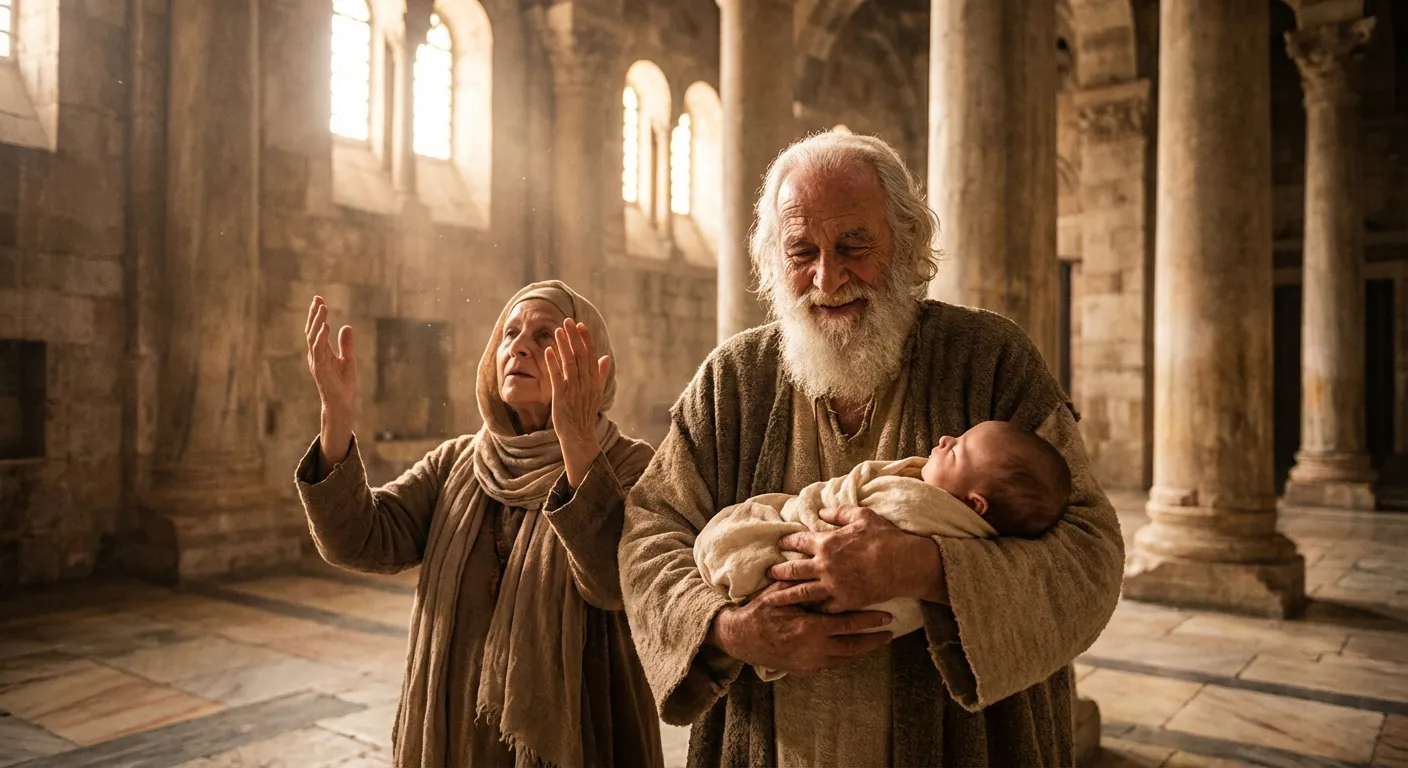
An old man named Simeon. An elderly widow named Anna.
And the day the wait finally broke.
Four Hundred Years of Silence
To understand Simeon and Anna, you need to understand what the world looked like when they lived. Because their waiting didn’t start when they were born. It started four centuries before that.
The last Old Testament prophet — Malachi — spoke around 430 BC. He delivered God’s final words to Israel, including a promise:
“Behold, I send my messenger, and he will prepare the way before me! The Lord, whom you seek, will suddenly come to his temple. Behold, the messenger of the covenant, whom you desire, is coming!” says Yahweh of Armies.
And then: silence.
Four hundred years of it.
No prophets. No visions. No angelic visitations. No pillars of fire. No voices from burning bushes. No writing on walls. For four centuries, the God who had spoken to Abraham in his tent, to Moses on a mountain, to Elijah in a whisper, to Daniel in a lion’s den — that God went quiet.
Empires rose and fell during the silence. Persia gave way to Greece. Alexander the Great conquered the known world and died at thirty-two. The Ptolemies ruled, then the Seleucids. Antiochus Epiphanes desecrated the temple with pig’s blood. The Maccabees revolted and won a brief, bloody independence. And then Rome arrived — unstoppable, efficient, brutal — and Israel became a province in someone else’s empire.
Through all of it, faithful Jews held onto the promise. The Messiah was coming. God had said so through Isaiah, Jeremiah, Ezekiel, Daniel, Micah, Zechariah. The prophets had painted a portrait — born in Bethlehem, from the line of David, a suffering servant, a conquering king. The details were there. The timeline was not.
Four hundred years is a long time to hold onto a promise with no new information.
Imagine inheriting a family story that your great-great-great-great-great-great-great-great-great-great-grandparents told. Imagine it being the center of your religious life, your national identity, your hope for the future. And imagine that for over a dozen generations, the only evidence that the promise was real was… an old book.
That was Israel in the first century. Waiting for a Messiah with nothing but ancient texts and stubborn faith.
Into that silence, Simeon and Anna held the line.
The Man Who Was Promised He Would See
Luke introduces Simeon in three verses that are some of the most loaded in the New Testament:
Behold, there was a man in Jerusalem whose name was Simeon. This man was righteous and devout, looking for the consolation of Israel, and the Holy Spirit was on him. It had been revealed to him by the Holy Spirit that he should not see death before he had seen the Lord’s Christ.
Three things. That’s all we get. And every one of them is extraordinary.
First: he was righteous and devout. In a world where religious leaders had largely become political operators — the Sadducees cozying up to Rome, the Pharisees turning faith into performance — Simeon was the real thing. Quietly, genuinely righteous. Not for show. Not for position. Just faithful.
Second: he was waiting for the consolation of Israel. That phrase — “the consolation of Israel” — is loaded with theological meaning. It comes from Isaiah’s promise: “Comfort, comfort my people, says your God” (Isaiah 40:1). The consolation wasn’t just a political rescue from Rome. It was the deep, prophesied comfort that God Himself would come to His people. Simeon wasn’t waiting for a military leader. He was waiting for God.
Third: the Holy Spirit had told him he wouldn’t die before seeing the Messiah. This is staggering. In four hundred years of prophetic silence — four centuries without a confirmed word from God — the Holy Spirit spoke personally to this one old man and made him a promise: You will see Him before you die.
We don’t know when Simeon received this promise. Was he young? Middle-aged? Already old? We don’t know. But we know that by the time Luke 2 happens, Simeon is elderly — the text calls him an old man, and his own words suggest he’s ready to die. Which means he waited for this promise for years. Maybe decades.
And here’s the thing nobody talks about: that promise was both the greatest gift and the most excruciating burden.
Think about it. The Holy Spirit told Simeon he would see the Messiah before he died. Which means every morning he woke up, the promise was still unfulfilled. Every year that passed, his body got weaker and the world got darker and the Messiah hadn’t come. Every ache in his joints, every shortness of breath, every funeral of a friend his age was a reminder: I’m running out of time, and the promise hasn’t happened yet.
Did he doubt? Scripture doesn’t say. But he was human. And humans — even righteous, devout ones — have nights where the silence feels heavier than the promise.
Abraham had Sarah to share the wait with. Joseph had dreams that kept reigniting his hope. Moses had a burning bush that marked a clear turning point. David had the Psalms — his own songs feeding his faith back to him.
What did Simeon have?
A whisper from the Holy Spirit and a lifetime of getting older.
The Day the Spirit Moved
And then, one ordinary Tuesday — or whatever day it was — something shifted.
He came in the Spirit into the temple. When the parents brought in the child, Jesus, that they might do concerning him according to the custom of the law,
“Moved by the Spirit.” Luke doesn’t dramatize it. No angel. No vision. No voice from heaven. Just a nudge. An impression. A pull. The same Holy Spirit who had made the promise years ago now said: Go to the temple. Today.
Simeon had probably been to the temple thousands of times. It was a few minutes’ walk from anywhere in Jerusalem. He likely went daily. But this time was different — not because the temple had changed, but because the Spirit had a specificity to the nudge that Simeon recognized.
Today.
He walked into the temple courts, surrounded by the usual crowd — pilgrims, priests, merchants, beggars, tourists, Roman soldiers keeping watch. Somewhere in that crowd, a young couple from Nazareth walked in carrying a baby.
They were poor. We know because of what they brought:
When the days of their purification according to the law of Moses were fulfilled, they brought him up to Jerusalem to present him to the Lord … and to offer a sacrifice according to that which is said in the law of the Lord, “A pair of turtledoves, or two young pigeons.”
The law required a lamb for purification. But Leviticus 12:8 allowed a concession for families who couldn’t afford a lamb: two doves or two pigeons. Mary and Joseph brought the poverty offering. The King of the Universe came to His own temple, and His parents couldn’t afford the standard sacrifice.
Nobody noticed them. A teenage girl. A carpenter. A forty-day-old baby. Just another poor family from the provinces fulfilling the ritual.
Nobody noticed — except Simeon.
The Arms That Had Been Empty for Decades
What happened next is one of the most intimate moments in the entire Bible:
then he received him into his arms and blessed God, and said,
Stop there.
An old man — decades of waiting behind him, the weight of years and silence and faith stretched thin — reached out and took a baby from His mother’s arms.
And he knew.
Not because the baby glowed. Not because angels appeared. Not because a voice boomed from heaven. He knew because the same Spirit who had whispered the promise now confirmed it. This is Him. This is the One. Your wait is over.
Simeon, holding a six-week-old infant, said words that have been prayed in churches every evening for two thousand years — the Nunc Dimittis:
“Now you are releasing your servant, Master, according to your word, in peace; for my eyes have seen your salvation, which you have prepared before the face of all peoples; a light for revelation to the nations, and the glory of your people Israel.”
Read that again slowly.
“You may now dismiss your servant in peace.”
Simeon is saying: I can die now. Not with resignation — with completion. The thing he was living for has happened. The promise that kept him alive has been fulfilled. He is holding salvation in his arms, and there is nothing left that he needs to see.
“My eyes have seen your salvation.”
Not read about it. Not hoped for it. Not believed it theoretically. Seen it. Touched it. Held it. A promise that had echoed through four hundred years of silence was now a warm body in an old man’s arms.
“A light for revelation to the Gentiles.”
This is remarkable. Most Jews in Simeon’s day expected a Messiah for Israel — a liberator who would break Roman chains and restore the kingdom to Jewish hands. But Simeon, holding this peasant baby, saw what the prophets had seen: this wasn’t just Israel’s Messiah. This was the world’s salvation. A light for all nations. Including the ones that were currently occupying Jerusalem.
Simeon’s theology was bigger than his culture. His vision was shaped by Isaiah, not nationalism. And in that moment, holding Jesus, he saw farther than most people would see for another three decades.
“And the glory of your people Israel.”
But not only for the Gentiles. Also for Israel. The consolation he’d been waiting for — the deep, prophesied comfort of God coming to His people — was here. Not as a conquering general, but as a baby. Not in a palace, but in poverty. Not announced by trumpets, but recognized by an old man nobody would have noticed.
God’s biggest moments almost always look small.
The Shadow Behind the Song
Simeon wasn’t finished. After the soaring beauty of the Nunc Dimittis, he turned to Mary and said something that must have cut through the joy like a blade:
Simeon blessed them, and said to Mary, his mother, “Behold, this child is appointed for the falling and the rising of many in Israel, and for a sign which is spoken against. Yes, a sword will pierce through your own soul, that the thoughts of many hearts may be revealed.”
A sword will pierce your own soul.
Simeon looked at a young mother holding her firstborn son, and he told her that this child’s life would break her heart. He didn’t explain how. He didn’t describe a cross — Mary wouldn’t have understood that yet. But he planted a seed of sorrow inside what should have been an entirely joyful moment.
Because that’s the truth about God’s promises: they’re always bigger, more complex, and more costly than we imagine. Abraham waited for Isaac and then was asked to sacrifice him on a mountain. Joseph rose to power and then had to forgive the brothers who sold him. Moses reached the Promised Land’s border and couldn’t enter it. David sat on the throne and watched his family tear itself apart.
And Mary? Mary received the Messiah — the hope of the world, the consolation of Israel — and she would watch Him die naked on Roman wood while soldiers gambled for His clothes.
Simeon saw all of it. Or at least the shadow of it. And he told her not to prepare her, but to anchor her. So that thirty-three years later, standing at the foot of a cross, she would remember: The old man in the temple knew. God knew. This was always the plan.
Even the sword was part of the promise.
The Woman Who Refused to Leave
If Simeon’s story is about a promise received and fulfilled, Anna’s story is about something even more remarkable: faithfulness without a promise.
There was one Anna, a prophetess, the daughter of Phanuel, of the tribe of Asher (she was of a great age, having lived with a husband seven years from her virginity, and she had been a widow for about eighty-four years), who didn’t depart from the temple, worshiping with fastings and petitions night and day.
Let’s do the math — because the math matters.
Anna married young, as was customary. She had seven years with her husband. Then he died. Some scholars read the text as saying she was eighty-four at the time of this story. Others read it as saying she had been a widow for eighty-four years, which would make her over a hundred.
Either way: she had been widowed for most of her life. Decades and decades without a partner, without financial security, without the social standing that marriage provided in the ancient world. A widow in first-century Israel was among the most vulnerable people in society.
And what did Anna do with her decades of widowhood?
and she had been a widow for about eighty-four years), who didn’t depart from the temple, worshiping with fastings and petitions night and day.
Night and day. Not occasionally. Not when she felt like it. Not when circumstances were encouraging. Night and day, fasting and praying. For sixty years. Maybe longer.
Let that settle.
Sixty years of praying in the same temple. Sixty years of fasting — denying herself comfort to press deeper into God. Sixty years of worshipping — not because she had received an answer, but because she believed God was worth worshipping even without one.
Simeon had a promise: You will see the Messiah. Anna had no recorded promise. No whisper from the Spirit guaranteeing she’d live to see anything. She just had faithfulness — raw, daily, unglamorous faithfulness.
No one was watching Anna. No one was recording her prayers. No one was writing songs about the elderly widow who showed up at the temple every single day and prayed for something she had no guarantee of seeing.
But God was watching. And God remembered.
The Moment She Had Prayed Sixty Years to See
Luke tells Anna’s climactic moment in a single verse — and its brevity makes it even more powerful:
Coming up at that very hour, she gave thanks to the Lord, and spoke of him to all those who were looking for redemption in Jerusalem.
At that very moment. While Simeon was still holding the baby. While Mary was still processing the prophecy about the sword. While the temple bustled with people who had no idea what was happening.
Anna walked up.
And she knew.
How? Luke doesn’t say. Maybe the Holy Spirit moved her, as He had moved Simeon. Maybe she overheard Simeon’s prayer and something clicked. Maybe sixty years of praying sharpens your spiritual eyes until you can see what others miss. Maybe when you’ve spent your whole life seeking God’s face, you recognize it when it shows up — even when it’s the face of a six-week-old baby in a peasant woman’s arms.
Whatever the mechanism, Anna saw Jesus — and she did two things.
She gave thanks to God. After sixty years of prayer, the first word out of her mouth was gratitude. Not “finally!” Not “what took so long?” Not bitterness about the decades of unanswered silence. Thanks. She was grateful — deeply, profoundly grateful — because she knew what she was looking at. Not just a baby. The answer. The redemption. The thing she had spent her entire adult life asking for.
She spoke about the child to all who were looking forward to the redemption of Jerusalem. Anna didn’t keep this to herself. She became the first evangelist of Jesus. Before the disciples, before the Twelve, before Peter’s sermon at Pentecost — an eighty-four-year-old widow became the first person to publicly proclaim that the Messiah had arrived. She told everyone who was waiting. Because when you’ve spent sixty years praying for something and it finally happens, you don’t stay quiet.
This is what decades of faithfulness produce. Not fame. Not recognition. Not a book deal or a speaking tour. But the privilege of being present when God moves. Anna earned nothing — salvation is grace, not wages — but her faithfulness positioned her to see what millions of people in Israel’s history had longed to see and never did.
“But blessed are your eyes, for they see; and your ears, for they hear. For most certainly I tell you that many prophets and righteous men desired to see the things which you see, and didn’t see them; and to hear the things which you hear, and didn’t hear them.…”
Jesus said those words decades later. But they were already true in Luke 2. Abraham longed to see this day. Moses and David and Isaiah and Jeremiah and Daniel — they all pointed toward it, wrote about it, ached for it. And they died without seeing it.
Simeon and Anna saw it. And the only difference between them and the prophets who didn’t wasn’t talent, or status, or theological sophistication. It was timing. God chose to fulfill the promise in their generation, and their faithfulness meant they were in the room when it happened.
Two Kinds of Waiting, One Faithful God
Simeon and Anna represent two different — and equally beautiful — models of waiting on God.
Simeon had a specific promise. The Holy Spirit told him something concrete: you will see the Messiah. His waiting was anchored to a guaranteed outcome. The question was when, not if.
Anna had no recorded promise. She had hope. She had faith. She had the prophetic tradition of Israel. But Scripture records no personal guarantee from God that she would live to see the Messiah. Her waiting was anchored not to a promise about the future, but to a Person in the present — the God she worshipped night and day, whether He answered or not.
Both kinds of waiting are real. And both kinds show up in your life.
Sometimes God gives you a Simeon-promise. A clear word, a specific direction, a moment where the Holy Spirit whispers something concrete to your spirit. You will get through this. This relationship will heal. I have a plan for this situation. And the waiting, while painful, has an anchor of certainty.
But sometimes you’re in an Anna-season. No promise. No word. No guarantee. Just faithfulness. Just showing up. Just praying into silence and worshipping a God who hasn’t given you a timeline or a reason. And the waiting isn’t anchored to a promise — it’s anchored to a Person. To the belief that God is good even when He’s quiet, that prayer matters even when you can’t see the results, that faithfulness is never wasted even when it feels invisible.
Both are valid. Both are honored. Both end the same way: with God showing up.
Why the Wait Was Worth It
Here’s what I want you to see — the thing that ties this entire series together:
Abraham waited twenty-five years for Isaac. And Isaac became the father of Jacob, who became the father of the twelve tribes, who became a nation that carried the knowledge of God through human history.
Joseph waited thirteen years in slavery and prison. And when he emerged, he saved not just Egypt but his own family — the family through which the Messiah would come.
Moses waited forty years in a desert. And when God finally spoke, Moses led two million people out of bondage and received the Law that would shape Western civilization.
David waited fifteen years in caves. And he wrote the Psalms, established the dynasty, and built the throne that Jesus would inherit eternally.
Simeon waited a lifetime for a baby. And when he held Jesus, he held the fulfillment of everything Abraham, Joseph, Moses, and David had been waiting for — the culmination of four thousand years of promises, prophecies, and preparation.
Anna prayed for sixty years without an answer. And then the answer walked through the door in His mother’s arms.
Every wait in this series was connected. Abraham’s promise produced the nation. Joseph’s suffering preserved the nation. Moses’ calling freed the nation. David’s faithfulness established the throne. And all of it — every year of silence, every cave, every dungeon, every desert — was moving toward this: a baby in a temple, an old man’s trembling arms, and the words “my eyes have seen your salvation.”
The wait was never wasted. It was never random. It was never forgotten. Every year of it was building something — not just in the people who waited, but in the story God was telling through all of history.
And if God was that faithful across four thousand years of human history, He is faithful in your four months, your four years, your four decades of waiting.
The Promise That Hasn’t Been Fulfilled Yet
There’s one more piece of this story. Because Simeon and Anna’s moment in the temple wasn’t the end of the waiting — it was a turning point.
Jesus came. He lived. He taught. He healed. He was crucified. He rose. He ascended. And before He left, He made a promise:
If I go and prepare a place for you, I will come again and will receive you to myself; that where I am, you may be there also.
Two thousand years later, that promise is still unfulfilled. We are living in our own “between” — between the first coming and the second, between the promise and the completion. And the question that has haunted every generation of Christians since the apostles is the same question that haunted Abraham, Joseph, Moses, David, Simeon, and Anna:
How long, Lord?
The writer of Hebrews looked back across all of these stories and wrote:
These all died in faith, not having received the promises, but having seen them and embraced them from afar, and having confessed that they were strangers and pilgrims on the earth.
And then, in a verse that should make you put this article down and just sit with God for a while:
These all, having been commended for their faith, didn’t receive the promise, God having provided some better thing concerning us, so that apart from us they should not be made perfect.
God had planned something better. The people who waited the longest — who died without seeing the fulfillment — are part of the same story we’re part of. Their faith and our faith are woven together. Their waiting and our waiting are chapters in the same narrative. And the ending hasn’t been written yet.
But it will be.
being confident of this very thing, that he who began a good work in you will complete it until the day of Jesus Christ.
He who began it will complete it. Not might. Will.
The same God who kept His promise to Abraham after twenty-five years. Who vindicated Joseph after thirteen. Who called Moses after forty. Who crowned David after fifteen. Who showed Simeon the Messiah after a lifetime. Who answered Anna’s sixty years of prayer in a single moment.
That God has not forgotten your wait.
He has not overlooked your faithfulness.
He has not lost track of the promise.
He is not silent because He is absent. He is silent because He is working — in the hidden places, in the details you can’t see, in the storylines that haven’t converged yet.
And when the wait ends — whether in this life or the next — you will hold the answer in your arms and say what Simeon said:
My eyes have seen your salvation.
Reflect
-
Are you in a Simeon season or an Anna season? Do you have a specific promise from God that you’re waiting on? Or are you in a season of faithfulness without guarantees — praying, trusting, showing up, without a specific word about when or how things will change? How does knowing both are honored by God change how you approach your waiting?
-
Anna worshipped night and day for sixty years. Not because she had a promise, but because she believed God was worth it. What does your worship look like when there’s no guarantee of a result? Is your faithfulness dependent on outcomes — or on the Person you’re faithful to?
-
Simeon said, “You may now dismiss your servant in peace.” What would it take for you to feel that kind of completion? What is the one thing you’re living to see — the promise or hope that defines your waiting? And what would it mean to hold it in your arms?
-
“A sword will pierce your own soul too.” Simeon warned Mary that the promise came with pain. Has your waiting revealed something painful — something you didn’t expect to be part of God’s plan? How do you hold hope and heartbreak in the same hands?
-
This series followed five stories of waiting — Abraham, Joseph, Moses, David, and Simeon and Anna. Which one resonated most with your current season? Why? What is the one lesson from their story that you need to carry into tomorrow?
A Final Word
If you’ve read all five parts of this series, you’ve walked through four thousand years of human waiting. You’ve stood in Abraham’s tent, Joseph’s dungeon, Moses’ desert, David’s cave, and Simeon’s temple.
And the thread that ran through every single story was this: God keeps His promises. Always. Without exception. But almost never on your timeline.
The wait isn’t a malfunction. It isn’t a sign that God has forgotten. It isn’t punishment. It’s the space where God does His deepest work — the work that couldn’t happen any other way. Abraham couldn’t have become the father of faith without the twenty-five years that broke his self-reliance. Joseph couldn’t have saved a nation without the suffering that forged his character. Moses couldn’t have led with humility without the desert that stripped his pride. David couldn’t have written the Psalms without the caves that crushed his soul. And Simeon couldn’t have held salvation in his arms without the lifetime of longing that made the moment sacred.
Your wait is doing something. Even now. Even when you can’t feel it.
So wait well. Not passively — the way you wait for a bus. But actively — the way Simeon listened for the Spirit. The way Anna prayed without ceasing. The way David worshipped in caves. The way Moses tended sheep until the bush caught fire.
Wait with open hands and stubborn faith and honest prayers and the bone-deep belief that the God who started the work will finish it.
Because He will.
He always does.
Wait for Yahweh. Be strong, and let your heart take courage. Yes, wait for Yahweh.
This is Part 5 of 5 in the “When God Says Wait” series. Start from the beginning with Part 1: He Waited 25 Years for a Baby.