

Anointed and Ignored — What David Learned in the Cave That He Never Could Have Learned on the Throne
He was a teenager when God's prophet poured oil on his head and called him king. Then nothing happened. No crown. No throne. No army. Just a harp, a flock of sheep, and eventually a madman with a spear trying to pin him to the wall. David waited fifteen years between his anointing and his coronation — and what he wrote in those years still echoes in every hospital room, rehab center, and 3 AM prayer.
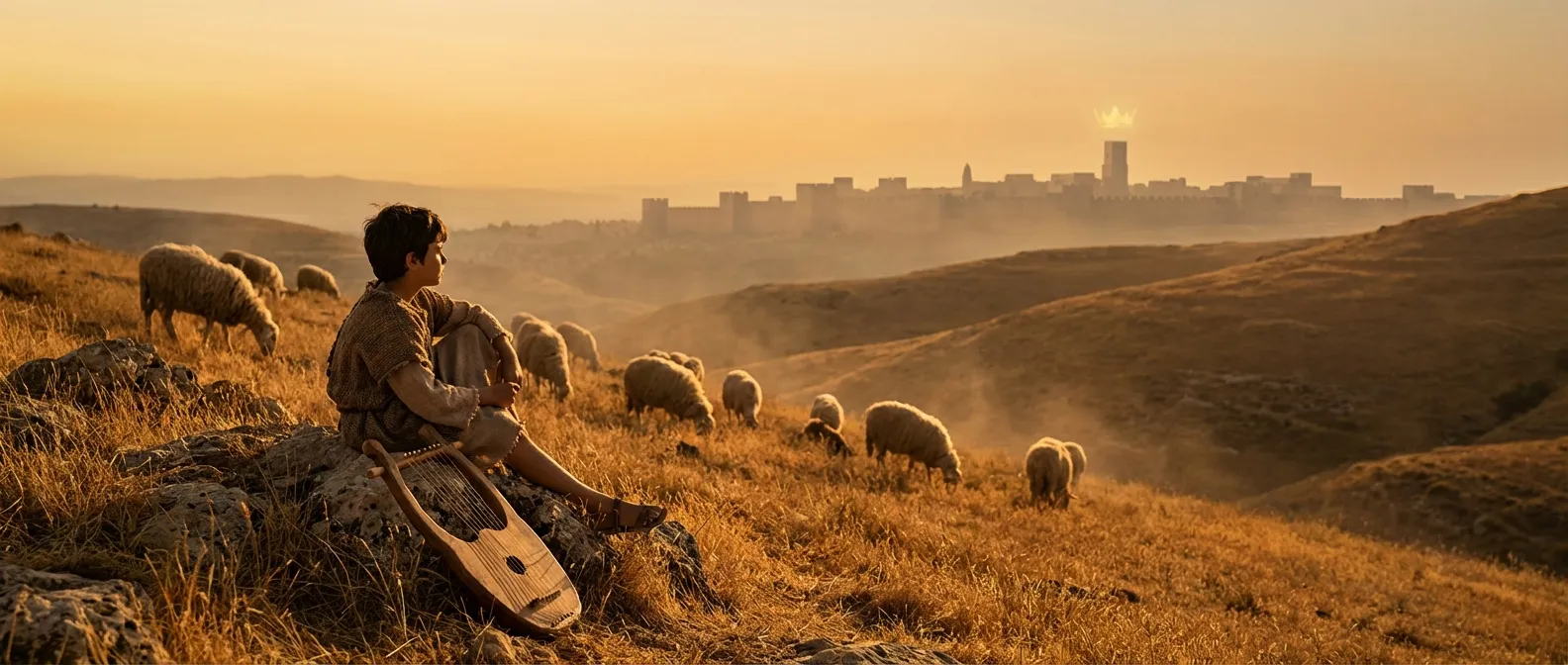
Part 4: The King Nobody Sent For
Abraham waited in the desert for a son. Joseph waited in a dungeon for vindication. Moses waited on the backside of nowhere for a voice from a bush. Each of them endured waiting that looked like abandonment.
But David’s waiting was different.
David didn’t wait in obscurity — he waited in danger. He wasn’t sitting still; he was running for his life. He wasn’t forgotten by God; he was hunted by a king. And the thing that made his story uniquely excruciating was this: he already had the promise. The oil was already on his head. The prophet had already spoken. God had already said yes.
And then fifteen years of caves, deserts, betrayals, and near-death escapes said not yet.
The Day Nobody Expected
To understand David’s waiting, you need to see how it started — because it started in the most unremarkable way imaginable.
God had rejected Saul as king. Not for some dramatic crime at first, but for something that looks almost reasonable on the surface: Saul didn’t fully obey. He kept what God told him to destroy. He performed a sacrifice he wasn’t authorized to perform. He chose expedience over obedience, and God chose someone else.
So God sent Samuel — the most respected prophet in Israel — to the town of Bethlehem, to the house of a man named Jesse, to anoint the next king:
Yahweh said to Samuel, “How long will you mourn for Saul, since I have rejected him from being king over Israel? Fill your horn with oil, and go. I will send you to Jesse the Bethlehemite, for I have provided a king for myself among his sons.”
Samuel arrived. Jesse paraded his sons — oldest to youngest, tallest to shortest. And Samuel, with the eye of a man who’d served God for decades, looked at the firstborn, Eliab, and thought: This is the one.
God’s response is one of the most quoted verses in the Old Testament:
But Yahweh said to Samuel, “Don’t look on his face, or on the height of his stature, because I have rejected him; for I don’t see as man sees. For man looks at the outward appearance, but Yahweh looks at the heart.”
Seven sons walked past Samuel. Seven times, God said no. Samuel, confused, asked Jesse the question that changed history:
Samuel said to Jesse, “Are all your children here?” He said, “There remains yet the youngest. Behold, he is keeping the sheep.” Samuel said to Jesse, “Send and get him, for we will not sit down until he comes here.”
Jesse’s answer tells you everything about David’s status in the family:
Samuel said to Jesse, “Are all your children here?” He said, “There remains yet the youngest. Behold, he is keeping the sheep.” Samuel said to Jesse, “Send and get him, for we will not sit down until he comes here.”
He didn’t even bring David inside. The boy was out with the animals. Not at the table. Not considered. Not in the conversation. His own father didn’t think he was worth presenting to the prophet.
And that was the kid God wanted.
He sent, and brought him in. Now he was ruddy, with a handsome face and good appearance. Yahweh said, “Arise! Anoint him, for this is he.” Then Samuel took the horn of oil and anointed him in the middle of his brothers. Then Yahweh’s Spirit came mightily on David from that day forward. So Samuel rose up and went to Ramah.
Oil on his head. The Spirit of God on his life. A king — declared, anointed, chosen.
And then Samuel went home.
The Longest Promotion in History
This is where the story gets brutal. Because after the most significant spiritual moment of David’s young life — after God’s prophet publicly anointed him as the future king of Israel — nothing happened.
No coronation. No throne. No transfer of power. Saul was still king. David was still a shepherd. The oil dried on his forehead, and he went back to the sheep.
The text doesn’t give us David’s internal response. But imagine being a teenager — scholars estimate he was between twelve and sixteen — and having God’s prophet pour oil on your head and call you king. The highest moment of your life. And then… back to the pasture.
How do you go back to normal after that?
David did. And what happened next wasn’t a straight line to the palace. It was a winding, violent, heartbreaking journey that would last roughly fifteen years.
The Harp and the Spear
David’s first entry into royal life came not as a king-in-waiting, but as a musician. After the Spirit of God left Saul, an “evil spirit” tormented him, and his servants suggested finding someone who could play the harp to soothe him. David was recommended:
Then one of the young men answered and said, “Behold, I have seen a son of Jesse the Bethlehemite who is skillful in playing, a mighty man of valor, a man of war, prudent in speech, and a handsome person; and Yahweh is with him.”
The LORD is with him. Even the servants could see it.
So David entered Saul’s court as a harp player. A servant. The anointed king of Israel soothing the sitting king of Israel with music. The irony is almost literary — because of course the man who would write the Psalms entered the palace not with a sword but with a song.
Saul loved David at first:
David came to Saul and stood before him. He loved him greatly; and he became his armor bearer.
But love, in the story of David and Saul, was always temporary. Because what came next was a giant, a sling, a stone — and the moment everything turned.
After the Giant
The Goliath story is so famous it’s almost impossible to read it fresh. David and his sling. The stone. The giant falling. It’s become a metaphor for every underdog story ever told.
But what matters for David’s waiting story isn’t the battle itself — it’s what came after the battle. Because killing Goliath made David a national hero overnight:
As they came, when David returned from the slaughter of the Philistine, the women came out of all the cities of Israel, singing and dancing, to meet King Saul with tambourines, with joy, and with instruments of music. The women sang to one another as they played, and said, “Saul has slain his thousands, and David his ten thousands.”
That song was a lit match in a room full of gasoline.
Saul was very angry, and this saying displeased him. He said, “They have credited David with ten thousands, and they have only credited me with thousands. What can he have more but the kingdom?” Saul watched David from that day and forward.
What more can he get but the kingdom?
Saul sensed it. He didn’t know about Samuel’s anointing, but he felt the shift. He could see the Spirit on David the way it had once been on him. And the realization didn’t humble him — it enraged him.
The very next day:
On the next day, an evil spirit from God came mightily on Saul, and he prophesied in the middle of the house. David played with his hand, as he did day by day. Saul had his spear in his hand; and Saul threw the spear, for he said, “I will pin David to the wall!” David escaped from his presence twice.
This is the beginning of David’s real waiting. Not the quiet waiting of a shepherd in a field. The terrified waiting of a man who has God’s promise on his life and a king’s spear aimed at his chest.
Running From the Man on Your Throne
What followed was years — somewhere between seven and fifteen years, depending on how you date the events — of David running from Saul. And these weren’t strategic retreats or dignified exiles. This was survival.
David fled to the priest Ahimelech at Nob, desperate and lying about why he was alone (1 Samuel 21:1-9). Eighty-five priests died because they helped him. David carried that weight.
He fled to the Philistine city of Gath — to the enemies of Israel — and had to pretend to be insane, scratching marks on the gate and drooling into his beard, just to avoid being killed (1 Samuel 21:10-15). The anointed king of Israel, acting like a madman in a foreign court.
He hid in the cave of Adullam, where a ragged band of misfits gathered around him:
Everyone who was in distress, everyone who was in debt, and everyone who was discontented gathered themselves to him; and he became captain over them. There were with him about four hundred men.
This was David’s “army.” Not elite soldiers — the desperate, the broke, the bitter. The outcasts of Israel rallied around the outcast king. It wasn’t exactly the court of a monarch.
David hid in the Desert of Ziph, the Desert of Maon, the strongholds of En Gedi. He moved from cave to cave, canyon to canyon, always one step ahead of Saul’s three thousand chosen soldiers. He was hungry, hunted, and surrounded by men who had every reason to lose hope.
And somewhere in those caves — in the dark, in the cold, in the terror — David wrote.
Songs From the Darkness
This is the part of David’s story that echoes across thirty centuries. Because the Psalms — the hymnal of the Hebrew people, the prayer book of Jesus Himself, the most read collection of poetry in human history — were not written in a palace.
They were written in caves.
Psalm 57 carries this header: “When he had fled from Saul into the cave.”
For the Chief Musician. To the tune of “Do Not Destroy.” A poem by David, when he fled from Saul, in the cave. Be merciful to me, God, be merciful to me, for my soul takes refuge in you. Yes, in the shadow of your wings, I will take refuge, until disaster has passed.
Until the disaster has passed. Not “if.” Until. David, huddled in a cave with Saul’s army outside, wrote a prayer of faith rooted in the certainty that the disaster was temporary. Not because he could see the end — but because he knew the God who held it.
And then, impossibly, from the same cave, the same danger, the same desperation:
My heart is steadfast, God. My heart is steadfast. I will sing, yes, I will sing praises. Wake up, my glory! Wake up, lute and harp! I will wake up the dawn.
I will awaken the dawn. A fugitive in a cave declaring that he would sing loudly enough to wake up the sun. That’s not denial. That’s not positive thinking. That’s worship born in a place where worship makes no earthly sense — and that’s exactly why it’s powerful.
Psalm 142 has the same setting: “When he was in the cave.”
A contemplation by David, when he was in the cave. A Prayer. I cry with my voice to Yahweh. With my voice, I ask Yahweh for mercy. I pour out my complaint before him. I tell him my troubles. When my spirit was overwhelmed within me, you knew my route. On the path in which I walk, they have hidden a snare for me.
Notice what David does: he complains. He tells God his trouble. He admits that his spirit is faint. Biblical worship isn’t putting on a brave face and pretending everything’s fine. It’s bringing the raw, unfiltered truth of your situation to a God who can handle it — and then choosing to trust anyway.
Look on my right, and see; for there is no one who is concerned for me. Refuge has fled from me. No one cares for my soul.
No one cares for my life. The anointed king of Israel, with God’s own oil on his head, feeling utterly alone and forgotten. And yet the next line:
I cried to you, Yahweh. I said, “You are my refuge, my portion in the land of the living.”
“You are my refuge.” Not the cave. Not the army. Not the promise. You. David’s worship, at its deepest, wasn’t about what God would do — it was about who God was. In a season where every circumstance screamed that the promise had failed, David anchored himself to the Person behind the promise.
Psalm 34 was written after David’s humiliation in Gath — after he pretended to be insane to save his life:
I sought Yahweh, and he answered me, and delivered me from all my fears. They looked to him, and were radiant. Their faces shall never be covered with shame.
Never covered with shame. Written by a man who had literally drooled on himself in front of his enemies. If that’s not grace, nothing is. David took his worst, most humiliating moment and wrote a song of deliverance from it.
This is what the cave taught David that the throne never could have: worship is not a response to blessing. Worship is a declaration of trust in the absence of blessing. Anyone can praise God in the palace. But the songs that sustain generations — the ones people whisper at 3 AM in hospital rooms, the ones refugees hum on long marches, the ones addicts cling to in early recovery — those are the songs written in caves.
The Twice-Spared King
Perhaps the most remarkable chapters in David’s wilderness years are the two moments when he could have ended his waiting with a single stroke of his sword — and chose not to.
En Gedi (1 Samuel 24):
Saul entered a cave to relieve himself. The same cave where David and his men were hiding in the back. David’s men whispered that this was God delivering Saul into his hands. The logic was irresistible: Saul was vulnerable, David had been anointed, and this was clearly providence.
David crept forward and cut off a corner of Saul’s robe.
And immediately felt guilty about it:
He said to his men, “Yahweh forbid that I should do this thing to my lord, Yahweh’s anointed, to stretch out my hand against him, since he is Yahweh’s anointed.”
David could have killed Saul. Every human argument supported it. Self-defense, divine destiny, practical necessity, the safety of his men. But David understood something that most people in power never learn: the end does not justify the means when the means violate God’s character.
Saul was still God’s anointed king. Removing him was God’s job, not David’s. And David, who had already seen what happens when a man tries to force God’s timeline (he’d watched Moses’ story play out in the Torah), refused to take the shortcut.
Desert of Ziph (1 Samuel 26):
It happened again. David snuck into Saul’s camp at night while the entire army slept. Abishai, one of David’s fiercest warriors, begged for permission:
Then Abishai said to David, “God has delivered up your enemy into your hand today. Now therefore please let me strike him with the spear to the earth at one stroke, and I will not strike him the second time.”
I won’t strike him twice. Abishai was confident. One thrust. Clean. Done. The waiting over. The kingdom secured.
David said no:
David said to Abishai, “Don’t destroy him, for who can stretch out his hand against Yahweh’s anointed, and be guiltless?” David said, “As Yahweh lives, Yahweh will strike him; or his day shall come to die, or he shall go down into battle and perish. Yahweh forbid that I should stretch out my hand against Yahweh’s anointed; but now please take the spear that is at his head and the jar of water, and let’s go.”
His time will come. Three options, none of which involve David swinging the sword. David trusted that God’s promise didn’t need his violence to come true. That the same God who anointed him was fully capable of transitioning him to the throne without requiring him to become a murderer on the way.
This is the hardest kind of waiting. Not waiting when nothing is happening — waiting when something could happen and choosing not to force it. Holding the sword and sheathing it. Seeing the opportunity and letting it pass. Believing that God’s timing, even when it’s slow, is better than your timing, even when it’s available.
The Dark Valley Before the Throne
David’s waiting wasn’t a clean arc from suffering to triumph. There were moments when it nearly broke him.
After years of running, David made a choice that reveals how exhausted he was:
David said in his heart, “I will now perish one day by the hand of Saul. There is nothing better for me than that I should escape into the land of the Philistines; and Saul will despair of me, to seek me any more in all the borders of Israel. So I will escape out of his hand.”
One of these days I will be destroyed. The man who killed Goliath, who wrote “The Lord is my shepherd, I shall not want,” who twice spared the king who hunted him — that man looked at his situation and saw only death.
David fled to the Philistines and lived among Israel’s enemies for sixteen months. He was given the town of Ziklag. He raided villages and lied to the Philistine king about his targets. The anointed king of Israel, living a double life in enemy territory, surviving on deception.
This is important to include because the Bible doesn’t sanitize David. Waiting didn’t make him a saint. It made him human. He had moments of extraordinary faith and moments of utter despair. He worshipped from caves and he lied to survive. He trusted God’s timing and he hid among God’s enemies.
If your waiting season includes failure — moments where you chose survival over faithfulness, where your fear overruled your theology — you’re walking the same road David walked. And God didn’t abandon him there.
The lowest point came at Ziklag. While David and his men were away, the Amalekites raided the town and took everything — their wives, their children, their possessions. When David returned to smoking ruins:
David was greatly distressed, for the people spoke of stoning him, because the souls of all the people were grieved, every man for his sons and for his daughters; but David strengthened himself in Yahweh his God.
His own men — the ones who’d followed him through caves and deserts — wanted to kill him. He’d lost his family, his home, and his people’s loyalty in a single day. If there was ever a moment to give up on the promise, this was it.
And then the verse that defines David’s entire life:
David was greatly distressed, for the people spoke of stoning him, because the souls of all the people were grieved, every man for his sons and for his daughters; but David strengthened himself in Yahweh his God.
But. The most powerful word in Scripture is often “but.” Everything before it is the reality of the situation. Everything after it is the reality of God.
David didn’t find strength in his track record. Not in his anointing. Not in his men. Not in a strategy or a plan. He found strength in the LORD his God. In the Person behind the promise. In the same God who met him in the sheep field, who guided the stone into Goliath’s forehead, who kept him alive through years of caves and deserts and spears.
He inquired of the Lord. God said pursue. David pursued, recovered everything, and rescued every person — not one was lost (1 Samuel 30:18-19).
And shortly after that, Saul fell on his own sword on Mount Gilboa. He wasn’t killed by David’s hand, or by David’s men, or by anything David orchestrated. He died in battle, exactly as David had prophesied: His time will come.
The throne was open. And the man who had waited fifteen years to sit on it hadn’t seized it, schemed for it, or killed for it. He had wept for it, worshipped through it, and trusted the God who promised it.
What the Cave Teaches the Throne
David eventually became king — first over Judah, then over all Israel. And he reigned for forty years. He unified the kingdom, conquered Jerusalem, brought the Ark of the Covenant home, and established a dynasty that would eventually produce Jesus Christ.
But the David we remember — the David whose words we pray, whose songs we sing, whose heart God called “a man after my own heart” (Acts 13:22) — that David was made in the cave, not the palace.
The palace gave David power. The cave gave David perspective.
The palace gave David authority. The cave gave David empathy.
The palace gave David a kingdom. The cave gave David God.
Here’s the thing nobody tells you about the waiting season: the cave is where God builds the things the throne can’t. Thrones build administrators. Caves build worshippers. Thrones build strategists. Caves build men and women who know — in their bones, in their breath, in the marrow of who they are — that God is enough when everything else is gone.
Yahweh is near to those who have a broken heart, and saves those who have a crushed spirit.
David didn’t write that from a throne room. He wrote it from the ragged edge of desperation. And it’s been true for every brokenhearted person who’s read it since.
What David’s Waiting Teaches Us
1. God’s anointing doesn’t come with an itinerary. David was anointed as a teenager. He didn’t become king until he was thirty (2 Samuel 5:4). Between those two events, God gave him no roadmap, no timeline, and no explanation. If God has spoken a promise over your life, the silence between the promise and the fulfillment isn’t contradiction — it’s preparation.
2. The people closest to you may not see what God sees. Jesse didn’t bring David inside. His brothers mocked him at the battle line (1 Samuel 17:28). Saul, who should have been his mentor, tried to kill him. David learned that human validation and divine calling are different things — and only one of them matters.
3. Shortcuts that violate God’s character will never lead to God’s purpose. David could have killed Saul. Twice. The logic was overwhelming, and his men pressured him to do it. But David understood that how you get to the throne matters as much as whether you get there. A crown gained through murder would have been a different crown — and a different kingdom.
4. Worship isn’t a response to your circumstances — it’s a declaration of who God is regardless of your circumstances. David worshipped in caves. He praised God while being hunted. He sang while hiding. This wasn’t denial or performance — it was the deepest kind of faith: choosing to orient yourself toward God when everything else is disorienting.
5. Your worst season might produce your greatest contribution. The Psalms — humanity’s most enduring prayer book — were born in David’s worst years. Not his victories, not his reign, not his prosperity. His pain. If you’re in a season of suffering, you might be writing something that will sustain people for generations. You just can’t see it from inside the cave.
For his anger is but for a moment. His favor is for a lifetime. Weeping may stay for the night, but joy comes in the morning.
Reflect
-
Have you ever felt “anointed but ignored”? Is there something you feel called to — a purpose, a role, a dream — that seems confirmed by God but contradicted by your circumstances? How are you responding to the gap between the promise and the reality?
-
Read 1 Samuel 24:6 again. David felt guilty for merely cutting Saul’s robe. What “shortcuts” are available to you right now — ways to force a result, manipulate a situation, or take matters into your own hands? What would it look like to trust God’s timing instead?
-
David wrote his best songs in the worst caves. What is your “cave” producing in you? Bitterness, or depth? Resentment, or worship? Is there something you could create, write, say, or build from your pain rather than just enduring it?
-
“David found strength in the LORD his God.” When everything falls apart — relationships, plans, even the loyalty of people who followed you — where do you actually look for strength? Be honest. Is it God, or is it something else?
-
What would it look like to worship before the promise is fulfilled? Not just waiting patiently, but actively praising God in the cave. What song can you sing right now — in the middle of your uncertainty — that declares who God is regardless of what you see?
Coming Up Next
Abraham waited for a son. Joseph waited in a dungeon. Moses waited in a desert. David waited in a cave. Each of them was young — or at least had decades of life ahead when the waiting began.
But in Part 5, we’ll meet two people who waited so long that most would have called it cruel. An old man who was promised he wouldn’t die until he saw the Messiah — and an elderly widow who spent sixty years praying in a temple, day and night, without ever hearing God answer back.
Their names were Simeon and Anna. And when the waiting finally ended, they were holding the answer in their arms.