

The Prayer She Prayed Through Tears — How Hannah's Desperation Moved God
She was childless, mocked, and misunderstood — even by the priest. But Hannah didn't pray a polished prayer. She prayed the raw, ugly, desperate one. And it changed a nation. What happens when you stop performing for God and start hemorrhaging in front of Him?
📖 Passage: 1 Samuel 1-2
Before You Begin
Read 1 Samuel 1:1–2:11 in one sitting. Don’t skim. Read it like a story — because it is one. Notice Hannah’s silence. Count how many times other people speak about her or at her before she ever opens her mouth. Pay attention to who misreads her, who dismisses her, and who finally listens.
Then ask yourself: When was the last time I brought God the prayer I was most afraid to pray?
The Setup That Usually Gets Skipped
Before we get to Hannah’s prayer, we need to understand why it mattered so much. And for that, we need to zoom out.
The book of 1 Samuel opens with one of the darkest periods in Israel’s history. The previous book — Judges — ends with this haunting summary:
In those days there was no king in Israel. Everyone did that which was right in his own eyes.
The priesthood was corrupt. The nation was in spiritual free fall. The last judge, Eli, was old and passive, and his sons — Hophni and Phinehas — were supposed to be the next generation of spiritual leadership. Instead, they were stealing offerings and sleeping with women at the entrance to the tabernacle (1 Samuel 2:12-17, 22).
Israel didn’t just need a baby. Israel needed a prophet. And God’s plan to rescue an entire nation began not in a palace, not on a battlefield, not in a seminary — but in the tears of one overlooked woman.
This is how God works. Always has been.
but God chose the foolish things of the world that he might put to shame those who are wise. God chose the weak things of the world that he might put to shame the things that are strong. God chose the lowly things of the world, and the things that are despised, and the things that don’t exist, that he might bring to nothing the things that exist,
Reflection Questions
- Have you ever felt like your personal pain couldn’t possibly matter in the “big picture”? What if God sees it differently?
- Where in your life right now does it feel like “everyone is doing as they see fit” — chaos with no clear direction?
A Woman Caught Between Two Wounds
He had two wives. The name of one was Hannah, and the name of the other Peninnah. Peninnah had children, but Hannah had no children.
In ancient Israel, a woman’s identity, security, and social standing were tied directly to motherhood. No children meant no legacy, no provision in old age, and — in the minds of many — no favor from God.
Hannah wasn’t just sad about not having a baby. She was living in a culture that told her every single day that she was less than. And to make it worse, she had a front-row seat to everything she didn’t have — because Peninnah had children. Multiple children. And Peninnah made sure Hannah knew it.
⚠️ Could not parse scripture reference: "1 Samuel 1:5b-7"
Year after year. This wasn’t a one-time insult. This was a drip torture of daily humiliation. Every family meal. Every trip to Shiloh. Every time Peninnah’s children ran past, laughing, calling out for their mother.
And notice the brutal honesty of the text: “the LORD had closed Hannah’s womb.” The narrator doesn’t soften it. Doesn’t say “it just happened” or “she had a medical condition.” The text says God did it.
That’s a hard thing to sit with. We’ll come back to it.
The Husband Who Loved Her But Couldn’t Fix Her
When the day came that Elkanah sacrificed, he gave portions to Peninnah his wife and to all her sons and her daughters; but he gave a double portion to Hannah, for he loved Hannah, but Yahweh had shut up her womb.
Elkanah loved Hannah. He gave her extra. He tried to be enough. And then he said the most well-meaning, tone-deaf thing a husband has ever said:
Elkanah her husband said to her, “Hannah, why do you weep? Why don’t you eat? Why is your heart grieved? Am I not better to you than ten sons?”
There it is. The ancient equivalent of “But you have me — isn’t that enough?”
Elkanah wasn’t cruel. He was clueless. He saw her pain and tried to solve it with logic and love. But some wounds can’t be fixed by another person’s affection. Some aches live in a place only God can reach.
Hannah didn’t need someone to explain away her pain. She needed someone to sit in it with her. And when no human could, she turned to the only One who could.
Reflection Questions
- Have you ever been in Hannah’s position — hurting deeply while someone who loves you tries to fix it but can’t?
- Have you ever been Elkanah — watching someone suffer and feeling helpless because your love isn’t enough to heal them?
- What does it look like to love someone well in a season you can’t fix?
The Prayer That Didn’t Look Like a Prayer
She was in bitterness of soul, and prayed to Yahweh, weeping bitterly.
Here it is. The moment everything changes.
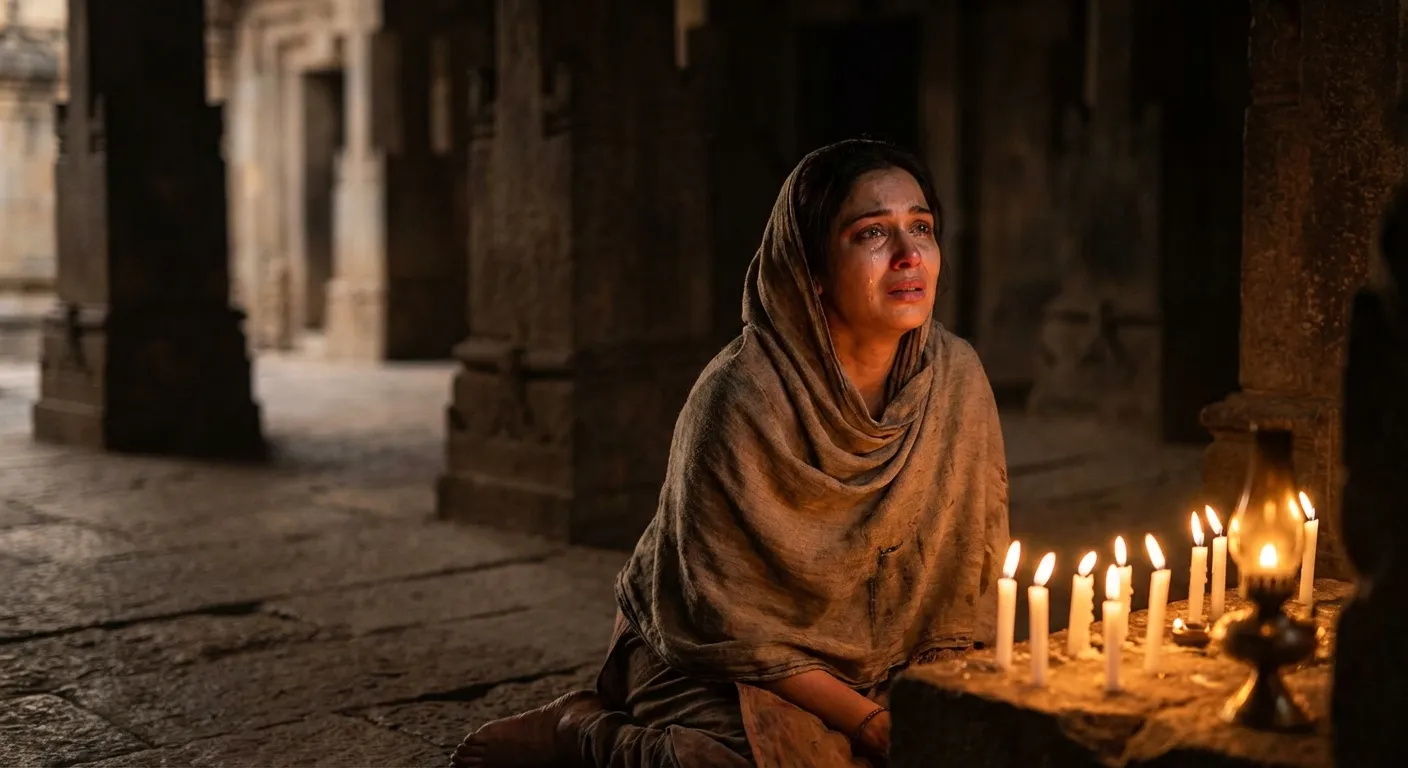
Hannah doesn’t organize her thoughts. She doesn’t find the right words. She doesn’t compose herself first. She walks into the tabernacle — the holiest place she knows — and she falls apart.
Now Hannah spoke in her heart. Only her lips moved, but her voice was not heard. Therefore Eli thought she was drunk.
Her pain was so deep it bypassed language. She was praying, but no sound came out. Just her lips moving, tears streaming, her whole body shaking with a grief she’d carried for years.
This is important. Some of the most powerful prayers ever prayed had no words.
Paul describes this phenomenon in Romans:
In the same way, the Spirit also helps our weaknesses, for we don’t know how to pray as we ought. But the Spirit himself makes intercession for us with groanings which can’t be uttered.
Hannah’s prayer was a wordless groan. It was the kind of prayer you pray when you’ve run out of scripts, run out of theology, run out of patience, and all that’s left is the raw, unfiltered truth of what you feel.
And God heard every syllable she didn’t say.
Reflection Questions
- Do you believe God hears the prayers you can’t articulate? The ones that are just tears, or sighs, or silence?
- When was the last time you stopped editing your prayers and just let God see the mess?
The Priest Who Got It Wrong
This is where the story gets infuriating.
⚠️ Could not parse scripture reference: "1 Samuel 1:12b-14"
The high priest of Israel — the man whose literal job was to stand between God and broken people — looked at the most sincere prayer happening in that tabernacle and called it drunkenness.
Let that land.
The spiritual leader couldn’t tell the difference between a woman consumed by wine and a woman consumed by God. He saw desperation and assumed the worst. He saw tears and reached for judgment instead of compassion.
This is what happens when religious leadership loses touch with raw faith. Eli was so accustomed to ritual — to the proper forms, the right words, the expected behaviors — that when genuine, gut-wrenching prayer showed up in his house of worship, he didn’t recognize it.
How many Hannahs have walked into churches and been misread? How many people pouring out their hearts to God have been told they’re doing it wrong, being too emotional, making a scene?
Hannah’s response is stunning in its composure:
Hannah answered, “No, my lord, I am a woman of a sorrowful spirit. I have not been drinking wine or strong drink, but I poured out my soul before Yahweh. Don’t consider your servant a wicked woman; for I have been speaking out of the abundance of my complaint and my provocation.”
“I was pouring out my soul to the LORD.” That phrase — pouring out — is the Hebrew word shaphak. It means to spill, to dump, to empty completely. The same word is used for pouring out blood at the base of the altar (Leviticus 4:7). Hannah wasn’t offering God a curated highlight reel. She was bleeding out on the altar floor.
And here’s what’s remarkable: she didn’t leave. She didn’t say, “Fine, if the priest thinks I’m drunk, I’ll just go pray at home.” She corrected him, stood her ground, and kept worshiping.
Sometimes the biggest obstacle between you and God isn’t your sin — it’s other people’s opinions about how you should approach Him.
Reflection Questions
- Have you ever been misunderstood while trying to be vulnerable with God? How did it affect your prayer life?
- Are there people in your life who are “pouring out their souls” in ways that look messy? How can you respond like God instead of responding like Eli?
The Vow Hidden Inside Her Prayer
Here’s the part of Hannah’s prayer that most people skip too quickly:
She vowed a vow, and said, “Yahweh of Armies, if you will indeed look at the affliction of your servant and remember me, and not forget your servant, but will give to your servant a boy, then I will give him to Yahweh all the days of his life, and no razor shall come on his head.”
Read that again. Hannah is asking God for the one thing she wants more than anything in the world. And in the same breath, she promises to give it back.
This isn’t a transaction. This is surrender.
Hannah isn’t bargaining — “Give me a son and I’ll tithe more.” She’s saying: The thing I want most — if You give it to me, I’ll dedicate it entirely to You. He won’t be mine. He’ll be Yours.
The “no razor” clause is a Nazirite vow (Numbers 6:1-8) — a life set apart for God from birth. Hannah is promising that her son won’t just attend temple on holidays. He’ll live there. She’ll nurse him, wean him, and then hand him over to serve God in the tabernacle for the rest of his life.
Think about what that means practically. In a culture where children were your security, your legacy, your identity — Hannah is offering to surrender the very thing that would finally give her standing. She’s saying: I want God’s purposes more than I want my own comfort.
This is the same posture Abraham showed on Mount Moriah. The same posture Mary showed in Nazareth. The willingness to hold your deepest desire with open hands and say: Not my will, but Yours.
He who seeks his life will lose it; and he who loses his life for my sake will find it.
Reflection Questions
- What’s the thing you want most from God right now? Could you pray Hannah’s prayer over it — “If You give it to me, I’ll give it back to You”?
- Where are you holding something so tightly that you’ve made it an idol instead of an offering?
- What does “open-handed living” look like practically in your season?
The Shift
After Hannah explains herself, something changes:
Then Eli answered, “Go in peace; and may the God of Israel grant your petition that you have asked of him.” She said, “Let your servant find favor in your sight.” So the woman went her way and ate; and her facial expression wasn’t sad any more.
Wait. Nothing has changed yet. She’s not pregnant. She doesn’t have a son. Eli didn’t perform a miracle. He just said, “Go in peace.”
But Hannah’s face changed. She ate. She was no longer downcast.
What happened? The answer matters more than almost anything else in this story.
Hannah had transferred the weight. She’d been carrying this burden alone — through years of mocking, through well-meaning husbands, through silent meals and tear-soaked pilgrimages. And in that moment at the tabernacle, she didn’t receive an answer. She released the question.
This is what real surrender looks like. Not getting what you want and then feeling peace. Feeling peace before you get what you want because you’ve placed it in hands bigger than yours.
The psalmist knew this:
Cast your burden on Yahweh and he will sustain you. He will never allow the righteous to be moved.
For the Chief Musician. A Psalm by David. I waited patiently for Yahweh. He turned to me, and heard my cry. He brought me up also out of a horrible pit, out of the miry clay. He set my feet on a rock, and gave me a firm place to stand.
Peter echoed it centuries later:
casting all your worries on him, because he cares for you.
Hannah didn’t get her answer at the altar. She got something better — she got free. Free from the obsession. Free from the bitterness. Free from the need to control the outcome. She put it in God’s hands and she left it there.
And then — only then — did God move.
They rose up in the morning early and worshiped Yahweh, then returned and came to their house to Ramah. Then Elkanah knew Hannah his wife; and Yahweh remembered her. When the time had come, Hannah conceived, and bore a son; and she named him Samuel, saying, “Because I have asked him of Yahweh.”
“The LORD remembered her.” Not because He’d forgotten. But because the time was right. The surrender was complete. And the vessel was ready.
The name Samuel means “heard by God” or “asked of God.” Every time she called her son’s name, she was testifying: God heard me. God answered me. God remembered me.
Reflection Questions
- Have you ever experienced peace before the answer came? What made that possible?
- Is there a burden you’ve been carrying that you need to release — not because you don’t care, but because you trust the One who does?
- What would your life look like if you lived as though God had already said “yes” to His best for you?
The Follow-Through That Proves It Was Real
Here’s where Hannah becomes extraordinary, even by biblical standards.
She keeps her vow.
When she had weaned him, she took him up with her, with three bulls, and one ephah of meal, and a container of wine, and brought him to Yahweh’s house in Shiloh. The child was young. They killed the bull, and brought the child to Eli. She said, “Oh, my lord, as your soul lives, my lord, I am the woman who stood by you here, praying to Yahweh. I prayed for this child, and Yahweh has given me my petition which I asked of him. Therefore I have also given him to Yahweh. As long as he lives he is given to Yahweh.” He worshiped Yahweh there.
Scholars estimate Samuel was around three years old. Hannah nursed him, loved him, watched his first steps, heard his first words — and then she walked him to the tabernacle and handed him to the same priest who’d called her a drunk.
She gave back the miracle.
Not because she had to. Not because God would have struck her down. But because she meant what she said. Her prayer wasn’t desperation talking. It was faith.
And notice — she didn’t hand Samuel over with tears and regret. She handed him over with a song.
Hannah’s Song: The Magnificat Before the Magnificat
1 Samuel 2:1-10 is Hannah’s prayer of praise, and it’s one of the most theologically rich songs in the Old Testament. Scholars believe Mary’s Magnificat (Luke 1:46-55) was directly modeled on it.
Hannah prayed, and said, “My heart exults in Yahweh! My horn is exalted in Yahweh. My mouth is enlarged over my enemies, because I rejoice in your salvation. There is no one as holy as Yahweh, for there is no one besides you, nor is there any rock like our God.…”
“Yahweh kills and makes alive. He brings down to Sheol and brings up. Yahweh makes poor and makes rich. He brings low, he also lifts up.…”
He raises up the poor out of the dust. He lifts up the needy from the dunghill to make them sit with princes and inherit the throne of glory. For the pillars of the earth are Yahweh’s. He has set the world on them.
Hannah isn’t just singing about her son. She’s singing about the God who reverses everything. The God who takes the barren woman and makes her the mother of a prophet. The God who takes the dust and turns it into thrones.
And buried in this song is a line that echoes forward through centuries:
He will keep the feet of his holy ones, but the wicked will be put to silence in darkness; for no man will prevail by strength.
This is the thesis statement of the entire Bible. Not by strength. Not by power. Not by what you can produce or perform. By surrender.
Reflection Questions
- When was the last time God answered a prayer and your response was worship rather than just relief?
- Hannah’s song is about reversal — the humble exalted, the proud brought low. Where do you see God doing this in your life or in the world?
What Hannah’s Prayer Produced
Let’s not miss the ripple effect.
Samuel — the son prayed for through tears, surrendered before he was born, raised in the tabernacle — became:
- The last judge of Israel
- The prophet who anointed Saul, Israel’s first king
- The prophet who anointed David, Israel’s greatest king
- The man through whom God transitioned an entire nation from chaos to monarchy
Go back to where we started. Israel was in spiritual free fall. The priesthood was corrupt. “Everyone did as they saw fit.” And God’s rescue plan wasn’t a military campaign or a political revolution.
It was one woman’s desperate prayer.
Hannah didn’t know she was praying for a nation. She thought she was praying for a baby. But God was doing something so much bigger than she could see. Her private pain became the catalyst for public transformation.
This is the pattern of Scripture:
Now to him who is able to do exceedingly abundantly above all that we ask or think, according to the power that works in us,
You have no idea what your desperate, tear-soaked, wordless prayer might produce. The thing you’re begging God for — the healing, the breakthrough, the child, the restoration — you’re seeing one thread. God is weaving a tapestry.
Reflection Questions
- Is there a prayer you’ve given up on because it seems too personal or too small to matter? What if God has generational plans tied to it?
- How does knowing that Hannah’s private grief became Israel’s public salvation change the way you view your own struggles?
Why God Closed Her Womb
We need to circle back to the hardest part of this story.
but he gave a double portion to Hannah, for he loved Hannah, but Yahweh had shut up her womb.
If God is good, why did He cause this? Why years of pain? Why the mockery? Why the tears?
The text doesn’t give us a clean answer. But it gives us a pattern.
God didn’t close Hannah’s womb because He was punishing her. He closed it because the timing mattered. Samuel wasn’t just any child — he was a called child, a Nazirite, a prophet set apart from birth. He needed to be born to a mother who would surrender him completely. And that kind of surrender isn’t manufactured — it’s forged.
Hannah’s years of barrenness weren’t wasted. They were preparation. Every tear taught her dependence. Every year of waiting stripped away self-sufficiency. By the time she walked into that tabernacle, she wasn’t making a deal — she was making a sacrifice. She could give Samuel back because the pain had taught her that God was trustworthy even when He was silent.
This doesn’t make the pain okay. It doesn’t mean God enjoys watching His children suffer. But it means He doesn’t waste it either.
We know that all things work together for good for those who love God, for those who are called according to his purpose.
Count it all joy, my brothers, when you fall into various temptations, knowing that the testing of your faith produces endurance.
The waiting isn’t the absence of God’s plan. Sometimes, the waiting is the plan.
Reflection Questions
- Is there a closed door in your life that might be God’s preparation rather than God’s punishment?
- How has a season of waiting or suffering shaped you in ways that comfort never could?
- Can you trust that God is working even when He’s silent?
This Week’s Practice
Hannah teaches us to pray honestly. This week, try this:
- Monday — Write down the prayer you’re most afraid to pray. The one you’ve been editing for God. Write the raw version. Then pray it.
- Tuesday — Practice “pouring out” — set a timer for 10 minutes. No agenda, no structure. Just talk to God like He’s sitting across from you. Let it be messy.
- Wednesday — Pray Hannah’s prayer of surrender: “God, the thing I want most — if You give it to me, I’ll hold it with open hands. It’s Yours.”
- Thursday — Sit in silence for 10 minutes. No requests. No words. Just be with God. Let the Spirit intercede with “wordless groans” (Romans 8:26).
- Friday — Read Hannah’s song (1 Samuel 2:1-10) out loud. Worship before the answer comes.
- Weekend — Identify one person in your life who might be “pouring out their soul” and looking like a mess. Don’t be Eli. Be present. Listen. Don’t fix. Just witness.
Coming Up Next: The King Who Knelt
Hannah prayed from desperation. Next, we meet a king who prayed from devastation.
David had everything — the throne, the victory, the promise of God. Then he made the worst decision of his life. Adultery. Murder. Cover-up. And when the prophet Nathan cornered him with the truth, David didn’t make excuses. He didn’t spin it. He dropped to his knees and prayed the most gut-wrenching psalm ever written.
Psalm 51 isn’t a prayer of a good man asking for a favor. It’s the prayer of a broken man begging for mercy. And it reveals something shocking about what God actually wants from us — hint: it’s not perfection.
Next: “The King Who Knelt — David’s Prayer That Proves God Doesn’t Want Your Performance”