

"Not My Will" — The Prayer Jesus Struggled to Pray
In a garden, past midnight, Jesus asked His Father if there was another way. The Father didn't answer. Jesus, sweating blood and trembling, prayed three words back: not my will, but yours. This is the prayer the whole series has been building toward. It's the prayer underneath every other dangerous prayer.
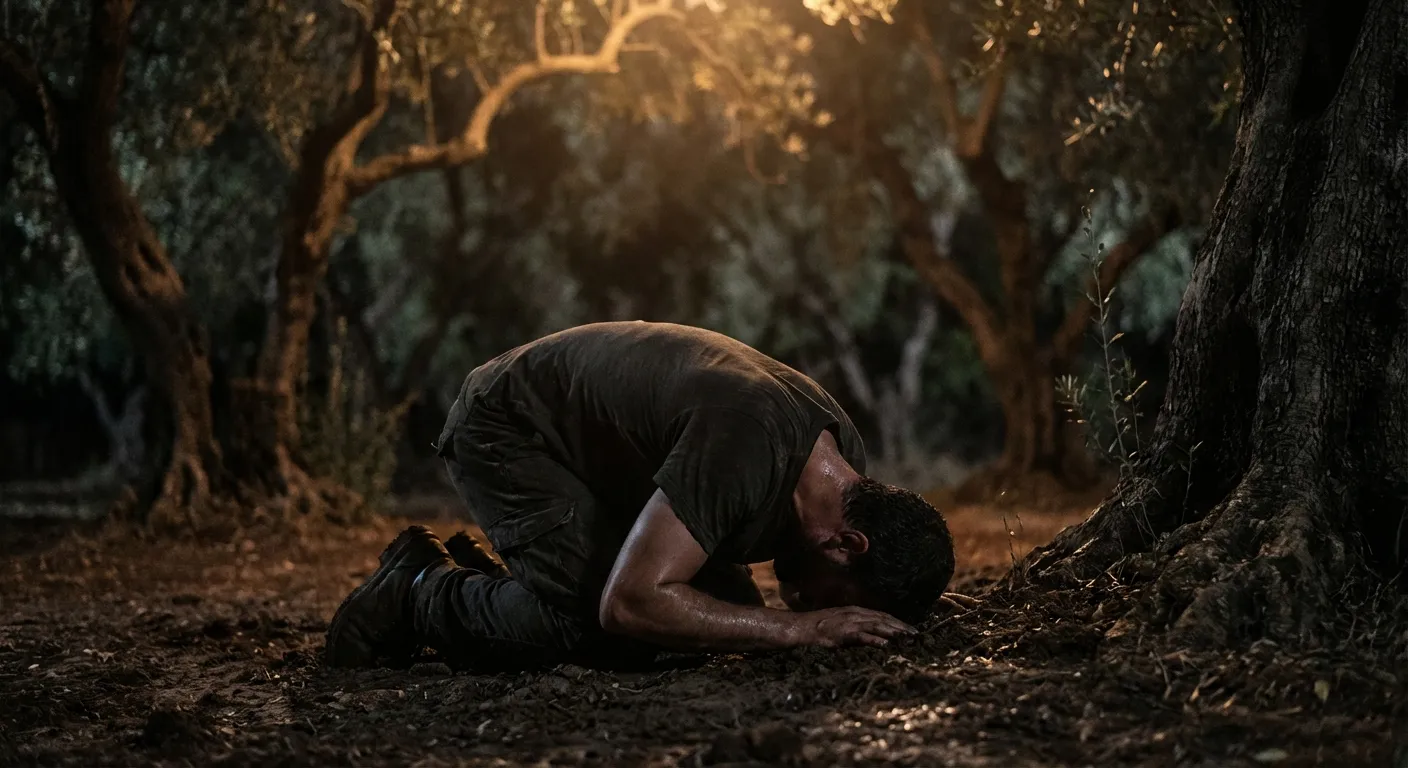
The Night Everything Hinged on Three Words
We’ve been building to this.
“Search me” — let God see everything. “Break me” — let God tear down the walls. “Send me” — let God deploy you wherever He wants. “Whatever it takes” — let God have it all, no conditions attached.
Each prayer costs more than the last. Each one strips away another layer of self. Gideon lost his army. Paul trashed his résumé. Abraham raised a knife over his own son. And at every step, you’ve been invited to pray alongside them — to open your hands a little wider, to trust a little deeper, to release a little more.
But here’s what you need to understand about every prayer in this series: they were all echoes of this one.
Every surrender in Scripture — every costly act of obedience, every moment where a human being chose God’s plan over their own — is a shadow of the night when the Son of God knelt in the dirt, sweating blood, begging His Father for another way, and then said three words that purchased the redemption of the entire human race.
Not my will.
This isn’t the hardest prayer in the series because it costs the most. It’s the hardest because the Person praying it knew — with perfect clarity, down to the molecular level — exactly what it would cost. And He said it anyway.
Before the Garden: The Meal
To understand Gethsemane, you have to understand what happened right before it.
It’s Thursday night. Jerusalem is packed for Passover — hundreds of thousands of pilgrims crammed into a city built for a fraction of that number. Lambs are being slaughtered in the temple. Families are gathered around tables, retelling the story of God’s deliverance from Egypt.
And in an upper room, Jesus is having supper with His twelve closest friends.
He already knows what’s coming. John’s Gospel makes this explicit:
Now before the feast of the Passover, Jesus, knowing that his time had come that he would depart from this world to the Father, having loved his own who were in the world, he loved them to the end.
He knew. Not suspected. Not feared. Knew. He’d been talking about it for months — predicting His death with a specificity that unnerved His disciples. He told them He’d be betrayed, arrested, mocked, spit on, flogged, and killed (Mark 10:33-34). He told them which city it would happen in. He told them He’d rise on the third day.
And they didn’t get it. Every time He said it, they changed the subject, or argued about who would sit at His right hand, or Peter would pull Him aside and rebuke Him for saying something so terrible (Matthew 16:22).
So Jesus sat at that table, looking at the faces of men who didn’t understand what was about to happen, knowing that one of them would betray Him, another would deny Him three times, and all of them would scatter like sheep the moment the wolves showed up.
And what did He do?
He got up from the table, wrapped a towel around His waist, and washed their feet.
The King of the universe, hours from the most agonizing death in human history, knelt on the floor and cleaned the dirt off the toes of the men who would abandon Him before sunrise.
Then He broke bread. Poured wine. Instituted the meal that two billion people still celebrate two thousand years later:
He took bread, and when he had given thanks, he broke and gave it to them, saying, “This is my body which is given for you. Do this in memory of me.” Likewise, he took the cup after supper, saying, “This cup is the new covenant in my blood, which is poured out for you.…”
He was already choosing. Already surrendering. Already walking toward the cross with every word and every gesture. The prayer in Gethsemane wasn’t the beginning of the surrender — it was the culmination. The agonizing, blood-sweating moment where the full weight of what He’d been choosing finally landed on His chest and threatened to crush Him.
The Walk to the Garden
They sang a hymn. Matthew 26:30 — one of the easiest verses to skip, and one of the most devastating.
Jesus sang. Hours from crucifixion, He opened His mouth and sang. Scholars believe it was the Hallel — Psalms 113-118, the traditional Passover hymns. Which means Jesus sang these words on the way to the garden:
Yahweh is on my side. I will not be afraid. What can man do to me?
And:
I will not die, but live, and declare Yah’s works. Yah has punished me severely, but he has not given me over to death.
And:
The stone which the builders rejected has become the cornerstone. This is Yahweh’s doing. It is marvelous in our eyes.
He was singing about Himself. Singing about the rejection. Singing about the death that would become the cornerstone of everything. And then He walked into the night.
He crossed the Kidron Valley — where the blood of the Passover lambs being slaughtered in the temple ran down in a stream — and entered a garden called Gethsemane. The name means “olive press.” The place where olives were crushed until the oil poured out.
The symbolism is not subtle.
The Weight That Almost Killed Him
He took with him Peter, James, and John, and began to be greatly troubled and distressed. He said to them, “My soul is exceedingly sorrowful, even to death. Stay here and watch.”
Read those words slowly. Greatly troubled. Distressed. Exceedingly sorrowful, even to death.
The Greek words Mark uses here are extreme. Ekthambeisthai — to be struck with terror, to be utterly appalled. Adēmonein — to be in anguish, to be so distressed that you can’t find rest. These aren’t words for nervousness or mild anxiety. These are words for someone approaching the breaking point. Words for a soul being crushed under a weight no human psyche was designed to carry.
And then Jesus said: “My soul is exceedingly sorrowful, even to death.”
He was telling His closest friends: I am being killed by grief right now. The sorrow itself is lethal. I’m not speaking metaphorically. My soul is dying.
Luke, the physician, adds the clinical detail that confirms Jesus wasn’t exaggerating:
Being in agony, he prayed more earnestly. His sweat became like great drops of blood falling down on the ground.
This is a medical condition called hematidrosis — the rupturing of capillaries in the sweat glands under extreme psychological distress, causing blood to seep through the skin. It’s rare. It’s documented. It happens when the human body is under a level of stress that the system cannot process.
Jesus was being crushed.
But here’s the question that should stop you: By what?
He hadn’t been arrested yet. He hadn’t been struck. No nails, no thorns, no whips. He was kneeling in a garden, surrounded by olive trees, in the cool night air. Nothing had happened to His body.
Everything was happening to His soul.
What Was He Carrying?
This is where we have to be careful and honest, because the Bible doesn’t give us a simple one-line answer. But Scripture provides enough threads to weave together a picture that should leave you undone.
He was carrying the anticipation of the cross. Not just death — crucifixion. Rome’s most creative expression of cruelty. The flogging that would expose muscle and bone. The thorns pressed into His scalp. The nails through nerve clusters in the wrists and feet. The hours of slow suffocation as His body failed. He knew every detail.
He was carrying isolation. In the history of the Trinity — from before the foundation of the world — the Father, Son, and Spirit had never been separated. Never. An eternal communion of love, deeper than any human relationship, without interruption, without distance, without a single moment of disconnection. And Jesus knew that on the cross, for the first time in all eternity, that communion would break:
About the ninth hour Jesus cried with a loud voice, saying, “Eli, Eli, lima sabachthani?” That is, “My God, my God, why have you forsaken me?”
He was anticipating the un-anticipatable. Separation from His Father. For a human, that’s loneliness. For the Son of God, it was something we don’t have a word for. Something worse than death. Something that made death look like a footnote.
He was carrying sin. Not His own — He had none. But ours:
For him who knew no sin he made to be sin on our behalf, so that in him we might become the righteousness of God.
The spotless Lamb of God — who had never known a moment of guilt, shame, corruption, or moral failure — was about to absorb the sin of every human being who had ever lived or ever would live. Every murder. Every betrayal. Every abuse. Every lie. The full moral wreckage of human history, compressed and concentrated and poured onto the shoulders of the only perfectly innocent person who ever walked the earth.
Isaiah saw it seven hundred years before it happened:
Surely he has borne our sickness and carried our suffering; yet we considered him plagued, struck by God, and afflicted. But he was pierced for our transgressions. He was crushed for our iniquities. The punishment that brought our peace was on him; and by his wounds we are healed.
Pierced. Crushed. Crushed. In the olive press. In Gethsemane.
That’s what was bearing down on Jesus in the garden. Not fear of pain — though pain was coming. Not fear of death — though death was coming. But the convergence of physical agony, cosmic isolation, and the full concentrated weight of human sin pressing on a soul that was utterly, perfectly clean.
And still He knelt. And still He prayed.
The Prayer
He went forward a little, fell on his face, and prayed, saying, “My Father, if it is possible, let this cup pass away from me; nevertheless, not what I desire, but what you desire.”
There it is. The most important sentence ever spoken.
Notice: He fell with His face to the ground. Not kneeling with hands folded. Not sitting contemplatively. He collapsed. Face in the dirt. The Son of God, prostrate on the earth He created, begging.
And the prayer has two parts. You cannot understand it if you only hear one of them.
Part one: “If it is possible, let this cup pass away from me.”
Jesus asked to be spared.
Let that sink in. He didn’t walk to Gethsemane with stoic resignation. He didn’t arrive already at peace. He asked God if there was another way. He asked if the cup — the cup of God’s wrath against sin, the cup of crucifixion, the cup of separation — could pass away from Him.
This was not a rhetorical question. This was not a performance of humanity for our benefit. This was the honest, desperate, agonized prayer of a Person who did not want to drink what was in front of Him. Who wanted — with every fiber of His being — for there to be a Plan B.
Mark’s account is even more raw:
He said, “Abba, Father, all things are possible to you. Please remove this cup from me. However, not what I desire, but what you desire.”
Abba. Daddy. Papa. The most intimate possible address. Not “Almighty God.” Not “Lord of Hosts.” Abba. A son crying out to his father in the dark.
And notice: “All things are possible to you.” Jesus wasn’t doubting God’s power. He was affirming it. You can do this. You can remove this cup. You can find another way. You’re omnipotent. You’re infinite. You spoke the universe into existence with a word. Surely — surely — there’s a path to redemption that doesn’t run through Golgotha.
This is the honest half of “not my will.” The half that doesn’t get printed on coffee mugs. The half that says: I don’t want this. This is going to destroy me. I’m asking — begging — for another option.
Part two: “Yet not what I desire, but what you desire.”
And there it is. The hinge of history. The three words that changed everything.
Not my will. Yours.
Not my preference. Yours. Not my comfort. Yours. Not my plan, my timing, my method, my escape route. Yours. I’ve told You what I want. I’ve laid bare the deepest desire of my heart. And now I’m subordinating all of it — every fear, every preference, every survival instinct — to Your purpose.
Because You see what I can’t. You know what I don’t. And even if this cup is the worst thing that has ever happened or will ever happen in the history of the cosmos — if it’s Your will, then Your will is enough.
Three Times
He didn’t pray it once.
Again, a second time he went away and prayed, saying, “My Father, if this cup can’t pass away from me unless I drink it, your desire be done.”
Notice the shift. The first time: “If it is possible, let this cup pass away from me.” The second time: “If this cup can’t pass away from me unless I drink it…” He’s already accepting the answer. Already moving from petition to submission. Already letting the “not my will” expand until it fills the whole prayer.
He left them again, went away, and prayed a third time, saying the same words.
Three times. Like Peter’s three denials in reverse. Like God’s three-fold call to Samuel. Like the three days in the tomb. Three times Jesus knelt in the dirt and fought the hardest battle ever fought — not against Rome, not against the Pharisees, not against Satan directly — but against the natural human desire to avoid suffering.
And three times, He chose surrender.
This is what the other four prayers in this series were pointing toward. This is their source, their root, their reason. “Search me” works because Jesus submitted to the Father’s searching gaze. “Break me” works because Jesus let Himself be broken. “Send me” works because Jesus said “here am I” before Isaiah ever did. “Whatever it takes” works because Jesus looked at the cost — the full, unthinkable, cosmos-shaking cost — and said yes.
Every dangerous prayer you’ll ever pray is a tributary feeding into this river. Every act of Christian surrender is a faint echo of this moment in this garden on this night.
The Silence of the Father
Here’s the part nobody talks about.
Jesus prayed three times. And the Father never answered.
Matthew doesn’t record a voice from heaven. Mark doesn’t. Luke mentions an angel appearing to strengthen Him (Luke 22:43), but no words. No “This is the only way, Son.” No “I know it hurts, but here’s why.” No explanation. No comfort. No promise that it would be worth it.
Just silence.
And Jesus said yes into the silence.
This matters more than you might think. Because most of us can handle obedience when it comes with explanation. We can surrender when God tells us why. We can accept suffering when we can see the purpose, trace the logic, understand the plan.
But what about when He’s silent?
What about when you’re on your face in your own Gethsemane — a diagnosis, a betrayal, a loss that makes no sense — and you’re begging God for an explanation, and heaven is quiet? What about when you’ve prayed three times and the cup hasn’t moved and God hasn’t said a word?
Jesus shows you what to do with silence: you trust the character of the One who isn’t speaking.
He didn’t need the Father to explain the plan. He knew the Father’s heart. He’d known it from eternity. And He trusted — in the darkest, loneliest, most agonizing moment any being has ever experienced — that a good Father doesn’t ask for this unless this is the path to something unspeakably beautiful on the other side.
looking to Jesus, the author and perfecter of faith, who for the joy that was set before him endured the cross, despising its shame, and has sat down at the right hand of the throne of God.
There was joy on the other side. There was resurrection. There was redemption. There was a bride — the Church — ransomed from death. There were billions of people across millennia who would hear the gospel and be saved because one night, in one garden, one Man said “not my will.”
But in the garden, He couldn’t see the joy. He could only feel the cup.
And He drank it anyway.
What “Not My Will” Actually Means
Let’s be clear about what this prayer is and isn’t.
It is not passivity. Jesus wasn’t saying “whatever happens, happens.” He wasn’t shrugging. He was actively, deliberately, agonizingly choosing the Father’s will over His own. That’s not passivity. That’s the most intense act of the will ever performed.
It is not fatalism. Fatalism says “nothing I do matters.” Jesus says “everything I do matters — and what matters most is that I align my will with the Father’s, even when the Father’s will includes a cross.” This is the opposite of fatalism. This is a Person who knows their choice will change the course of history, and chooses faithfulness.
It is not the absence of desire. Jesus wanted the cup to pass. He said so. Three times. “Not my will” doesn’t mean “I don’t have a will” or “my desires don’t matter.” It means: I have desires, and they’re real, and they’re strong — but Your purpose is more important than my preferences.
It is not a one-time event. Jesus modeled what the Christian life actually looks like: a repeated, daily, sometimes hourly choice to subordinate your will to God’s. Some days it’s easy. Some days it’s Gethsemane. But the prayer is the same: not my will, but Yours.
This is what Paul meant when he wrote:
I have been crucified with Christ, and it is no longer I who live, but Christ lives in me. That life which I now live in the flesh, I live by faith in the Son of God, who loved me and gave himself up for me.
Crucified with Christ. The “not my will” prayer lived out in daily practice. Dying to self — to preferences, to comfort, to control — and trusting that what rises in its place is something far more alive than what you laid down.
The Prayers That Changed the World
This series started with a question: What would happen if you actually prayed prayers that could wreck your comfortable faith?
Now you have the answer. Look at what happened when these prayers were prayed:
“Search me, O God” — David wrote Psalm 139 and invited God to expose what was hidden. The result: the psalms of repentance that have guided millions of broken people back to God for three thousand years.
“Break me” — David prayed Psalm 51 after his worst failure. The result: the most honest prayer in the Bible became the template for every person who’s ever needed to start over.
“Send me” — Isaiah saw God on His throne and volunteered for the mission. The result: a prophetic ministry that would point to the Messiah with a precision that still converts skeptics today.
“Whatever it takes” — Gideon, Paul, and Abraham released everything into God’s hands. The result: a military victory that defied mathematics, a theology that reshaped civilization, and a faith so deep it became the template for trusting God when nothing makes sense.
“Not my will” — Jesus sweat blood in a garden and chose the cross. The result: the salvation of the human race.
That’s what dangerous prayers do. They don’t wreck your life. They wreck your smallness. They tear down the tiny, self-protective, safety-first version of faith that you’ve been living in and replace it with something that actually looks like the kingdom of God — costly, beautiful, free, and world-changing.
Your Turn
You’ve read five prayers. You’ve walked through Scripture with people who prayed them. You’ve watched God respond — not by making life comfortable, but by making it meaningful.
Now what?
You can close this and go back to safe prayers. “Bless this food.” “Help me have a good day.” “Be with us.” There’s nothing wrong with those prayers. They’re fine. They’re just small.
Or you can kneel.
You can get on your face — literally or figuratively — and pray the way Jesus prayed. Honest about what you want. Submitted to what God wants. Holding nothing back, demanding nothing in return, trusting that the Father who didn’t spare His own Son will not abandon you in whatever garden you’re kneeling in tonight.
The five dangerous prayers, in order, form a single movement of the soul:
- Search me — God, see me as I really am.
- Break me — God, remove what’s in the way.
- Send me — God, I’m available.
- Whatever it takes — God, I’m holding nothing back.
- Not my will — God, I trust You with the outcome.
They build on each other. You can’t honestly pray “not my will” if you haven’t first let God search you, break you, commission you, and clear your hands. And you can’t pray “search me” if you’re not willing to let the process continue all the way to Gethsemane.
But if you pray all five — honestly, repeatedly, as a rhythm of your life — something will shift. Not because the words are magic. But because a person who regularly surrenders their will to God’s is a person God can actually use. A person whose hands are open. A person who has stopped trying to write their own story and started trusting the Author who’s been writing a better one all along.
A Final Prayer
Father,
I’ve been reading about dangerous prayers. And honestly? I’m scared. The cost is real. The surrender is not theoretical. You’re not asking for my words — You’re asking for my will.
But I’ve seen what happens when people say yes to You. I’ve seen armies routed. I’ve seen résumés turned to rubbish. I’ve seen a son walk off an altar alive. And I’ve seen Your own Son walk out of a tomb.
So here I am. Not confident in my own strength — I have none. Not confident in my own faith — it wavers more than I’d like to admit. But confident in You. In Your character. In Your track record. In the fact that You’ve never asked anyone to give up something without giving back something immeasurably greater.
Search me. Break me. Send me. Whatever it takes.
Not my will, but Yours.
I don’t know what that means for tomorrow. I don’t know what cup You’ll hand me or what garden You’ll lead me to. But I know who You are. And that’s enough.
It was enough for Jesus. It’s enough for me.
Amen.
Reflection Questions
-
Jesus asked three times for the cup to be taken. Have you ever prayed for something repeatedly and been met with silence? How did you respond — and how would you respond differently now?
-
Jesus said “Abba” — the most intimate name for God — in His darkest moment. When you’re in pain, does your prayer language become more intimate or more distant? What does that reveal about how you see God in suffering?
-
“Not my will” doesn’t mean “I don’t have a will.” Jesus was honest about wanting the cup to pass. How does Jesus’ honesty in prayer give you permission to be honest with God about your own desires — even when you’re choosing to surrender them?
-
The Father was silent in Gethsemane. Jesus trusted His Father’s character when He couldn’t hear His Father’s voice. Is there an area of your life where God seems silent right now? What would it look like to trust His character in that silence?
-
Looking at the five dangerous prayers together — search me, break me, send me, whatever it takes, not my will — which one is hardest for you right now? Why? What would it look like to start there this week?
This is Part 5 of the Dangerous Prayers series. If you missed the earlier parts, start with Part 1: “Search Me, O God”.
Next: “Open My Eyes” — The Prayer Elisha Prayed for a Servant Who Thought He Was Surrounded — Elisha’s servant saw an army. Elisha saw the hills on fire. This final prayer doesn’t change your circumstances. It changes what you can see.