

Forgotten in a Dungeon — What God Does When Nobody Remembers Your Name
Joseph did the right thing and ended up in prison. He helped a stranger and got forgotten for two more years. His story proves something most of us are afraid to believe: God does His best work in the places no one can see.
Part 2: The Address Nobody Puts on a Résumé
There’s a version of Joseph’s story that gets taught in Sunday School, and it goes like this: favorite son, colorful coat, jealous brothers, pit, Egypt, Potiphar’s house, prison, dreams, Pharaoh, power. A clean arc from suffering to success with a bow on top.
But here’s what that tidy version leaves out: the duration.
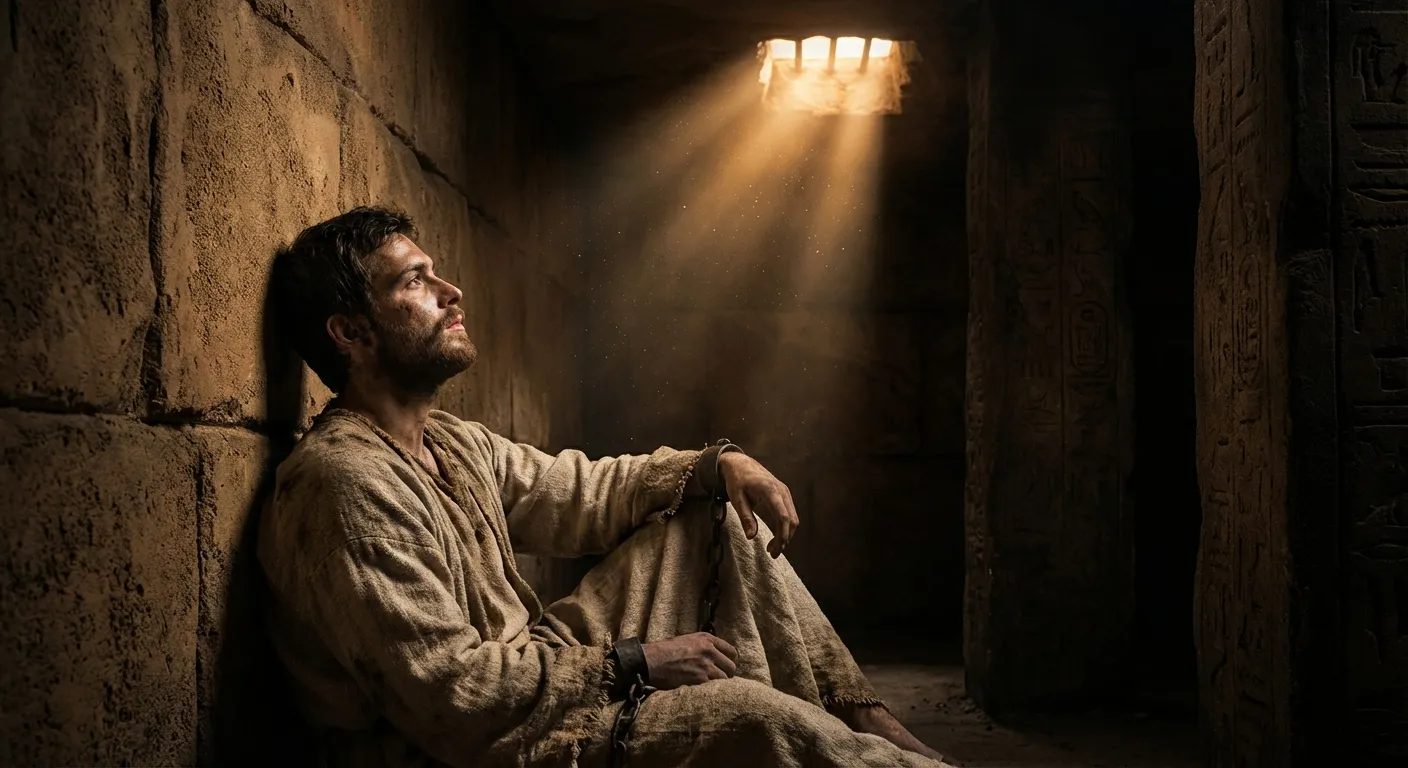
Joseph didn’t pass through prison like a layover between flights. He lived there. For years. Forgotten. Unnamed. A Hebrew slave in an Egyptian hole, with no lawyer, no appeal, and no indication that anyone — on earth or in heaven — was coming for him.
If Abraham’s waiting season was a slow burn in the desert, Joseph’s was a suffocation in the dark.
And what God built in that darkness is the reason millions of people survived a famine.
The Setup Nobody Talks About
Before we get to the dungeon, we need to understand what Joseph walked in with — because what you carry into the dark determines what comes out the other side.
Joseph was seventeen when his brothers threw him into a cistern and sold him to slave traders headed for Egypt (Genesis 37:2, 28). Seventeen. A kid. Still processing a father’s favoritism, still figuring out what those strange dreams meant, still young enough to believe the world was basically fair.
In one afternoon, he learned it wasn’t.
But here’s what Genesis 39 tells us happened next — and it’s easy to read past this, but don’t:
Yahweh was with Joseph, and he was a prosperous man. He was in the house of his master the Egyptian. His master saw that Yahweh was with him, and that Yahweh made all that he did prosper in his hand. Joseph found favor in his sight. He ministered to him, and Potiphar made him overseer over his house, and all that he had he put into his hand.
Sold into slavery. Ripped from his family. Shipped to a foreign country where he didn’t speak the language, didn’t know the customs, and had zero rights.
And the LORD was with him.
Not “the LORD rescued him.” Not “the LORD brought him home.” The LORD was with him in the wrong place. In the house of a man named Potiphar, doing work he never chose, in a life he never asked for.
Joseph didn’t just survive Potiphar’s house — he thrived. He was put in charge of everything. Every field, every servant, every account. Potiphar stopped worrying about anything except what he was having for dinner (Genesis 39:6).
You’d think this was God’s redemption story wrapping up. Sold into slavery, but rose to the top. Credits roll.
That’s not what happened.
The Cost of Doing the Right Thing
Potiphar’s wife wanted Joseph. The text is blunt about it:
After these things, his master’s wife set her eyes on Joseph; and she said, “Lie with me.”
Day after day, she pressed. And day after day, Joseph refused. His reason is one of the most theologically loaded sentences in the Old Testament:
“…No one is greater in this house than I am, and he has not kept back anything from me but you, because you are his wife. How then can I do this great wickedness, and sin against God?”
Not “sin against Potiphar.” Not “ruin my career.” Sin against God.
Joseph, in a pagan country, enslaved, separated from every person who shared his faith — still oriented his entire moral compass around a God he couldn’t see and who, from all appearances, had let his life fall apart.
And then she grabbed his cloak, he ran, and she told everyone he’d attacked her.
Joseph did the right thing. The exact right thing. And it cost him everything he’d rebuilt.
Joseph’s master took him, and put him into the prison, the place where the king’s prisoners were bound, and he was there in custody.
Let that timeline hit you: Sold into slavery. Built a life from nothing. Did the morally right thing. Lost it all again. Thrown into a dungeon.
If you’ve ever done the right thing and watched it blow up in your face — if you’ve ever been honest when lying would have been easier, faithful when compromise would have been safer, obedient when disobedience would have been painless — Joseph is your patron saint.
The Dungeon Years
And then, for the second time in Genesis, the same sentence appears:
Joseph’s master took him, and put him into the prison, the place where the king’s prisoners were bound, and he was there in custody. But Yahweh was with Joseph, and showed kindness to him, and gave him favor in the sight of the keeper of the prison.
Same God. Same presence. Different pit.
Joseph rose again. The warden put him in charge of the other prisoners. He ran the prison the way he’d run Potiphar’s house — with excellence, with integrity, with a quiet competence that people couldn’t help but notice.
But he was still in prison. And nobody was coming.
This is the part of the waiting season that breaks people. Not the initial crisis — humans are surprisingly good at handling acute pain. It’s the chronic nature of it. The morning after morning of waking up in the same cell. The slow erosion of hope that happens not in a single moment but across hundreds of ordinary, identical, airless days.
The Bible compresses Joseph’s prison years into a few paragraphs. Our brains compress them into a few seconds of reading. But Joseph lived them. Every hour. Every meal. Every night on a stone floor wondering if this was the rest of his life.
The Hope That Almost Was
Then, a flicker.
Two of Pharaoh’s officials — his cupbearer and baker — ended up in Joseph’s prison, and both had dreams they couldn’t interpret. Joseph could. He read the cupbearer’s dream accurately: in three days, you’ll be restored to your position (Genesis 40:12-13).
And then Joseph made a request. One request. The only thing he ever asked for himself in the entire narrative:
“…But remember me when it is well with you. Please show kindness to me, and make mention of me to Pharaoh, and bring me out of this house. For indeed, I was stolen away out of the land of the Hebrews, and here also I have done nothing that they should put me into the dungeon.”
Remember me.
Two words that contain an ocean of desperation. Joseph wasn’t asking for wealth or revenge or vindication. He was asking to be remembered. To not be invisible. To matter to someone on the other side of the wall.
The cupbearer was restored, exactly as Joseph predicted.
And then:
Yet the chief cup bearer didn’t remember Joseph, but forgot him.
He forgot him.
One verse. Nine words in English. Two more years of Joseph’s life erased in a single sentence.
What Two Years of Being Forgotten Feels Like
We need to sit here for a minute, because the Bible doesn’t, and we owe Joseph that much.
Two years. After doing the right thing. After accurately interpreting a dream that proved he had a gift from God. After one request — just remember me — the man walked out of prison, went back to the palace, and never thought about Joseph again.
Seven hundred and thirty days of silence after the closest thing to hope he’d had in years.
I wonder what day three hundred felt like. I wonder if Joseph replayed the conversation, wondering if he’d said something wrong. I wonder if day five hundred brought a numbness that felt worse than the pain. I wonder if somewhere around day six hundred, Joseph had a conversation with God that sounded a lot like Abraham’s: What’s the point?
Scripture doesn’t tell us. What it tells us is what it’s told us twice already: the LORD was with Joseph.
Not fixing it. Not explaining it. Not rushing it. With him.
There is a kind of divine faithfulness that doesn’t look like intervention. It looks like presence. And for Joseph, in a dungeon, forgotten by the one person who could have helped — presence was all there was.
Why God Didn’t Speed It Up
Here’s the question that honest readers ask: Why? Why did God let Joseph rot in prison for two extra years after the cupbearer forgot? God could have nudged the man’s memory. God could have sent Pharaoh a dream two years earlier. God controls the timeline — why the delay?
I don’t think we get a clean answer. But I think Genesis gives us clues.
The timing wasn’t about Joseph alone. Pharaoh’s dreams came when they came because the famine was coming when it was coming. Joseph needed to be in position at the exact moment when his gift could save not just Egypt, but his own family — the family that would become the nation of Israel. The two-year delay wasn’t about Joseph’s punishment. It was about the alignment of a hundred moving pieces across an entire region.
Joseph needed to reach the end of his own ability to fix it. After the cupbearer left, Joseph had no more plays. No more connections. No more plans. He was completely, utterly dependent on God. And that’s exactly where God could use him — not as a man with a strategy, but as a man with nothing left but faith.
Psalm 105:19 describes this season with surgical precision:
until the time that his word happened, and Yahweh’s word proved him true.
Tested. Not punished. Not forgotten. Tested. The dungeon was a refining fire, and what was being burned away was every last trace of self-reliance that would have gotten in the way of what God was about to do.
The Morning Everything Changed
Genesis 41:1 — “When two full years had passed, Pharaoh had a dream.”
Two full years. Not a day less. God’s timing has a precision that looks like cruelty from inside the waiting but looks like choreography from the outside.
Pharaoh dreamed of seven fat cows devoured by seven thin cows. Seven full heads of grain swallowed by seven withered ones. His magicians couldn’t interpret it. His wise men were useless.
And then the cupbearer remembered.
Then the chief cup bearer spoke to Pharaoh, saying, “I remember my faults today. … There was with us there a young man, a Hebrew, servant to the captain of the guard, and we told him, and he interpreted to us our dreams. He interpreted to each man according to his dream.…”
Joseph was cleaned up, shaved, given new clothes, and brought before the most powerful man in the world. And when Pharaoh said, “I hear you can interpret dreams,” Joseph gave an answer that reveals everything about what those dungeon years had produced:
Joseph answered Pharaoh, saying, “It isn’t in me. God will give Pharaoh an answer of peace.”
I cannot do it.
The seventeen-year-old who told his brothers about his grandiose dreams might have said, “I’m the best dream interpreter in the Ancient Near East.” The man who ran Potiphar’s house might have leveraged the moment for a deal. But the man who walked out of a dungeon after thirteen years of waiting said the only thing that was true: I can’t. But God can.
That’s what the waiting produced. Not bitterness. Not self-promotion. Not desperation. A man who had been emptied of himself and filled with a bone-deep trust that God was the one doing the work.
Joseph interpreted the dreams. Seven years of abundance, followed by seven years of devastating famine. He laid out a plan so comprehensive that Pharaoh looked at his advisors and said:
Pharaoh said to his servants, “Can we find such a one as this, a man in whom is the Spirit of God?”
In one day, Joseph went from prisoner to Prime Minister. From forgotten to second-in-command of the most powerful empire on earth. From a man nobody remembered to the man everyone depended on.
He was thirty years old (Genesis 41:46). Thirteen years after his brothers threw him in a pit. More than a decade of slavery, false accusations, prison, and silence.
And every single day of it was preparation.
What the Dungeon Teaches Us
Joseph’s story doesn’t promise that your waiting will end the way his did. Not everyone becomes Prime Minister. But his story reveals something about the nature of divine waiting that applies to every person sitting in their own kind of dungeon:
1. God’s presence doesn’t always mean God’s intervention. Three times, Genesis says “the LORD was with Joseph.” Not once does it say “the LORD removed Joseph from his circumstances.” God’s with-ness and God’s rescue are not the same thing, and sometimes you get the first long before you get the second. That doesn’t mean you’ve been abandoned. It means you’re being accompanied through something that has a purpose you can’t see yet.
2. Faithfulness in obscurity is the training ground for influence. Joseph ran Potiphar’s house with excellence. He ran the prison with excellence. He didn’t wait for a worthy stage to perform on. He brought his best to every room he was placed in, even the ones with bars on the windows. The man who was faithful with a prisoner’s trust was ready for a Pharaoh’s.
He who is faithful in a very little is faithful also in much. He who is dishonest in a very little is also dishonest in much.
3. Being forgotten by people doesn’t mean being forgotten by God. The cupbearer forgot. But God didn’t. Psalm 105 makes it clear that God was the one managing the timeline — not the cupbearer, not Pharaoh, not Joseph’s own efforts. The human who was supposed to remember you might forget. The system that was supposed to promote you might overlook you. But the God who placed you where you are is incapable of forgetting.
“Can a woman forget her nursing child, that she should not have compassion on the son of her womb? Yes, these may forget, yet I will not forget you! Behold, I have engraved you on the palms of my hands. Your walls are continually before me.…”
4. The delay is not the denial. Two years of silence after the cupbearer left didn’t mean God had changed His mind. It meant the stage wasn’t set yet. When you’re in month six or year two or decade three of waiting, the absence of movement is not evidence of absence. Sometimes the most important things God is doing are the things you cannot yet see.
Reflect
-
Where do you feel “forgotten in a dungeon” right now? Is there a place where you did the right thing and it cost you — where you’re waiting for someone to remember you, notice you, or vindicate you? Name it honestly.
-
How are you showing up in your current “prison”? Joseph didn’t stop being excellent just because his circumstances were unjust. Are you bringing your best to the room you’re in — even if it’s not the room you chose?
-
Who is your “cupbearer”? Is there someone you’ve been counting on to open a door for you? What would it look like to transfer that expectation from a person to God — to say, “Even if they forget, You won’t”?
-
Read Genesis 41:16 again. “I cannot do it, but God will give Pharaoh the answer.” What would your version of that sentence sound like? Where do you need to stop saying “I can do this” and start saying “I can’t — but God can”?
-
What might God be aligning while you wait? Joseph couldn’t see the famine coming. He couldn’t see Pharaoh’s dreams. He couldn’t see the hundred moving pieces God was orchestrating. What might be happening on the other side of your wall that you simply can’t see yet?
Coming Up Next
Abraham waited in the desert. Joseph waited in a dungeon. But in Part 3, we’ll meet a man who waited in the most unlikely place of all — the backside of nowhere. He spent forty years herding sheep after growing up in a palace, and he was absolutely convinced God had passed him by.
His name was Moses. And the bush that burned without burning down was God’s way of saying: I’ve been getting you ready this whole time.