

The Man Who Waited 40 Years for a Job He Never Applied For — What a Burning Bush Teaches About God's Timing
Moses grew up in a palace, killed a man trying to be a hero, and then spent four decades herding sheep in the middle of nowhere. He was 80 years old when God finally showed up — and what God said rewrites everything you think you know about wasted years.
Part 3: The Longest Demotion in History
If Abraham’s waiting looked like a slow burn in the desert, and Joseph’s looked like suffocation in a dungeon, then Moses’ waiting looked like something even harder to endure.
It looked like nothing happening at all.
No dramatic reversal. No false hope. No cupbearer who forgot. Just sand, sheep, and forty years of sunrise-to-sunset monotony in a place so remote the ancient world didn’t bother putting it on a map.
Moses didn’t wait in a pit or a prison. He waited in irrelevance. And for a man who grew up as royalty in the most advanced civilization on earth, irrelevance might have been the cruelest cell of all.
The Prince Who Had Everything
To understand what Moses lost, you have to understand what he had.
The book of Exodus opens with a genocide. Pharaoh, terrified of the growing Hebrew population, ordered every newborn Hebrew boy thrown into the Nile (Exodus 1:22). Moses’ mother hid him for three months, then did the most desperate, brilliant, faithful thing a mother has ever done — she put him in a basket and floated him into the reeds along the riverbank.
Pharaoh’s daughter found him. And the God who orchestrates impossible ironies arranged for Moses’ own mother to be hired as his nursemaid (Exodus 2:5-10).
So Moses grew up in the palace. Pharaoh’s palace. Not as a servant — as a grandson.
The book of Acts fills in what Exodus leaves sparse:
Moses was instructed in all the wisdom of the Egyptians. He was mighty in his words and works.
Powerful in speech and action. That phrase carries more weight than it seems. Egyptian education at this level meant mathematics, astronomy, military strategy, law, languages, architecture, and administration. Moses didn’t just live in the palace — he was trained to run things. He was, by any worldly measure, one of the most qualified men alive.
He had wealth, status, education, power, and access. He had a name that meant something. He had a future that most people couldn’t dream of.
And he threw it all away in a single afternoon.
The Murder That Changed Everything
Somewhere along the way, Moses learned the truth about who he was. He knew he was Hebrew. He knew his people were slaves. And at age forty, something inside him broke.
In those days, when Moses had grown up, he went out to his brothers and saw their burdens. He saw an Egyptian striking a Hebrew, one of his brothers. He looked this way and that way, and when he saw that there was no one, he killed the Egyptian, and hid him in the sand.
There’s a version of this story where Moses is a cold-blooded murderer. And there’s a version where he’s a righteous avenger. The truth, like most truth, is messier than either.
Moses saw injustice — real, brutal, systemic injustice — and he responded the only way he knew how. With force. With his own hands. With the confidence of a man who’d been trained to take action and solve problems.
He wasn’t wrong about the injustice. He was wrong about the method. And he was profoundly wrong about the timing.
The next day proved it:
He went out the second day, and behold, two men of the Hebrews were fighting with each other. He said to him who did the wrong, “Why do you strike your fellow?” He said, “Who made you a prince and a judge over us? Do you plan to kill me, as you killed the Egyptian?” Moses was afraid, and said, “Surely this thing is known.”
Who made you ruler and judge over us?
That question gutted Moses’ entire self-narrative. He thought he was the liberator. He thought the Hebrews would see him as their champion. He thought his education, his position, his willingness to risk everything would be enough to earn their trust.
Instead, they threw it back in his face. And when Pharaoh heard about the murder, Moses ran for his life.
In twenty-four hours, Moses went from prince of Egypt to fugitive. From the most powerful court in the world to the desert. From a man who had everything to a man who had nothing.
He was forty years old. And the next chapter of his life was about to be very, very quiet.
Forty Years of Sheep
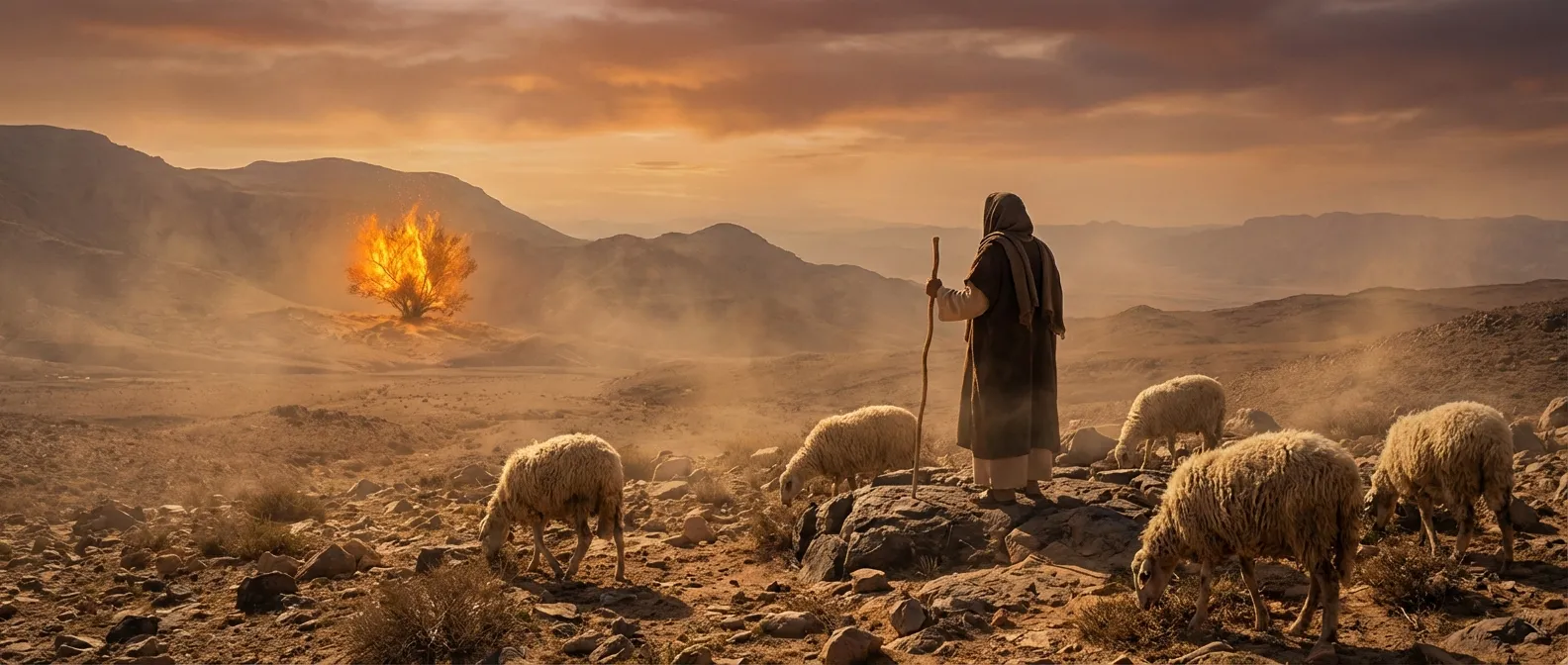
Moses fled east to Midian — a barren, sparsely populated region in what’s now the northwest corner of Saudi Arabia. He met a priest named Jethro, married his daughter Zipporah, and became a shepherd.
A shepherd.
Let that demotion sink in. In Egyptian culture, shepherds were considered detestable (Genesis 46:34). The man who was trained to lead armies was now leading sheep. The man who studied astronomy and law was now watching for wolves and looking for pasture. The man whose name was known in the palace was now anonymous in the wilderness.
Exodus doesn’t give us details about these forty years. There’s no journal. No inner monologue. No dramatic scenes. Just one verse that compresses four decades into a handful of words:
In the course of those many days, the king of Egypt died, and the children of Israel sighed because of the bondage, and they cried, and their cry came up to God because of the bondage.
“During that long period.”
Forty years. Fourteen thousand six hundred days. Moses woke up, tended sheep, ate, slept, and did it again. And again. And again. While his people suffered. While the skills he’d spent a lifetime developing gathered dust. While the ambition and passion that had driven him to kill a man slowly — agonizingly — cooled to ash.
I think about Moses at fifty. A decade into the desert. Still sharp enough to remember what he’d lost, still young enough to wonder if there was more. Did he rehearse the murder in his mind? Did he draft alternate versions where he was smarter, more careful, more patient? Did he think about his mother? About the basket in the reeds? About the God who arranged his rescue, only to let him wash out as a shepherd in the sticks?
I think about Moses at sixty. Twenty years in. The memories of Egypt starting to blur. His Egyptian accent fading. His hands calloused from staff and rope instead of scrolls and swords. The prince fully gone. The shepherd fully formed. A man who had stopped expecting anything to change.
I think about Moses at seventy-five. Thirty-five years in. An old man by ancient standards. Whatever fire had burned in him at forty was a memory now. Whatever calling he’d once felt was a story from another life. He was a shepherd. He’d always be a shepherd. God had passed him by.
Stephen, in his speech in Acts 7, captures what those forty years were with a single phrase:
“When forty years were fulfilled, an angel of the Lord appeared to him in the wilderness of Mount Sinai, in a flame of fire in a bush.…”
After forty years had passed.
God waited until Moses was eighty years old.
What the Desert Was Actually Doing
Here’s the thing about Moses that’s easy to miss: the man who killed the Egyptian was not ready to deliver Israel. He had the passion for it. He had the awareness of injustice. He even had the education and the position. But he wasn’t ready.
At forty, Moses thought deliverance looked like a powerful man taking decisive action. He thought the answer was him — his strength, his training, his willingness to fight. He tried to free Israel the Egyptian way: with force, with strategy, with a strong arm.
God had a different plan. And that plan required a different Moses.
The desert stripped away everything Moses had built his identity on:
His status. In Egypt, he was somebody. In Midian, he was nobody. The desert taught him that his value wasn’t tied to his title.
His self-sufficiency. In Egypt, he solved problems with his own power. In the desert, he was dependent on the land, the weather, and a father-in-law’s generosity. The desert taught him that competence without God is just a more educated version of helplessness.
His timeline. At forty, Moses was in a hurry. At eighty, hurry was a distant memory. The desert taught him patience — not the shallow patience of waiting politely, but the bone-deep patience of a man who has fully surrendered his right to control the timeline.
His method. Moses killed one Egyptian and ran. God would soon send ten plagues and split a sea. The difference between Moses’ plan and God’s plan wasn’t ambition — it was scale. Moses was thinking in terms of individual combat. God was thinking in terms of cosmic redemption. And you can’t lead a cosmic mission with a human-sized ego.
The desert didn’t waste Moses. It made him.
Numbers 12:3 describes the man who emerged from those forty years:
Now the man Moses was very humble, more than all the men who were on the surface of the earth.
The most humble man on earth. That’s not where Moses started. That’s where forty years of sheep and silence brought him. The prince who thought he could save Israel with his own fists became the shepherd who knew he couldn’t save anyone — and that made him the only person God could use to save everyone.
The Bush That Refused to Burn Up
And then one ordinary day, on the backside of Mount Horeb, while Moses was doing what he’d done ten thousand times before — leading sheep through barren terrain — something caught his eye.
Yahweh’s angel appeared to him in a flame of fire out of the middle of a bush. He looked, and behold, the bush burned with fire, and the bush was not consumed. Moses said, “I will go now, and see this great sight, why the bush is not burned.”
A bush on fire wasn’t unusual in the desert. But a bush on fire that didn’t consume itself — that was something else. And Moses’ response reveals the curiosity that forty years of desert hadn’t killed: I will go over and see.
He didn’t run. He didn’t dismiss it. He turned aside. And God had been waiting for exactly that:
When Yahweh saw that he came over to see, God called to him out of the middle of the bush, and said, “Moses! Moses!” He said, “Here I am.”
When the LORD saw that he had gone over to look.
God didn’t call out until Moses turned aside. That detail is staggering. The bush was burning. God was present. But the invitation required a response. God doesn’t shout at people walking the other direction. He waits for the ones who are curious enough — humble enough — to stop and pay attention.
And then God said the thing that rewrites forty years of silence:
Moreover he said, “I am the God of your father, the God of Abraham, the God of Isaac, and the God of Jacob.” Moses hid his face because he was afraid to look at God. Yahweh said, “I have surely seen the affliction of my people who are in Egypt, and have heard their cry because of their taskmasters, for I know their sorrows. I have come down to deliver them out of the hand of the Egyptians, and to bring them up out of that land to a good and large land, to a land flowing with milk and honey; to the place of the Canaanite, the Hittite, the Amorite, the Perizzite, the Hivite, and the Jebusite.…”
I have seen. I have heard. I am concerned. I have come down.
Four statements. Each one a direct answer to a question Moses had probably stopped asking decades ago. Does God see? Does God hear? Does God care? Will God act?
Yes. Yes. Yes. And yes.
But the how — the how — is where it gets terrifying:
“…Come now therefore, and I will send you to Pharaoh, that you may bring my people, the children of Israel, out of Egypt.”
I am sending you.
The man who’d been a shepherd for forty years. The man who’d failed so spectacularly the last time he tried. The man who was eighty years old, far from Egypt, forgotten by his people, and thoroughly convinced he was done.
You. Go.
The Objections of a Broken Man
What happens next is one of the most honest conversations in the Bible. Moses doesn’t leap at the opportunity. He doesn’t say “Here I am, send me!” like Isaiah. He argues. He deflects. He begs God to pick someone else.
Objection 1: “Who am I?” (Exodus 3:11)
The prince who once thought he was somebody now genuinely couldn’t imagine why God would choose him. The desert had done its work. Moses wasn’t performing humility — he meant it. Who am I to go to Pharaoh? Who am I to bring the Israelites out of Egypt?
God’s answer is devastating in its simplicity:
He said, “Certainly I will be with you. This will be the token to you, that I have sent you: when you have brought the people out of Egypt, you shall serve God on this mountain.”
Not “you’re more qualified than you think.” Not “here’s a list of your strengths.” Just: I will be with you. The same phrase Genesis used about Joseph, three times. The answer to “who am I?” is not a better version of you. It’s the presence of God.
Objection 2: “Who are You?” (Exodus 3:13)
Moses asked God’s name. Not a trivial question — in the ancient world, knowing someone’s name meant understanding their nature, their character, their authority. Moses was asking: What do I tell people? Who sent me? What God is this?
And God gave an answer that has echoed through thirty-five centuries of theology:
God said to Moses, “I AM WHO I AM,” and he said, “You shall tell the children of Israel this: ‘I AM has sent me to you.’”
I AM. Not “I was.” Not “I will be.” I AM. Present tense. Eternal tense. The God who exists outside of time, who was present in the palace and present in the desert and present in the burning bush and present in the dungeon with Joseph and present in the desert with Abraham.
The God who doesn’t explain Himself. He identifies Himself. And His identity is enough.
Objection 3: “They won’t believe me.” (Exodus 4:1)
Fair. The last time Moses tried to lead the Hebrews, they rejected him. God responded with signs — a staff that became a snake, a hand that turned leprous and was restored. Physical evidence for people who needed to see before they believed.
Objection 4: “I’m not a good speaker.” (Exodus 4:10)
This one is fascinating. Acts 7:22 said Moses was “powerful in speech.” But forty years of talking to sheep will do things to your confidence. Moses had lost his voice — not physically, but spiritually. The man who once commanded rooms now stuttered at the thought of addressing anyone.
God’s response was blunt:
Yahweh said to him, “Who made man’s mouth? Or who makes one mute, or deaf, or seeing, or blind? Isn’t it I, Yahweh? Now therefore go, and I will be with your mouth, and teach you what you shall speak.”
Objection 5: “Please send someone else.” (Exodus 4:13)
This is the raw one. After every reassurance, every sign, every promise — Moses just said it plain: I don’t want to go. Send someone else.
And God got angry. Not the kind of anger that destroys — the kind that comes from a father watching his son refuse to believe he’s capable of the thing he was born to do. God gave Moses his brother Aaron as a partner, but He didn’t let Moses off the hook.
The mission stood. The man was chosen. And the forty years of preparation were about to pay off in ways Moses couldn’t imagine.
Why Eighty and Not Forty
This is the question that nags at every person who feels like their best years are behind them: Why did God wait until Moses was eighty?
He had the education at forty. He had the passion at forty. He had the position at forty. Why not use him then?
Because at forty, Moses would have tried to deliver Israel in his own strength. And he would have failed. Not because he wasn’t talented — because he was too talented. Too confident. Too capable. Too convinced that the answer to Israel’s oppression was a strong man with a good plan.
God’s deliverance doesn’t run on human competence. It runs on divine power flowing through human surrender. And Moses at forty hadn’t surrendered anything. He was a man of action in a world that rewards action. He needed to become a man of dependence in a mission that required dependence.
The burning bush wasn’t a recruitment event. It was a reunion. God meeting a man He’d been preparing for four decades, in a place so barren that there was no one else to take credit.
but God chose the foolish things of the world that he might put to shame those who are wise. God chose the weak things of the world that he might put to shame the things that are strong.
An eighty-year-old shepherd with a speech problem walking into Pharaoh’s throne room is not a military strategy. It’s a statement. It says: This isn’t about the messenger. It’s about the God who sent him.
And that’s exactly the point.
What the Wilderness Teaches Us
Moses’ forty years in Midian carry truths that speak directly into the life of anyone who feels like they’re in a holding pattern — stuck, overlooked, or convinced that their best contributions are behind them.
1. The gap between your calling and your commissioning is not wasted time. Moses was called from birth — drawn from the water, placed in the palace, given a front-row seat to the suffering of his people. But he wasn’t commissioned until eighty. The forty years between weren’t a detour. They were the curriculum. Every skill, every failure, every quiet morning with the sheep was forming the leader Israel needed.
What feels like God’s silence might be God’s classroom.
2. Your greatest failure doesn’t disqualify you from your greatest purpose. Moses committed murder. He fled like a coward. He spent forty years hiding from his past. And God showed up at the burning bush and said: You. I want you. The person who failed — not someone else.
God doesn’t recruit from a roster of people who’ve never messed up. He recruits from the broken, the failed, the ones who’ve hit bottom hard enough to know they can’t do it alone.
3. God’s timing isn’t about your readiness — it’s about His plan. Moses wasn’t more physically capable at eighty than at forty. By human logic, God should have called him earlier. But God wasn’t optimizing for human metrics. He was orchestrating a deliverance that would define the identity of a nation for four thousand years. That kind of plan doesn’t run on our schedule.
“For my thoughts are not your thoughts, and your ways are not my ways,” says Yahweh.
4. Obscurity is not punishment — it’s preparation. There’s a prosperity-gospel version of faith that says if God is with you, things will always be going up and to the right. Moses’ life obliterates that theology. The man God chose for the greatest mission in the Old Testament spent his preparation years anonymous, obscure, and herding animals in a desert nobody cared about. If you’re in a season of obscurity, you’re in good company.
5. God speaks in the ordinary. A bush. Not a thunderstorm, not an earthquake, not a choir of angels. A bush, in a desert, on a day that started like every other day for forty years. God met Moses in the middle of his mundane routine. He didn’t demand that Moses climb a mountain or enter a temple or perform a ritual. He set fire to an ordinary shrub on an ordinary hillside and waited for Moses to notice.
The extraordinary invitation came wrapped in the ordinary. It usually does.
Reflect
-
What “Egypt” did you leave behind? Is there a season of your life — a career, a role, a version of yourself — that ended in failure or disappointment? How has that loss shaped who you are today? Can you see any evidence that God was working through it?
-
What does your “Midian” look like? Where are you right now that feels like a demotion from where you thought you’d be? A job that’s beneath your education, a season of life that feels invisible, a daily routine that seems pointless?
-
Read Exodus 3:11-12 again. Moses asked “Who am I?” and God answered “I will be with you.” Not a résumé boost — a presence promise. How would it change your current situation if you truly believed God’s answer to your inadequacy was simply His presence?
-
What are you learning from the sheep? Moses’ desert years taught him humility, patience, and dependence. What is your current “boring” season teaching you? What skills, character traits, or perspectives are being formed in the monotony?
-
Are you watching for burning bushes? Moses turned aside to look. He could have walked past. He could have dismissed it as a brushfire. Is there something unusual in your life right now that might be God trying to get your attention — something you’ve been too busy, too discouraged, or too “done” to investigate?
Coming Up Next
Abraham waited in the desert. Joseph waited in a dungeon. Moses waited on the backside of nowhere. But in Part 4, we’ll meet a man who waited while being hunted — anointed as king and then chased through caves by the very king he was meant to replace.
His name was David. And the years between his anointing and his throne taught him something that would make him the greatest songwriter who ever lived: how to worship in the wilderness before you ever see the palace.