

The Word That Undid the Grave
He had just conquered death — defeated the grave, fulfilled every prophecy, completed the mission that began before the foundations of the world. And the very first thing the risen Jesus chose to do was speak one word to one weeping woman. Her name. That's the kind of God who sees you.
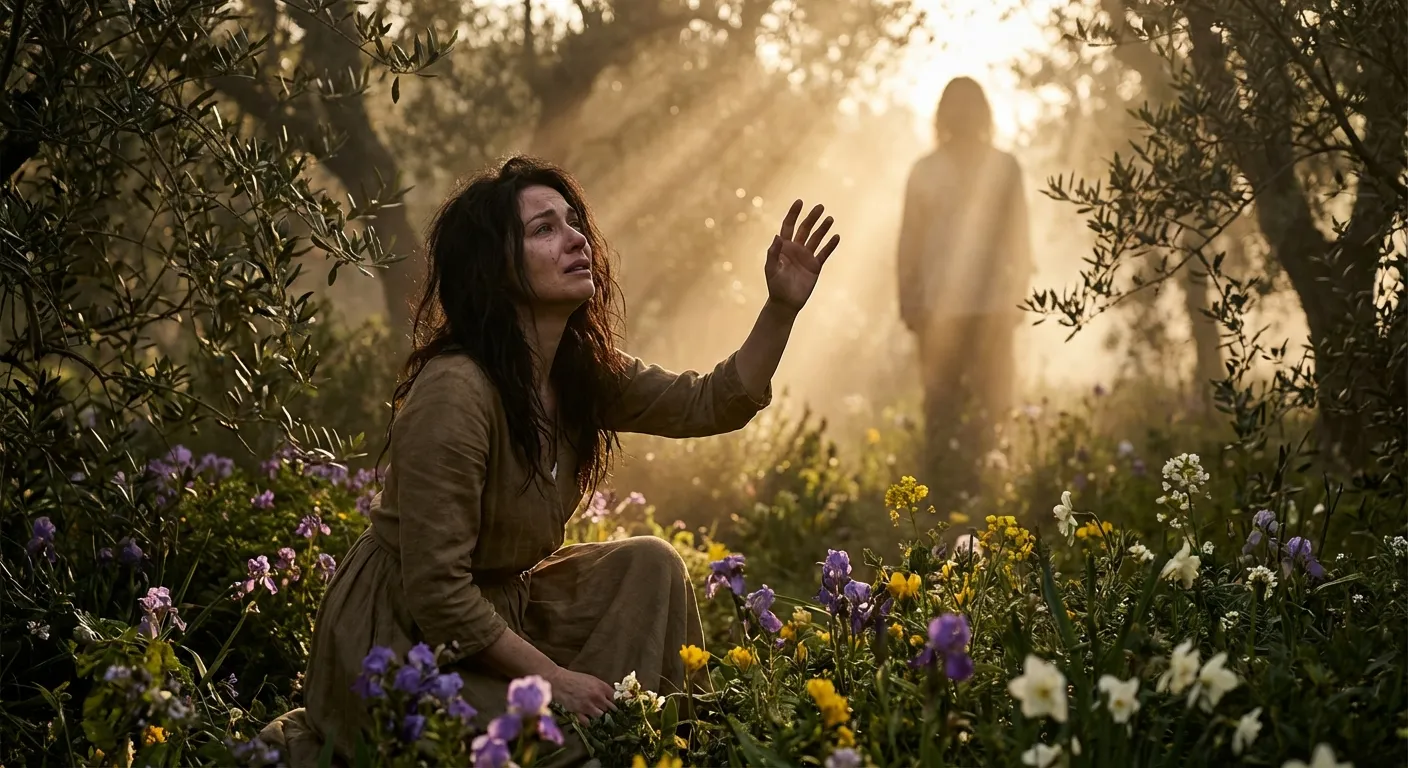
Part 5: The Word That Undid the Grave
It was still dark.
That detail matters. John wants you to know that when Mary Magdalene left for the tomb, the sun hadn’t risen yet. She wasn’t going at a civilized hour. She wasn’t organizing a group trip. She was alone, in the dark, walking toward a dead body, because waiting any longer was unbearable.
This is the final story in our series. We’ve walked with Hagar into the desert, with the man at Bethesda into his excuses, with the bleeding woman through the crowd, and with Elijah under the broom tree. Five people at five different rock bottoms, and every time, the same God showed up.
But this one is different. Because this time, the person who does the seeing isn’t just a God who notices. It’s a God who has just walked out of His own grave.
And His first word isn’t a sermon. It isn’t a proclamation. It isn’t “Go tell the world I’m alive.”
It’s a name.
What Mary Lost
To understand why this morning mattered so much, you have to understand what Friday took from her.
The Gospels don’t give us Mary Magdalene’s full biography, but they give us enough. Luke 8:2 tells us that Jesus had cast seven demons out of her. Seven. Not one. Not two. Seven — the biblical number of completeness — as if whatever had hold of her had hold of everything.
We don’t know what that looked like — the text doesn’t describe her symptoms. But we know what the result was: before Jesus, she was someone defined entirely by what was wrong with her. After Jesus, she was someone who followed Him from Galilee to Jerusalem, helped fund His ministry, and stood at the foot of the cross when nearly everyone else had fled.
Let that land.
When the disciples scattered — when Peter denied knowing Him, when the inner circle melted into the crowd — the women stayed. And Mary Magdalene was among them. She watched Him die. She watched the Roman spear puncture His side. She watched Joseph of Arimathea take the body down and lay it in a borrowed tomb.
She saw the stone rolled over the entrance.
And then she went home for the Sabbath, because the law required it, and she sat in whatever room she was staying in for an entire day, doing nothing, because the person who had given her back her life was dead.
Try to imagine that. Not abstractly. Concretely. The person who freed you from the worst thing that ever happened to you — the one who looked at you when everyone else looked away — is gone. Not gone like “moved to another city.” Gone like “you watched him suffocate on a Roman cross and they put his body in a hole in a rock.”
That’s Friday.
Saturday is worse, because Saturday is waiting. Saturday is silence. Saturday is the day when nothing happens and the grief has nowhere to go and the future is a wall.
And then comes Sunday. Still dark. And Mary goes to the tomb.
The Empty Room
Now on the first day of the week, Mary Magdalene went early, while it was still dark, to the tomb, and saw that the stone had been taken away from the tomb.
She’s coming to anoint a body. That’s the practical reason. In the rush of Friday afternoon — getting the body down before sunset, before the Sabbath — there hadn’t been time for a proper burial. The spices, the ointments, the careful wrapping — none of it was finished. Mary is coming to finish what death started.
But the stone is gone.
Not cracked. Not shifted. Removed. A stone that typically weighed between one and two tons, rolled away from the entrance like it weighed nothing. Because to a God who just defeated death, gravity is an afterthought.
Mary doesn’t go in. She doesn’t investigate. She runs.
Therefore she ran and came to Simon Peter and to the other disciple whom Jesus loved, and said to them, “They have taken away the Lord out of the tomb, and we don’t know where they have laid him!”
Her first conclusion isn’t resurrection. It’s theft. They took him. Someone moved the body. The authorities, the Romans, grave robbers — someone has stolen the only thing she had left of Him.
This is important. Mary is not a woman of weak faith — she’s a woman of enormous grief. She doesn’t jump to a miraculous conclusion because she isn’t thinking about miracles. She’s thinking about a body she needs to anoint and a goodbye she hasn’t been allowed to finish.
Grief doesn’t think clearly. Grief thinks in straight lines: he’s dead, the body is gone, someone took it, even this has been taken from me.
Peter and John
Peter and John run to the tomb. John — younger, faster — arrives first but stops at the entrance. Peter — older, bolder, still Peter — barges straight in.
They see the linen wrappings lying there. The cloth that had been around Jesus’ head is folded separately, set aside. Not tossed. Not tangled. Folded.
This detail has been preached a thousand ways, but the simplest reading is the most powerful: nobody who steals a body unwraps it first. Whatever happened here, it wasn’t theft. The body didn’t leave in the grave clothes. It left through them.
John sees and believes — though the text admits they still didn’t fully understand the Scripture about resurrection (John 20:9). They believe something, even if they can’t name it yet.
Then they go home.
Read that again. They go home.
Peter and John, the two leaders of the movement, see the empty tomb, have some kind of faith response, and leave. They go back to wherever they were staying.
Mary stays.
The Woman Who Wouldn’t Leave
But Mary was standing outside at the tomb weeping. So as she wept, she stooped and looked into the tomb,
Everyone else has left. The disciples came, looked, believed something, and went home. But Mary is still there. Standing outside. Crying.
The Greek word is klaiousa — not quiet tears, but audible weeping. The kind of crying you do when you don’t care who hears because the pain has burned past the point of self-consciousness.
This is the woman who stayed at the cross. This is the woman who came in the dark. And now she’s the woman who won’t leave the empty tomb even after everyone else has gone, because she has nowhere else to go. The tomb is the last place she saw Him. Even empty, it’s the closest she can get.
She finally bends down and looks inside.
and she saw two angels in white sitting, one at the head and one at the feet, where the body of Jesus had lain.
Two angels. Sitting casually in an empty tomb. One where His head had been. One where His feet had been. Bookends of absence.
And they ask her a question:
They asked her, “Woman, why are you weeping?” She said to them, “Because they have taken away my Lord, and I don’t know where they have laid him.”
It’s not a rebuke. It’s an invitation. Tell us what’s wrong. And Mary gives the same answer she gave Peter and John:
They asked her, “Woman, why are you weeping?” She said to them, “Because they have taken away my Lord, and I don’t know where they have laid him.”
She’s talking to angels and doesn’t even register it. She’s so consumed by grief that two supernatural beings in white don’t even break her focus. She doesn’t fall on her face. She doesn’t worship. She doesn’t ask what they are. She just answers the question and goes back to looking for the body.
This is what grief does. It narrows your vision until the only thing you can see is the thing you’ve lost. Angels could be sitting right in front of you and you’d look past them because they’re not the one you’re looking for.
The Gardener
When she had said this, she turned around and saw Jesus standing, and didn’t know that it was Jesus.
He’s there.
Right behind her. Standing. Alive. Breathing. The same body that was dead on Friday and gone on Saturday is now standing in the garden on Sunday morning, and Mary Magdalene — who knew His face better than almost anyone, who had followed Him for years, who had watched Him die — looks right at Him and doesn’t recognize Him.
Why?
Some say the resurrection body was different enough to confuse her. Some say it was still too dark. Some say God supernaturally prevented her from recognizing Him (like He did with the disciples on the road to Emmaus in Luke 24).
But maybe the simplest answer is the truest one: she couldn’t see Him because she wasn’t looking for someone alive. She was looking for a dead body. She was looking for a corpse to anoint. Her eyes were full of tears and her mind was full of death and when a living man stood in front of her, she couldn’t process it because it didn’t fit the only category her grief had left available.
You see what you expect to see. And Mary expected death.
Jesus asks her the same question the angels asked:
Jesus said to her, “Woman, why are you weeping? Who are you looking for?” She, supposing him to be the gardener, said to him, “Sir, if you have carried him away, tell me where you have laid him, and I will take him away.”
And then He adds:
“Who is it you are looking for?”
This is such a Jesus question. He doesn’t ask what she’s looking for. He asks who. Because Mary isn’t looking for a thing — she’s looking for a person. And the person she’s looking for is asking her the question.
Mary, still not recognizing Him, makes her guess:
Jesus said to her, “Woman, why are you weeping? Who are you looking for?” She, supposing him to be the gardener, said to him, “Sir, if you have carried him away, tell me where you have laid him, and I will take him away.”
She thinks He’s the groundskeeper. The man who maintains the garden where the tomb is located. And she makes an offer that reveals the depth of her devotion: Tell me where you put him, and I will get him.
She — a woman in first-century Palestine, with no social power, no physical strength advantage, no legal standing — is volunteering to carry a dead man’s body by herself. She doesn’t ask for help. She doesn’t ask someone else to do it. Just tell me where He is. I’ll go get Him. I’ll carry Him myself.
This is love past the point of reason. This is devotion that has outlived death and outlived the tomb and is now volunteering for the impossible because it doesn’t know what else to do.
One Word
And then Jesus says her name.
Jesus said to her, “Mary.” She turned and said to him, “Rabboni!” which is to say, “Teacher!”
One word.
Not “I am risen.” Not “Go tell the disciples.” Not a theological explanation of what just happened. Not a rebuke for not recognizing Him. Not even “Don’t cry.”
Mary.
Mariam in the Aramaic. The way He’d always said it. The voice she knew. The voice that had once commanded seven demons to leave her and they did. The voice she had followed from Galilee to Golgotha. The voice she thought she would never hear again.
One word, and the entire world changes.
Jesus said to her, “Mary.” She turned and said to him, “Rabboni!” which is to say, “Teacher!”
She turned toward him. She had already been facing Him — she’d been talking to Him. But she hadn’t really been facing Him. She’d been facing the gardener. Now she turns again — not physically but with her whole self. Recognition floods in. The grief-fog burns away. The man standing in front of her is not the groundskeeper.
It’s Jesus. Alive. Saying her name.
And she calls Him Rabboni — not just Rabbi but the intensified, personal form. “My great teacher.” “My master.” The word you use when the relationship is everything.
The text doesn’t explicitly describe it, but the next verse makes clear she grabbed onto Him — because Jesus says:
Jesus said to her, “Don’t hold me, for I haven’t yet ascended to my Father; but go to my brothers and tell them, ‘I am ascending to my Father and your Father, to my God and your God.’”
She’s clinging to Him. And honestly — who wouldn’t? You thought he was dead. You watched him die. You came to anoint his corpse. And now he’s standing here, solid and warm and alive, saying your name. Of course you hold on. Of course you don’t let go. The last time you let go, they put Him in a tomb.
Jesus gently loosens her grip. Not because her touch is wrong, but because there’s something He needs her to do:
Jesus said to her, “Don’t hold me, for I haven’t yet ascended to my Father; but go to my brothers and tell them, ‘I am ascending to my Father and your Father, to my God and your God.’”
Notice what He calls the disciples: my brothers. Not “my followers.” Not “my servants.” Not “those cowards who abandoned me on Friday.” Brothers. The men who scattered, denied, and hid — Jesus’ first reference to them after the resurrection is the most intimate term available. He’s not angry. He’s not keeping score. He’s calling them family.
And notice who He sends with this message. Not Peter. Not John. Not an angel.
Mary Magdalene. A woman. In a culture where a woman’s testimony wasn’t admissible in court. The first witness to the resurrection, the first evangelist of the empty tomb, the first person commissioned by the risen Christ — is a woman that seven demons used to call home.
Mary Magdalene came and told the disciples that she had seen the Lord, and that he had said these things to her.
Four words that changed human history: I have seen the Lord.
Why Her? Why Then? Why This Way?
Of all the ways God could have staged the most important moment in human history, He chose this.
He could have rolled the stone away during the day, in front of crowds. He could have appeared first to the Sanhedrin, to Pilate, to the soldiers who crucified Him — irrefutable proof delivered to the skeptics. He could have appeared to Peter, the leader. To John, the beloved. To all eleven at once.
Instead: a garden. Before dawn. One woman. A whisper of a name.
Why?
Because this is who God is. This is what the entire series has been about.
Hagar was a slave girl nobody cared about, and God found her in the desert and said, “You are the God who sees me.”
The man at Bethesda was invisible — thirty-eight years of blending into the scenery — and Jesus walked past everyone else to ask him a question.
The bleeding woman was untouchable — twelve years of isolation, ceremonially unclean, erased from community — and Jesus stopped a parade to make sure she was seen.
Elijah was curled under a bush, begging to die, and God sent bread, sleep, a whisper, and the truth that he was never alone.
And now Mary. Weeping outside an empty tomb. Looking for a dead man. And God — freshly risen, having just accomplished the single greatest act in cosmic history — doesn’t go to the powerful or the important or the influential first.
He goes to the one who’s crying.
He goes to the one who stayed when everyone else left.
He goes to the one who was so consumed by grief she couldn’t recognize Him standing right in front of her.
And He says her name.
The God Who Says Your Name
Here’s the thread that runs through every story in this series: God sees the person everyone else overlooks.
Not the performance. Not the résumé. Not the public face. The person.
- Hagar wasn’t a matriarch. She was a slave with no options.
- The man at Bethesda wasn’t a hero of faith. He was a professional victim who’d given up.
- The bleeding woman wasn’t in the inner circle. She was the one who shouldn’t have been there at all.
- Elijah wasn’t on the mountain anymore. He was under a bush.
- Mary wasn’t composing theology. She was barely functioning through tears.
And in every case, God didn’t wait for them to clean up first. He met them in the desert, at the pool, in the crowd, in the cave, in the garden. He met them where they were, not where they should have been.
This is not a God who sees you the way a security camera sees you — distant, passive, recording but not responding. This is a God who sees you the way a parent sees a child — scanning the room, noticing the one who’s quiet, the one who’s faking a smile, the one who stepped outside because the noise got to be too much.
This is a God who says your name. Not your title. Not your role. Not your sin. Not your failure. Your name. The word that means you — not the version of you that performs well, not the version that has it together, but the one standing in the garden, crying, looking for a dead man, unable to see that life itself is standing three feet away.
The Pattern
Look at what God does in each of these stories. The pattern is unmistakable:
1. He finds them where they are. Desert. Poolside. Crowd. Cave. Garden. God doesn’t send a map with directions to His office. He shows up at their location, in their situation, on their worst day.
2. He asks a question. “Where are you going?” (Hagar). “Do you want to get well?” (Bethesda). “Who touched me?” (the woman). “What are you doing here?” (Elijah). “Why are you crying? Who are you looking for?” (Mary). Every time, God opens with a question — not because He doesn’t know the answer, but because He wants them to say it out loud. Naming the wound is the first step toward healing it.
3. He meets the immediate need. Water for Hagar. Healing for the man at the pool. Physical wholeness for the woman. Bread and sleep for Elijah. His living presence for Mary. God doesn’t start with theology. He starts with what you need right now.
4. He restores identity. Hagar gets a name for God and a promise for her son. The man at Bethesda is told to pick up his mat — he’s not an invalid anymore. The woman is called “daughter” — she belongs. Elijah gets a mission — he’s not obsolete. Mary gets a commission — she’s the first witness. In every case, the person leaves with a clearer sense of who they are than when they arrived.
5. He sends them out. None of them stay in the encounter. Hagar goes back. The man walks. The woman goes in peace. Elijah anoints kings. Mary tells the disciples. The seeing always leads to the sending. Being known by God is never just for you — it’s always, eventually, for someone else.
What This Means for You
You’ve been reading these stories for five weeks. Five people, five encounters, five different flavors of being broken and being found.
And the question underneath all of them is the same one Jesus asked Mary in the garden:
Who are you looking for?
Because here’s the thing — you might be Mary. Standing in your own garden, staring at your own empty tomb, unable to find the thing you came looking for. The marriage that died. The faith that went cold. The calling that evaporated. The person you used to be. The God you used to feel close to.
And you might be so locked into your grief, your disappointment, your confusion, that the answer is standing right in front of you and you’re mistaking Him for the gardener.
Maybe God hasn’t been silent. Maybe He’s been speaking and you’ve been listening for the wrong sound — waiting for fire when He’s offering a whisper. Waiting for a spectacle when He’s standing in the ordinary, asking a question, saying your name.
The risen Christ — the one who holds all power in heaven and earth — chose a garden and a name as His first act. Not a throne room. Not a cosmic announcement. A garden. A name.
Because that’s the kind of God He is.
The kind who sees a slave girl in the desert. The kind who finds the man everyone walks past. The kind who stops for the one nobody will touch. The kind who brings bread to the prophet under the bush. The kind who says your name in the dark before the sun comes up.
Reflect
-
Which person in this series do you most identify with right now? Hagar, running with nowhere to go? The man at Bethesda, stuck for so long you’ve forgotten what movement feels like? The bleeding woman, reaching for something in desperation? Elijah, exhausted and wondering if it mattered? Mary, looking for something that isn’t where you left it?
-
What are you looking for? Not the Sunday school answer. The real one. What is the ache that gets you up before dawn and keeps you standing outside empty tombs? Name it. Say it out loud.
-
Have you been mistaking Jesus for the gardener? Is it possible that God has been present in your situation and you haven’t recognized Him because He doesn’t look the way you expected? What would it change if you believed He was already there?
-
What is your name? Not your role, your title, your label, or the thing people call you when they need something from you. What is the name that, if Jesus spoke it in a garden at dawn, would undo you? That’s the name He knows. That’s the name He’s saying.
A Prayer
Jesus,
You could have gone anywhere first. You had just done the most extraordinary thing in the history of everything — walked out of death like it was a room with an unlocked door. The whole universe was holding its breath. Angels were ready. History was turning.
And You went to a garden. And You said a name.
I want to believe You’d do that for me.
I want to believe that when I’m standing outside my own empty tombs — grieving things I can’t get back, searching for something that isn’t where I left it, blinded by tears and convinced that even the body is gone — I want to believe that You are standing three feet away, and that You know my name, and that one word from You is enough to change everything.
I’ve been Hagar. Running, scared, pregnant with a future I didn’t plan. You found me and called me by a name I didn’t know I had.
I’ve been Bethesda. Lying by the water, watching everyone else get their miracle, building a thirty-eight-year case for why it’s too late for me. You walked past everyone else and asked me the one question I’d been avoiding.
I’ve been the woman in the crowd. Spending everything on things that don’t work, reaching for the hem of something holy because I have nothing left to try. You stopped for me. You called me daughter.
I’ve been Elijah. Burned out, alone, under a bush in the desert, wondering if any of it mattered. You brought bread. You let me sleep. You whispered when I expected thunder.
And I’ve been Mary. Standing in the dark, looking for You in all the wrong places, unable to see You even when You’re right in front of me.
Say my name, Lord.
Not the name on my résumé. Not the name people use when they want something. Not the name I hide behind. My actual name — the one You knew before I was born, the one You’ve been saying since the desert, the pool, the crowd, the cave, the garden.
The one that means You see me.
I’m turning around now. I’m looking. I think I can almost hear it.
Say it again.
Amen.
Thank You for Reading This Series
The God Who Sees You started with a runaway slave in the desert and ended with a weeping woman in a garden. In between, we met a paralyzed man, a bleeding woman, and a suicidal prophet. Five stories spread across thousands of years, connected by one truth:
You are seen.
Not glanced at. Not observed. Not catalogued. Seen — the way God sees, which means known and pursued and met where you are and called by name.
If this series meant something to you, don’t let it end here. Go back and reread the story that hit you hardest. Sit with those reflection questions. Pray those prayers like you mean them. And then look around — because if God sees you, maybe you’re supposed to see someone else.
The woman at work who’s faking it. The friend who went quiet. The family member who seems fine but isn’t. The stranger at church who sits alone.
Be Hagar’s well. Be the bread under Elijah’s bush. Be the hand that stops the crowd and says, “I see you.”
The God who sees you is also the God who sends you.
Go.
🐾