

When the Bravest Man Alive Wanted to Die
He called down fire from heaven, outran a chariot, and single-handedly defeated 450 prophets of Baal. Twenty-four hours later, he was curled under a bush in the desert, begging God to kill him. What Elijah's breakdown reveals about depression, burnout, and the God who responds with bread instead of a sermon.
Part 4: When the Bravest Man Alive Wanted to Die
Here is a man who called fire from the sky.
Not metaphorical fire. Not inspirational fire. Actual, consuming, stone-licking, water-evaporating, trench-drying fire that fell from heaven onto a soaking-wet altar and convinced an entire nation that they’d been worshipping the wrong god.
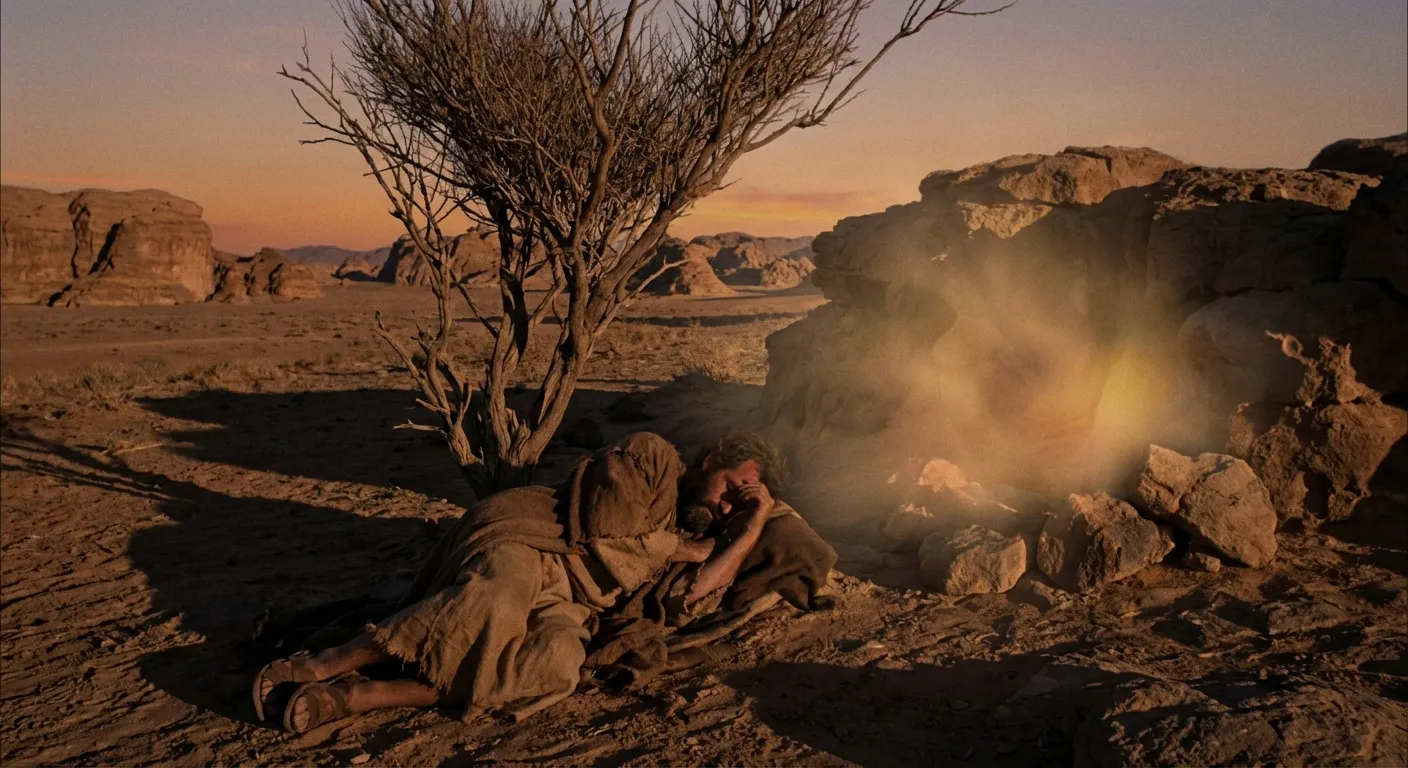
Twenty-four hours later, that same man was lying under a broom tree in the desert, alone, asking God to end his life.
If you’ve ever felt like a fraud — standing tall in public while crumbling in private — Elijah’s story will either comfort you or terrify you. Maybe both. Because it proves that spiritual victory and emotional collapse aren’t opposites. Sometimes they’re neighbors.
The Highest High
You can’t understand 1 Kings 19 without 1 Kings 18. You can’t understand the crash without the peak.
Here’s the setup: Israel has been in a three-and-a-half-year drought. No rain. No dew. The land is cracking apart. And it’s Elijah’s doing — he’s the one who declared the drought in God’s name, then vanished into hiding while the nation slowly starved.
Now God sends him back with a mission: confront King Ahab, confront the prophets of Baal, and settle once and for all who the real God is.
What follows is one of the most cinematically dramatic scenes in the entire Bible.
Elijah stands on Mount Carmel against 450 prophets of Baal and 400 prophets of Asherah. Eight hundred and fifty to one. He proposes a contest: two altars, two bulls, no fire. Whichever god sends fire from heaven to consume the sacrifice — that’s the real God.
The prophets of Baal go first. They pray. They shout. They dance. They slash themselves with swords and spears until blood runs down their bodies. From morning until evening, eight hundred and fifty men beg Baal to send fire.
Nothing.
And Elijah — this is the part that tells you exactly what kind of man he is — starts trash-talking:
At noon, Elijah mocked them, and said, “Cry aloud, for he is a god. Either he is deep in thought, or he has gone somewhere, or he is on a journey, or perhaps he sleeps and must be awakened.”
The Hebrew is even more savage than most translations let on. “Maybe he’s busy” uses a word that can mean “gone aside” — an ancient euphemism for using the bathroom. Elijah just told 850 pagan prophets that their god might be indisposed on the toilet.
This man had nerve.
Then Elijah takes his turn. And instead of making it easy, he makes it impossible. He rebuilds the altar with twelve stones. Digs a trench around it. Lays out the bull. And then:
He put the wood in order, and cut the bull in pieces and laid it on the wood. He said, “Fill four jars with water, and pour it on the burnt offering and on the wood.” He said, “Do it a second time;” and they did it the second time. He said, “Do it a third time;” and they did it the third time.
Twelve jars of water. During a drought. Soaking the sacrifice, flooding the trench, turning the whole altar into a swamp. Because the God Elijah serves doesn’t need dry conditions to send fire.
Then Elijah prays. Not a long prayer. Not a performance. Seven Hebrew words:
At the time of the evening offering, Elijah the prophet came near and said, “Yahweh, the God of Abraham, of Isaac, and of Israel, let it be known today that you are God in Israel and that I am your servant, and that I have done all these things at your word. Hear me, Yahweh, hear me, that this people may know that you, Yahweh, are God, and that you have turned their heart back again.”
And fire falls.
Not a spark. Not a slow burn. An inferno that consumes the sacrifice, the wood, the stones, the soil, and the water in the trench. The altar doesn’t just catch fire — it evaporates.
The people fall on their faces: “Yahweh, he is God! Yahweh, he is God!” (1 Kings 18:39)
Then Elijah has the 450 prophets of Baal executed. Then he climbs back to the top of Carmel, crouches on the ground with his face between his knees, and prays for rain. A cloud appears. The sky turns black. The drought breaks.
And then — the detail that should make your jaw drop — Elijah tucks his cloak into his belt and outruns Ahab’s chariot the seventeen miles from Mount Carmel to Jezreel.
On foot. After a full day of spiritual warfare. Powered by nothing but adrenaline and the hand of God.
This is Elijah at his peak. Fire from heaven. A nation repenting. Rain after three years. A footrace against horses. The greatest single day in prophetic history.
And it was the last good day he’d have for a long time.
The Crash
Chapter 19 opens like a door slamming shut.
Ahab tells his wife Jezebel everything that happened — the fire, the prophets, the rain. And Jezebel, rather than repenting like the rest of Israel, sends Elijah a message:
Then Jezebel sent a messenger to Elijah, saying, “So let the gods do to me, and more also, if I don’t make your life as the life of one of them by tomorrow about this time!”
One woman. One threat. That’s all it takes.
The man who stood alone against 850 prophets, who mocked a false god to his priests’ faces, who called fire from the sky and didn’t flinch — that man hears one angry queen’s death threat and runs.
When he saw that, he arose and ran for his life, and came to Beersheba, which belongs to Judah, and left his servant there.
He runs south. Past Beersheba — the last town in Judah. Past the border of civilization. Into the wilderness. A day’s journey into nothing.
And then he stops. Sits down under a broom tree — a scrubby desert bush barely tall enough to offer shade. And says:
But he himself went a day’s journey into the wilderness, and came and sat down under a juniper tree. Then he requested for himself that he might die, and said, “It is enough. Now, O Yahweh, take away my life; for I am not better than my fathers.”
Read that again.
Take my life.
The prophet who just saw God’s fire consume stone and water now wants God’s fire to consume him. Not in glory — in relief. He’s not asking for a dramatic exit. He’s asking to stop existing.
I have had enough.
The Hebrew is rav — it means “too much.” Not “I’m done with this particular situation.” But “the total weight of everything has exceeded what I can carry.”
I am no better than my ancestors.
His ancestors died. They didn’t save Israel permanently either. The victory on Carmel already feels hollow. Nothing changed. Jezebel is still in power. The system is still corrupt. One afternoon of fire didn’t fix a generation of rot. And now he’s the target.
So Elijah lies down under a bush and asks to die.
What Just Happened?
Here’s what every honest reader needs to wrestle with: How does this happen?
How does the man who stood toe-to-toe with 850 false prophets yesterday collapse at a single threat today? How does the greatest demonstration of God’s power in a generation lead to a suicidal prophet in a desert within twenty-four hours?
Because if it can happen to Elijah, it can happen to anyone. And pretending otherwise is a lie the church has been telling for centuries.
There are at least three things at work here:
1. Physical exhaustion. Elijah had been running on fumes. The confrontation on Carmel took all day. He’d been praying intensely. He ran seventeen miles on foot. He probably hadn’t eaten properly in days. The human body is not designed for sustained adrenaline without recovery, and Elijah had been operating in crisis mode for years — hiding by the brook Cherith, surviving on bread from ravens, living with a widow during a famine, then Mount Carmel. The man was depleted.
2. Emotional crash. This is the phenomenon psychologists call “post-adrenaline drop.” After a massive high — a performance, a victory, a crisis survived — the body’s stress hormones plummet, leaving a person in an emotional valley far below their baseline. Athletes experience it after championships. Performers experience it after opening night. Soldiers experience it after combat. And prophets experience it after calling down fire from heaven. The bigger the high, the deeper the drop.
3. Unmet expectations. Elijah expected Carmel to be the turning point. Fire from heaven! National repentance! The drought broken! Surely now Israel would return to God for good. Surely now the king would repent. Surely now the system would change. And instead — a death threat from the queen. Business as usual. The spiritual high didn’t produce the lasting change he risked his life for. His victory felt pointless.
This is not a failure of faith. This is the cost of faith. Elijah didn’t collapse because he stopped believing in God. He collapsed because he’d given everything — body, soul, spirit — and the world hadn’t changed enough to justify the expense.
If you’ve ever poured yourself into ministry, into a relationship, into a cause you believed in, and then watched it not matter — you know this desert. You know this bush. You might know this prayer.
What God Didn’t Do
Now watch what God does. Or more precisely — watch what God doesn’t do.
God doesn’t rebuke him.
Let that sink in. The prophet who just fled his post, abandoned his mission, wished himself dead, and is currently lying facedown in the dirt feeling sorry for himself — God does not deliver a single word of correction.
No “Where’s your faith?” No “Didn’t I just show up for you on Carmel?” No “Get up, soldier, there’s work to do.” No sermon. No pep talk. No guilt trip. No Bible verse about being strong and courageous.
Nothing.
Imagine if Elijah had posted this in a church small group: “I’m done. I want to die. Nothing I do matters.” You can almost hear the responses. “But God is good!” “Remember what He did on the mountain!” “Maybe you need to pray more.” “Are you in the Word?”
God says none of that.
Because God understands something the church often doesn’t: a person at the end of themselves doesn’t need a lecture. They need a sandwich and a nap.
What God Did
He lay down and slept under a juniper tree; and behold, an angel touched him, and said to him, “Arise and eat!” He looked, and behold, there was at his head a cake baked on the coals, and a jar of water. He ate and drank, and lay down again.
God sends an angel. The angel brings bread and water. The angel wakes Elijah up — gently. “Get up and eat.”
No agenda. No assignment. No “let’s talk about what happened back there.” Just food and water.
Elijah eats. Drinks. And goes back to sleep.
And God lets him.
Yahweh’s angel came again the second time, and touched him, and said, “Arise and eat, because the journey is too great for you.”
The second time, the angel adds something extraordinary: “The journey is too much for you.”
God is acknowledging, out loud, through an angel, that what Elijah is carrying is too heavy. Not “you’re too weak.” Not “you should be stronger.” The journey is too much. The problem isn’t Elijah’s character. The problem is the load.
This is the God who sees you. Not the you who called down fire. Not the you who performed well in public. The you who is lying under a bush with nothing left, and the most spiritual thing you can do is eat a piece of bread and close your eyes.
God didn’t send a Bible study. He sent a meal.
Sometimes the most spiritual thing you can do is sleep.
The Forty-Day Walk to Nowhere
Strengthened by the food, Elijah walks. And walks. And walks.
He arose, and ate and drank, and went in the strength of that food forty days and forty nights to Horeb, God’s Mountain.
Forty days. From the desert south of Beersheba to Mount Horeb — also called Mount Sinai. The same mountain where Moses received the Ten Commandments. The same mountain where God appeared in fire and smoke and thunder centuries earlier.
Elijah doesn’t go to Horeb because God told him to. God told him to eat. Elijah walked to Horeb on his own — perhaps seeking something. Perhaps going back to the place where God once showed up in power, hoping He’d do it again. Perhaps just walking because he had nowhere else to go.
He arrives and crawls into a cave.
He came to a cave there, and camped there; and behold, Yahweh’s word came to him, and he said to him, “What are you doing here, Elijah?”
God asks a question. Not an accusation — the Hebrew tone is open, not hostile. It’s the same kind of question God asked Adam in the garden: “Where are you?” Not because God didn’t know, but because He wanted to hear Elijah say it.
And Elijah answers with the most honest, unfiltered prayer in the Old Testament:
He said, “I have been very jealous for Yahweh, the God of Armies; for the children of Israel have forsaken your covenant, thrown down your altars, and killed your prophets with the sword. I, even I only, am left; and they seek my life, to take it away.”
Listen to what he’s saying:
- I did my part. I was zealous. I showed up. I fought.
- It didn’t work. They rejected the covenant anyway. The altars are still torn down.
- Everyone else is gone. I am the only one left.
- And now they want me dead too.
This is the prayer of someone who gave everything and has nothing to show for it. It’s the prayer of the pastor who burned out after twenty years. The missionary who came home broken. The parent who poured their soul into a child who walked away. The activist who fought the system and the system won.
I did everything right. It didn’t matter. I’m alone. And I’m next.
The Sound of Almost Nothing
What happens next is one of the most important moments in the entire Bible. And it’s almost always misread.
He said, “Go out and stand on the mountain before Yahweh.” Behold, Yahweh passed by, and a great and strong wind tore the mountains and broke in pieces the rocks before Yahweh; but Yahweh was not in the wind. After the wind there was an earthquake; but Yahweh was not in the earthquake.
God is about to show up. And Elijah has a front-row seat.
He said, “Go out and stand on the mountain before Yahweh.” Behold, Yahweh passed by, and a great and strong wind tore the mountains and broke in pieces the rocks before Yahweh; but Yahweh was not in the wind. After the wind there was an earthquake; but Yahweh was not in the earthquake. After the earthquake a fire passed; but Yahweh was not in the fire. After the fire, there was a still small voice.
Wind. Earthquake. Fire. The three most dramatic manifestations of divine power in Scripture — the same trilogy that showed up at Sinai when Moses stood on this very mountain. The ground shakes. Rocks shatter. Fire blazes.
And God is in none of them.
Not in the wind. Not in the earthquake. Not in the fire.
Here’s why this matters: Elijah just came from fire. Mount Carmel was fire. The whole first half of Elijah’s ministry was dramatic, loud, spectacular divine intervention. And it didn’t work. The fire fell, the people cheered, and twenty-four hours later, Jezebel was still Jezebel.
So God shows Elijah the wind, the earthquake, the fire — the fireworks — and says, effectively: I’m not in those. Not this time.
Then:
After the earthquake a fire passed; but Yahweh was not in the fire. After the fire, there was a still small voice.
The Hebrew phrase is qol demamah daqqah — and it’s one of the most debated phrases in the Old Testament. It’s been translated as “a still small voice,” “a gentle whisper,” “a sound of sheer silence,” and “a thin silence.” Some scholars argue it’s not a voice at all — it’s the sound of almost nothing. The faintest possible sound that is still, technically, sound.
After the wind that split mountains. After an earthquake. After fire. God shows up as a whisper so faint you’d miss it if you were making any noise at all.
This is the answer to Elijah’s despair — and it’s not the answer he was looking for.
Elijah wanted God to do it again. Bigger fire. Louder thunder. More dramatic intervention. Force the nation to repent. Destroy Jezebel. Make the victory on Carmel permanent.
God said: That’s not how I work this time.
The whisper is God saying: I was never primarily in the spectacle. The fire on Carmel was real, but it wasn’t the point. I don’t need to be loud to be present. I don’t need to shatter mountains to be close. Sometimes I am closest when I am quietest.
And there’s something else — something deeply personal. Elijah is exhausted. Depleted. Running on fumes. A God who showed up as wind, earthquake, and fire would have been one more overwhelming experience for a man who had nothing left to give to overwhelming experiences.
But a whisper? A whisper requires closeness. You can hear a shout from a mile away, but a whisper means someone is right next to you. The gentleness of God’s approach matched the fragility of Elijah’s condition.
God didn’t show up in power because Elijah didn’t need power. He needed presence.
The Kindest Correction in the Bible
After the whisper, God asks the same question:
When Elijah heard it, he wrapped his face in his mantle, went out, and stood in the entrance of the cave. Behold, a voice came to him, and said, “What are you doing here, Elijah?”
And Elijah gives the exact same answer. Word for word. The same speech about being zealous, being alone, being targeted.
He wasn’t transformed by the whisper. The theophany didn’t fix him. He’s still in the same place emotionally that he was before the wind and the earthquake and the fire. Still tired. Still convinced he’s alone. Still feeling like it was all for nothing.
And God — this is so kind it almost hurts — doesn’t argue with him.
He doesn’t say “You’re wrong, Elijah.” He doesn’t correct his theology. He doesn’t point out that Elijah isn’t actually alone. Not yet.
Instead, God gives him three concrete tasks:
Yahweh said to him, “Go, return on your way to the wilderness of Damascus. When you arrive, anoint Hazael to be king over Syria. Anoint Jehu the son of Nimshi to be king over Israel; and anoint Elisha the son of Shaphat of Abel Meholah to be prophet in your place.…”
God gives him something to do. Not “go call fire from heaven again.” Not “go confront Jezebel.” Small, manageable assignments. Anoint this person. Anoint that person. Find your successor.
God is putting him back to work — gently, practically, one step at a time. Not because the work will heal him, but because purposelessness was part of what was killing him. Elijah felt useless. God gave him a next step.
And then — only then — God corrects the lie:
“…Yet I reserved seven thousand in Israel, all the knees of which have not bowed to Baal, and every mouth which has not kissed him.”
You are not the only one left, Elijah. There are seven thousand others.
Seven thousand. Not seven. Not seventy. Seven thousand faithful people in Israel that Elijah didn’t know about. People who had never bowed to Baal. People who had kept the faith in silence, without fire from heaven, without dramatic confrontations, without anyone noticing.
Elijah thought he was alone. He was surrounded.
God waited until the very end to tell him this. Because the information alone wouldn’t have been enough. Elijah needed food, sleep, presence, a whisper, and a purpose before he could receive the truth that he wasn’t alone.
The sequence matters: body first, then soul, then truth.
What Elijah’s Breakdown Teaches Us
1. Spiritual highs do not prevent emotional crashes.
Carmel didn’t insulate Elijah from depression. The greatest spiritual victory in the Old Testament was immediately followed by the worst emotional collapse. If you’ve ever wondered why you can feel so close to God on Sunday and so empty by Wednesday — this is why. Spiritual experience and emotional health are not the same system. They interact, but one doesn’t guarantee the other.
2. Depression is not a faith failure.
God never rebukes Elijah for his despair. Never. Not a word. If depression were a faith problem, you’d expect the all-knowing God to say something about it. Instead, He sent bread. If God’s first response to a suicidal prophet is “eat something and go back to sleep,” then maybe the church should stop treating mental health struggles as spiritual deficiencies.
3. God ministers to the body before the soul.
Food. Water. Sleep. Twice. Before any conversation, any revelation, any assignment — God addressed the physical first. There is a kind of despair that no amount of prayer, worship, or Bible reading will touch because it’s rooted in a body that has been pushed past its limits. Sometimes the most faithful thing you can do is eat a meal, drink some water, and go to bed.
4. God meets you where you are, not where you should be.
Elijah was in a desert. Under a bush. Running from his calling. And God met him there. Not on Carmel. Not in the temple. Not at his post. In the desert. Under the bush. In the cave. God is not limited to the places where you perform well.
5. You are never as alone as you feel.
Seven thousand. Elijah had no idea. Isolation lies to you — it tells you that you’re the only one fighting, the only one struggling, the only one who still cares. And it’s almost always wrong. You just can’t see the others from inside the cave.
What This Means for You
Maybe you’re in a cave right now.
Not literally. But there’s a place you’ve retreated to — emotionally, spiritually, relationally — because the load got too heavy and the results didn’t match the investment. You gave everything to something, and it wasn’t enough. You stood on your Carmel, and the fire fell, and then the next day nothing had changed.
And now you’re tired in a way that scares you. Not the kind of tired that sleep fixes. The kind that makes you wonder if anything you’ve done has mattered at all.
Here’s what 1 Kings 19 says to you:
You are not disqualified. Elijah’s ministry continued after this. He anointed kings. He trained Elisha. He was taken to heaven in a chariot of fire. His breakdown was not the end of his story. It wasn’t even a chapter ending. It was a paragraph — a hard, real, necessary paragraph — in a story that God was still writing.
Your exhaustion is not weakness. God Himself said, “The journey is too much for you.” Not “you are too weak for the journey.” The load was too heavy. That’s not a character flaw. That’s a math problem. And the solution isn’t “be stronger.” The solution is bread, water, and someone who stays with you while you sleep.
The whisper is not less than the fire. You might be waiting for God to show up the way He used to — dramatic, loud, unmistakable. And instead, there’s silence. Or something so quiet you’re not sure it’s Him at all. That’s not absence. That’s intimacy. A God who whispers is a God who is close enough to whisper. And sometimes, after the fire, the whisper is what you actually need.
Reflect
-
Have you experienced a “post-Carmel crash”? A time when a spiritual high was immediately followed by an emotional low? What did you make of that experience? Did you treat it as a faith failure, or did you recognize it as a human one?
-
What is your body telling you right now? Not your spirit — your body. Are you sleeping enough? Eating well? Have you been running on adrenaline? God’s first intervention for Elijah was food and rest. What would that look like for you this week?
-
Are you listening for the whisper? Or are you only looking for the fire? What would it mean to stop expecting God to be dramatic and start paying attention to the quiet?
-
Do you believe you might have seven thousand people you don’t know about? People fighting the same fight, carrying the same burden, who you’ve never met because isolation has convinced you there’s no one else? What would change if you believed that?
A Prayer
God, I’m tired.
Not the kind of tired that wants a vacation. The kind that wants to stop. The kind that lies down under whatever bush is closest and wonders if this is it — if this is all there is. I’ve been running, and I’m not sure what I’m running from anymore, or toward.
I have been zealous. I have shown up. I have fought hard for things I believe in. And I’m looking around at the results and I’m not sure it mattered. I feel like the only one left, and I know that’s probably not true, but it feels true, and feelings don’t always listen to facts.
So I’m in the cave. I’m in the desert. I’m in the place I’m not supposed to be.
And You’re here.
You’re not yelling. You’re not lecturing. You’re not disappointed. You’re holding out bread and saying “eat.” You’re saying the journey is too much. You’re agreeing with me that it’s heavy — not telling me to be stronger, but acknowledging the weight.
I don’t need fire right now. I need the whisper. I need to know You’re close enough to be quiet. I need to believe there are seven thousand others out there, even if I can’t see a single one of them from here.
Feed me. Let me sleep. And when I wake up — give me one next step. Just one. I can’t handle the whole mission right now. But I can handle one step.
Whisper, Lord. I’m finally quiet enough to hear.
Amen.
Coming Next
Elijah was alone in the desert — broken, exhausted, convinced nobody saw him and nobody cared. And God met him with bread, sleep, a whisper, and the truth that he was never as alone as he felt.
But there’s one more person in this series we haven’t met yet. One more story of being seen.
She went to a tomb at dawn, expecting to anoint a dead body. She found the stone rolled away and the grave clothes folded and every certainty she’d ever held shattered on the ground. She stood there weeping, and through her tears she saw a man she assumed was the gardener.
And then He said her name.
In Part 5, we meet Mary Magdalene at the empty tomb — the moment when the risen Jesus chose, as His very first act after conquering death, to speak one word to one grieving woman. Not a sermon. Not a proclamation. Just a name.