

She Ran Into the Desert Alone — And God Followed Her There
Before anyone cared about her name, God gave her a promise. The forgotten story of Hagar reveals something stunning about the God who sees you when no one else does.
Part 1: El Roi — The God Who Sees
There’s a woman in the Bible who most people skip over.
She wasn’t a queen. She wasn’t a prophet. She wasn’t even free. She was property — an Egyptian slave girl caught in someone else’s story, someone else’s plan, someone else’s mess.
Her name was Hagar.
And she gave God a name that no one else in Scripture ever did.
A Woman Nobody Asked
To understand what happens in Genesis 16, you have to feel the weight of Hagar’s invisibility.
Sarai and Abram had a promise from God — a son, a nation, descendants like the stars. But years passed. Decades. And Sarai’s womb stayed closed.
So Sarai did what was culturally acceptable but spiritually devastating: she handed her slave girl to her husband.
Sarai said to Abram, “See now, Yahweh has restrained me from bearing. Please go in to my servant. It may be that I will obtain children by her.” Abram listened to the voice of Sarai.
Notice who isn’t consulted. Hagar doesn’t speak. She doesn’t choose. She doesn’t consent. She is given. A body to carry someone else’s blessing.
And when it worked — when Hagar conceived — the whole arrangement curdled. Sarai resented her. Abram washed his hands of it: “Your servant is in your hand. Do to her whatever is good in your eyes” (Genesis 16:6).
So Sarai mistreated her. The Hebrew word there — ʿānâ — is the same word used for the oppression of Israel in Egypt. This wasn’t a cold shoulder. This was cruelty.
And Hagar did what anyone crushed under the weight of being unseen would do.
She ran.
The Desert Where God Shows Up
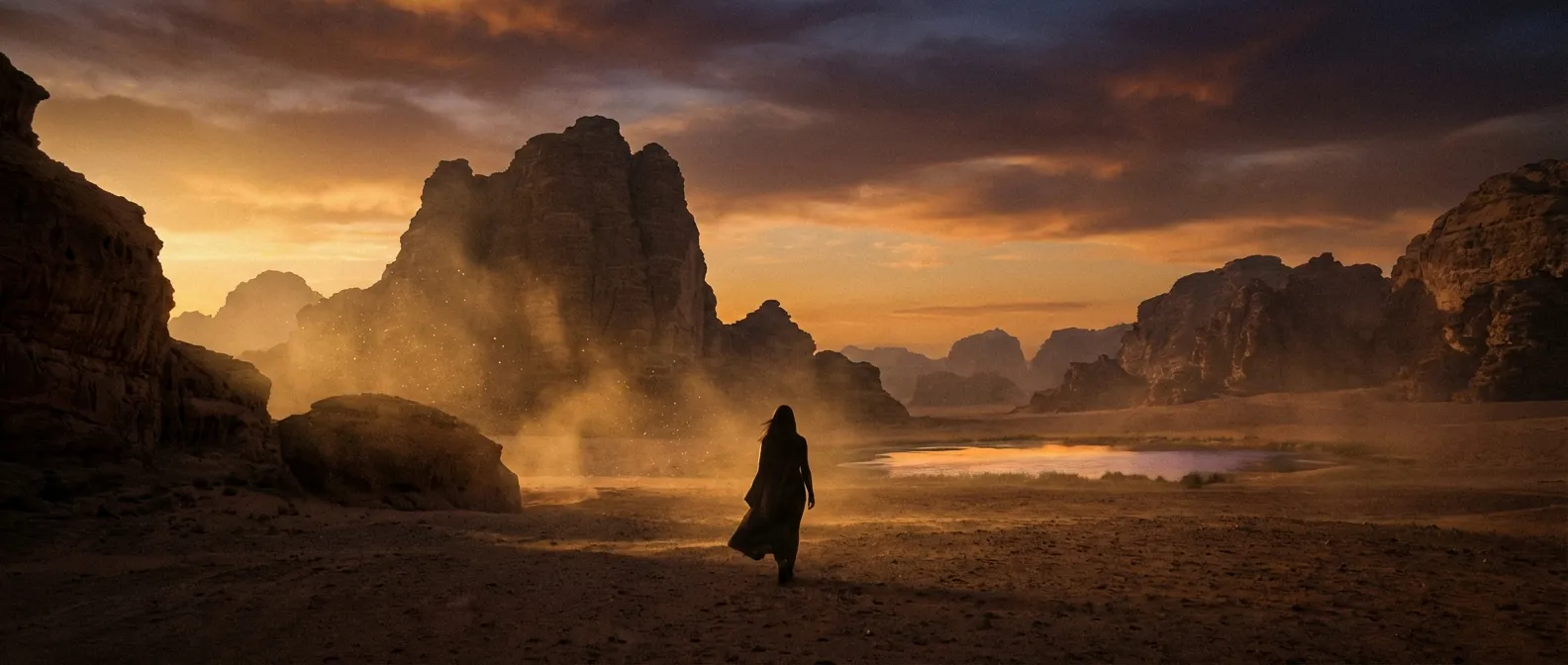
Pregnant, alone, with nothing, Hagar fled into the wilderness toward Shur — the road back to Egypt, back to the only home she’d ever known before she was someone’s property.
And here’s where the story breaks open.
Yahweh’s angel found her by a fountain of water in the wilderness, by the fountain on the way to Shur.
Read that again slowly.
Hagar didn’t find God. She wasn’t praying. She wasn’t on a spiritual retreat. She was running away, half-starved, probably terrified.
God found her.
In a culture where slaves were invisible, in a story where she had no voice, in a desert where no one was looking for her — the God of the universe came to a spring beside a dusty road and sat down with a runaway slave girl.
The angel asks her two questions: “Where have you come from, and where are you going?” (Genesis 16:8).
And Hagar answers with devastating honesty: “I’m running away from my mistress Sarai.”
She doesn’t dress it up. She doesn’t perform. She tells the truth to the only one who bothered to ask.
A Name No One Else Gave God
What happens next is one of the most under-preached moments in all of Scripture.
God gives Hagar a promise — her own promise. Not Abram’s. Not Sarai’s. Hers.
Yahweh’s angel said to her, “I will greatly multiply your offspring, that they will not be counted for multitude.”
A slave girl. Homeless. Pregnant. Alone in the desert. And God looks at her and says: You will be the mother of nations.
But it’s what Hagar does next that shatters me.
She called the name of Yahweh who spoke to her, “You are a God who sees,” for she said, “Have I even stayed alive after seeing him?”
El Roi. The God Who Sees.
In the entire Bible, this is the only time a human being gives God a new name. Not Abraham. Not Moses. Not David. Not Paul.
A discarded, abused, invisible slave woman looked into the face of the living God and named Him.
And the name she chose? Not “the God who rescued me” or “the God who punished my enemies.”
The God who sees me.
Because before she needed rescue, before she needed provision, before she needed anything else — she needed to be seen.
What It Means to Be Seen
There is a loneliness that goes deeper than being alone.
It’s the loneliness of being in a room full of people and feeling invisible. Of giving everything you have and being overlooked. Of carrying pain that nobody asks about. Of smiling on Sunday morning while something inside you is screaming.
Hagar knew that loneliness. She was surrounded by people — Abram’s camp was enormous — but she was invisible to all of them. She was a function, not a person. A womb, not a woman.
And the God of the universe crossed the gulf between heaven and a roadside spring to say: I see you.
Not “I see your usefulness.” Not “I see your sin.” Not “I see what you can do for me.”
I see you.
The Hebrew root of El Roi — ra’ah — means more than visual observation. It means to perceive, to regard, to pay attention to with care. It’s the difference between glancing at someone and truly looking at them.
God didn’t glance at Hagar. He beheld her.
And Then It Got Worse (Genesis 21)
Hagar obeyed. She went back. She bore Ishmael. And for over a decade, she lived in that fractured household.
Then Isaac was born — the promised child, the miracle baby — and suddenly Ishmael was a threat. Sarah (newly renamed) saw Ishmael playing with Isaac and demanded his removal.
Therefore she said to Abraham, “Cast out this servant and her son! For the son of this servant will not be heir with my son, Isaac.”
And Abraham — the father of faith, the friend of God — sent them away with a loaf of bread and a skin of water.
Into the desert. Again.
This time Hagar wasn’t running. She was expelled. Cast out with a teenage boy and a canteen that wouldn’t last a day.
When the water ran out, Hagar did the most heartbreaking thing any mother has ever done in Scripture:
The water in the container was spent, and she put the child under one of the shrubs. She went and sat down opposite him, a good way off, about a bow shot away. For she said, “Don’t let me see the death of the child.” She sat opposite him, and lifted up her voice, and wept.
A bowshot away. Close enough to be near. Far enough to not watch her son die.
This is the floor. This is the lowest a person can go — sitting in sand, out of water, out of options, listening to your child moan, believing it’s over.
And God shows up. Again.
God heard the voice of the boy. The angel of God called to Hagar out of the sky, and said to her, “What troubles you, Hagar? Don’t be afraid. For God has heard the voice of the boy where he is.…”
He calls her by name. Not “slave.” Not “that woman.” Hagar.
And then:
God opened her eyes, and she saw a well of water. She went, filled the container with water, and gave the boy a drink.
The well was there the whole time. She just couldn’t see it.
Sometimes God doesn’t change your circumstances. He opens your eyes in the middle of them.
This Is About You
Maybe you read Hagar’s story and felt something tighten in your chest.
Maybe you know what it’s like to be used for what you produce — your work, your ministry, your body, your time — and then discarded when you’re inconvenient.
Maybe you’ve run into your own desert. Maybe you were pushed into one.
Maybe right now, you’re sitting a bowshot away from something you love, and you can’t watch it die, and the water is gone, and you’re starting to believe that no one is coming.
Here’s what Hagar’s story says to you:
El Roi sees you.
He sees the tears you cry in the car before you walk into work. He sees the 2 a.m. anxiety that no one else knows about. He sees the marriage that looks fine on Instagram. He sees the loneliness in the crowded church. He sees the exhaustion behind the volunteer smile.
He doesn’t just know about it. He sees you. He beholds you with care, with attention, with intention.
And He is not far away.
Reflect
Take a few minutes. Don’t rush past this.
-
Where in your life do you feel unseen right now? Be specific. Name it — even if only to yourself and God.
-
Hagar didn’t go looking for God — He came to her. How does that challenge the idea that you need to “get it together” before God shows up?
-
The well was already there. Is there provision in your life right now that you haven’t been able to see? Ask God to open your eyes.
-
God called Hagar by name. Spend a moment in silence and let this truth settle: the Creator of the universe knows your name. He is not too busy. He is not looking away.
A Prayer
God, I don’t even know how to say this except honestly: I feel unseen. I’ve been carrying things that no one has asked me about. I’ve been showing up and pouring out, and sometimes it feels like the desert — dry and endless and alone.
But You are El Roi. You are the God who sees. Not the God who glances. The God who beholds.
See me today. Not my performance. Not my résumé. Me.
And if there’s a well I’ve been missing — open my eyes. I’m tired of stumbling in the dark.
In Jesus’ name, Amen.
Coming Next
Hagar’s story reveals a God who sees the invisible.
But what about the people who aren’t invisible — they’re just broken? The ones everybody can see, and nobody wants to touch?
In Part 2, we’re going to the edge of a pool called Bethesda, where a man has been lying for 38 years waiting for someone to help him — and Jesus asks him the most disruptive question in the Gospels:
“Do you want to get well?”
It sounds obvious. It isn’t. And the answer might cost you everything.