

What Will Heaven Actually Be Like? — It's Not What You Think (And It's Better)
Clouds, harps, and floating forever? Most people's picture of heaven sounds more like an eternal waiting room than a paradise. Here's what the Bible actually describes — and why it's wildly more physical, more beautiful, and more alive than anything you've imagined.
📖 The Other Side — What the Bible Actually Says About Eternity — Part 3 of 5
The Worst Sales Pitch in History
If I asked you to describe heaven right now — no Bible, no Googling, just whatever image comes to mind — what would you see?
Clouds. White robes. Maybe some harps. Vague light. Floating. Singing worship songs. Forever.
Now be honest: does that sound like something you actually want?
Because here’s the thing most people won’t say out loud: the popular version of heaven — the one absorbed from cartoons, funeral sermons, and greeting cards — sounds boring. Peaceful, sure. But boring. An eternity of sitting still in a white room doing one thing on repeat. If that’s the real offer, no wonder so many people struggle to get excited about it.
But here’s the twist: that’s not what the Bible describes. Not even close.
The Bible’s picture of eternity isn’t about leaving earth behind for some floaty, spiritual dimension. It’s about earth being healed. It’s not about escaping your body — it’s about getting a better one. It’s not an eternal church service. It’s a city, a feast, a kingdom, a garden, a homecoming, and a beginning.
And once you see what Scripture actually says, you’ll wonder why nobody told you sooner.
The Big Surprise: It’s Not “Going Up” — It’s God “Coming Down”
This might be the single most important thing most Christians get wrong about heaven.
The dominant assumption goes like this: you die, your soul floats up to heaven, and you live there forever as a spirit. Earth gets destroyed. Physical existence is over. The end.
But that’s not the biblical ending. Not even close. Here’s the actual climax of the entire Bible:
I saw a new heaven and a new earth, for the first heaven and the first earth have passed away, and the sea is no more. I saw the holy city, New Jerusalem, coming down out of heaven from God, prepared like a bride adorned for her husband. I heard a loud voice out of heaven saying, “Behold, God’s dwelling is with people; and he will dwell with them, and they will be his people, and God himself will be with them as their God.…”
Read that again slowly. The direction matters.
Heaven doesn’t stay up there. Heaven comes down. God’s dwelling place moves to humanity. The final destination isn’t us leaving earth — it’s God joining us on a renewed earth. The whole biblical story, from Genesis to Revelation, is about God closing the distance between Himself and His creation. Eden was God walking with humans. The tabernacle was God camping with Israel. The incarnation was God becoming human. And the ending? God making His permanent, visible, tangible home with us.
As theologian N.T. Wright puts it: “Heaven is important, but it’s not the end of the world.”
The intermediate state — what happens between death and resurrection — is real. As we explored in Part 1, believers who die are “with Christ” (Philippians 1:23), which Paul calls “far better.” That’s genuine comfort. But it’s the waiting room, not the final destination. The final destination is resurrection on a renewed creation.
A Real Body, Not a Ghost
This changes everything about what “eternal life” actually looks like.
The Christian hope isn’t immortality of the soul. That’s Plato. The Christian hope is resurrection of the body.
Paul goes to extraordinary lengths to make this point in 1 Corinthians 15 — the longest single argument in any of his letters:
But someone will say, “How are the dead raised?” and, “With what kind of body do they come?” … So also is the resurrection of the dead. The body is sown perishable; it is raised imperishable. It is sown in dishonor; it is raised in glory. It is sown in weakness; it is raised in power. It is sown a natural body; it is raised a spiritual body. — 1 Corinthians 15:35, 42-44
“Spiritual body” doesn’t mean “non-physical.” It means a body animated and empowered by the Spirit of God. Think about what happened to Jesus after His resurrection — He’s the prototype, the “firstfruits” of what’s coming for everyone who belongs to Him (1 Corinthians 15:20):
- He ate food. Grilled fish on the beach (John 21:12-13). This wasn’t symbolic — He chewed, swallowed, and apparently enjoyed it.
- He could be touched. He told Thomas to put his finger in the nail marks (John 20:27). He was physical enough to grab.
- He walked, talked, and traveled. He walked the road to Emmaus (Luke 24:15). He appeared in different locations.
- He was recognizable — eventually. Mary knew His voice when He said her name (John 20:16). The disciples recognized Him at breakfast.
- But He was also more. He appeared in locked rooms (John 20:19). He vanished at will (Luke 24:31). His body had real continuity with the old one (the scars were still there), but it had been transformed into something new.
Whatever the resurrection body is, it’s not less physical than what we have now — it’s more. It’s physicality upgraded, redeemed, set free from decay and limitation.
who will change the body of our humiliation to be conformed to the body of his glory, according to the working by which he is able even to subject all things to himself.
You will have a body. You will eat. You will touch. You will move through a real, material world. But everything that makes physical existence painful — disease, aging, fatigue, death — will be gone.
A Real Place: The New Earth
So if we have real bodies, where do we live?
The answer isn’t “the clouds.” It’s a renewed earth.
The prophets saw this coming long before John wrote Revelation:
“For, behold, I create new heavens and a new earth; and the former things will not be remembered, nor come into mind… They will build houses and inhabit them. They will plant vineyards and eat their fruit. They will not build and another inhabit. They will not plant and another eat.” — Isaiah 65:17, 21-22
Notice the verbs: build, dwell, plant, eat. This isn’t a description of spirits floating in light. It’s a description of a world — but one where the curse has been reversed.
Peter picks up the same thread:
But, according to his promise, we look for new heavens and a new earth, in which righteousness dwells.
The word “new” in Revelation 21:1 (kainos in Greek) doesn’t mean “brand new, totally different.” It means renewed, restored, made fresh. It’s the same word used for the “new covenant” — which didn’t erase the old covenant but fulfilled and transformed it. The new earth isn’t a replacement for this one; it’s this earth set free.
Paul hints at the same thing in one of the most overlooked passages in the New Testament:
For the creation waits with eager expectation for the children of God to be revealed. For the creation was subjected to vanity, not of its own will, but because of him who subjected it, in hope that the creation itself also will be delivered from the bondage of decay into the liberty of the glory of the children of God.
Creation itself is waiting for liberation. The mountains, the oceans, the forests — they groan under the weight of the fall, and they’re anticipating restoration. The final chapter isn’t the destruction of the physical world. It’s its healing.
Think about what that means. The things you’ve loved about this earth — sunsets that stopped you in your tracks, the smell of rain, the vastness of the ocean, the sound of wind through trees — those aren’t distractions from the spiritual life. They’re previews. Trailers for what’s coming.
The City: New Jerusalem
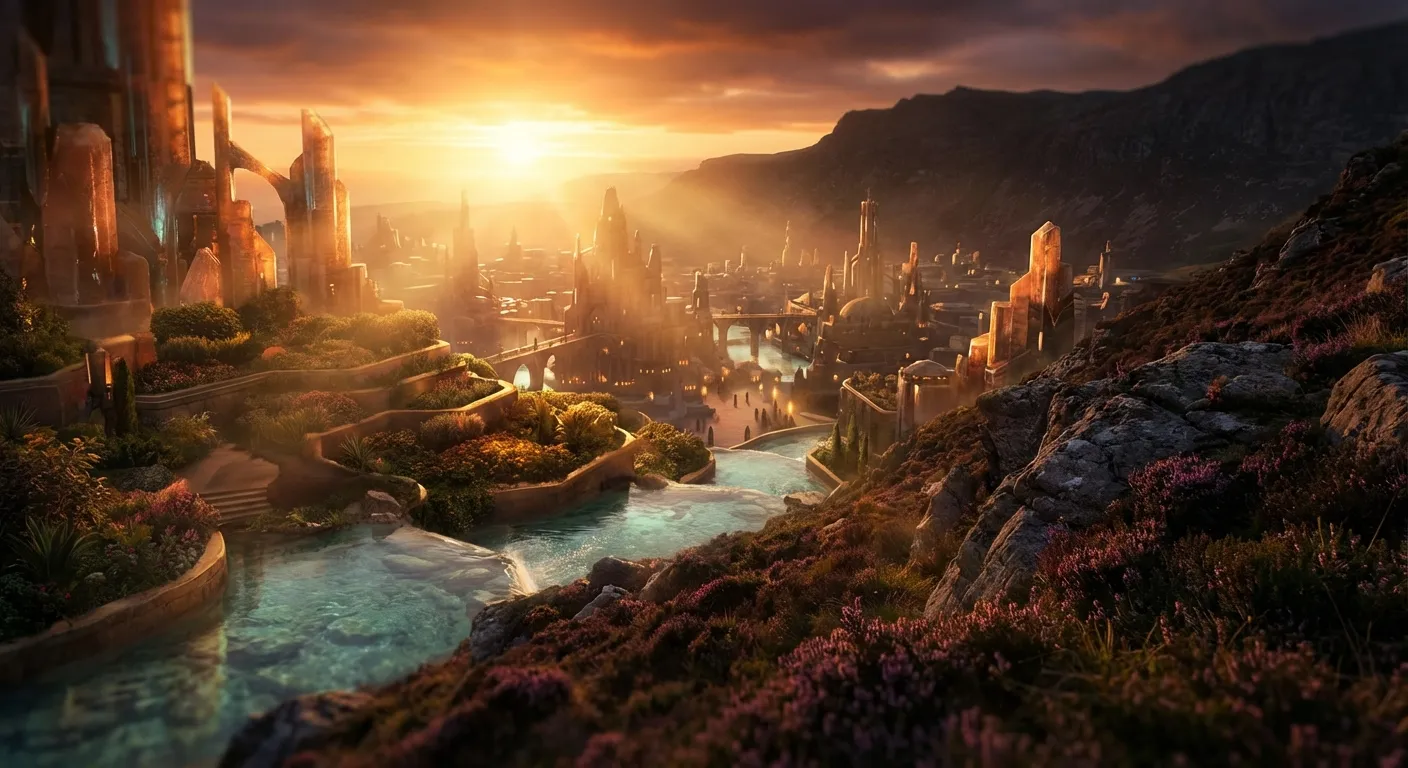
Revelation gives us one extended picture of the eternal home, and it’s fascinating — not because it’s meant to be taken as a literal architectural blueprint, but because of what every detail communicates.
Having the glory of God. Her light was like a most precious stone, like a jasper stone, clear as crystal; having a great and high wall with twelve gates… The construction of its wall was jasper. The city was pure gold, like pure glass. The foundations of the city’s wall were adorned with all kinds of precious stones. — Revelation 21:11-12, 18-19
The city is described as approximately 1,400 miles in each direction — a perfect cube (Revelation 21:16). That’s the distance from New York to Dallas… on each side. Whether the dimensions are literal or symbolic, the message is clear: this isn’t a small corner of paradise. There’s room. Abundance. Overflow.
And the cube shape matters. In the Old Testament, only one structure was a perfect cube: the Holy of Holies in Solomon’s temple (1 Kings 6:20) — the place where God’s presence dwelled. The entire New Jerusalem is designed as one enormous Holy of Holies. The whole city is the inner sanctum. Every street, every home, every corner is saturated with the direct, unmediated presence of God.
That’s why John writes:
I saw no temple in it, for the Lord God the Almighty and the Lamb are its temple. The city has no need for the sun or moon to shine, for the very glory of God illuminated it and its lamp is the Lamb.
No temple — because you don’t need a building to meet God when God is everywhere. No sun — not because there’s no light, but because there’s so much light that the sun is redundant. This isn’t darkness; it’s the brightest place that ever existed.
What Won’t Be There
Sometimes the most powerful way to describe a place is to say what’s missing. And John’s list of absences is staggering:
“…He will wipe away every tear from their eyes. Death will be no more; neither will there be mourning, nor crying, nor pain any more. The first things have passed away.”
Let that list sink in:
- No death. No funerals. No cancer diagnoses. No phone calls at 2 AM. No hospice. No wondering if today is the last day.
- No mourning. No grief. No heartbreak. No loss. No standing over a grave. No empty chairs at the table.
- No crying. Not that joy will be restrained — but the tears of suffering, of betrayal, of loneliness, of failure — those will be gone forever.
- No pain. Not just physical pain. Emotional pain. Relational pain. The ache of wanting something you can’t have. The sting of being misunderstood. The weight of shame. Gone. All of it.
And the reason is the very next verse:
He who sits on the throne said, “Behold, I am making all things new.” He said, “Write, for these words of God are faithful and true.”
Not “I am making new things.” That would be replacement. “I am making everything new.” That’s redemption. That’s restoration. God takes what was broken and makes it whole. He doesn’t discard your story — He redeems it.
What Will We Actually Do?
This might be the most common question people never think to ask. If heaven goes on forever… what fills the time?
The answer is: far more than singing.
We’ll Reign
There will be no night, and they need no lamp light or sun light; for the Lord God will illuminate them. They will reign forever and ever.
This echoes God’s original mandate to humanity in Genesis 1:28 — to have dominion, to steward creation, to rule as His representatives. That mandate wasn’t a temporary assignment. It was the purpose. And in the new creation, it’s finally fulfilled. We will have meaningful work, real authority, and genuine responsibility — without the frustration, futility, and corruption that make work feel like a grind now.
Jesus hints at this in His parables: the faithful servant who managed five talents is given ten cities (Luke 19:17). Not a retirement package. More responsibility. Greater scope. Expanded creativity.
We’ll Create
If we’re made in the image of a Creator — and that image is fully restored — then creativity will be central to eternal life. Art, music, architecture, cultivation, exploration, invention. Not as hobbies to fill empty hours, but as expressions of a fully alive, fully free, fully empowered humanity.
Isaiah’s vision includes building and planting (Isaiah 65:21-22). If the new earth is a real material world, there will be things to build. The difference? Nothing will be built from anxiety, nothing will be motivated by competition, and nothing will decay.
We’ll Feast
He said to me, “Write, ‘Blessed are those who are invited to the wedding supper of the Lamb.’” He said to me, “These are true words of God.”
Jesus repeatedly described the kingdom as a feast — a banquet, a celebration, a party. He began His ministry at a wedding and turned water into really excellent wine. He spent so much time eating with people that His critics called Him a glutton (Matthew 11:19).
Eating is one of the most communal, joyful, embodied experiences humans have. And Jesus placed it right at the center of eternity. The final picture isn’t a library — it’s a table.
We’ll Know and Be Known
For now we see in a mirror, dimly, but then face to face. Now I know in part, but then I will know fully, even as I was also fully known.
Every relationship you’ve ever had has been filtered through misunderstanding, insecurity, and self-protection. Every conversation has been limited by what you couldn’t say or they couldn’t hear. That veil lifts. Full transparency. Full understanding. Full intimacy — with God and with each other.
The loneliness, the feeling of being unseen, the ache of being known and rejected or unknown and isolated — all of it resolved. Finally, completely, permanently.
The Center of It All
But here’s what matters most — the thing that makes all of this more than just a really impressive real estate listing:
I heard a loud voice out of heaven saying, “Behold, God’s dwelling is with people; and he will dwell with them, and they will be his people, and God himself will be with them as their God.…”
Every detail of the new creation orbits one central reality: God is there, and there’s nothing between you and Him anymore.
That’s the point. The golden streets and precious stones aren’t the attraction — He is. The removal of pain and death aren’t the main event — His presence is. Every good thing about the new creation flows from one source: unhindered, face-to-face, unbreakable communion with the God who made you, died for you, and moved heaven and earth — literally — to be with you.
The whole Bible is a love story driving toward this moment. God walks with Adam. Sin breaks it. God chases humanity through covenants, prophets, kings, exile, and return. God becomes human. God dies. God rises. God sends His Spirit. And at the very end, God moves in. Permanently.
They will see his face, and his name will be on their foreheads.
Seeing His face. In the Old Testament, no one could see God’s face and live (Exodus 33:20). Moses, the closest friend God had on earth, could only see God’s back. But in the new creation, you’ll see His face. The barrier is gone. The veil is torn. The distance is closed.
And it won’t get old. Because God is infinite, eternity won’t be repetition — it’ll be endless discovery. Deeper beauty. Deeper knowledge. Deeper love. Every moment better than the last, forever, with no ceiling and no end.
Why This Matters Right Now
This isn’t just theology for the afterlife. What you believe about the future shapes how you live in the present.
If you think heaven is an escape from the physical world, you’ll treat the physical world as disposable — your body, your neighborhood, this earth. Why bother?
But if the future is a renewed creation — physical, tangible, material, real — then what you do with your body, your community, your work, and this earth matters. It’s practice. It’s preparation. It’s a preview.
When you build something good — a family, a friendship, a just community, a beautiful piece of art — you’re participating in something that will outlast the sun.
When you fight for justice, heal the sick, feed the hungry, or comfort the grieving, you’re doing on earth what God will do permanently in the new creation. You’re borrowing from the future and pulling it into the present.
When you forgive someone, you’re breaking the power of the old creation and releasing a tiny preview of the new.
And when suffering comes — because it will — you can grieve fully while holding onto this:
For I consider that the sufferings of this present time are not worthy to be compared with the glory which will be revealed toward us.
Not “the glory that we will escape to.” The glory that will be revealed — uncovered, unveiled, made manifest in us and in all of creation. The same creation that groans now will one day sing.
Reflection Questions
-
What has been your mental picture of heaven? Where did that image come from — Scripture, culture, or something else? How does the biblical picture differ?
-
Does the idea of a renewed, physical earth change how you think about eternity? What excites you about it? What surprises you?
-
Read Romans 8:19-21. What does it mean that creation itself is “waiting” and “groaning”? How does this change how you view the natural world?
-
If eternity involves meaningful work, creativity, and authority — not just rest — how does that change what you look forward to?
-
How might a robust theology of the new creation change the way you live this week? Your work, your relationships, your body, your community?
-
Read Revelation 21:3-5. The center of eternity is God’s presence, not God’s stuff. What does it look like to orient your life around His presence now?
Up Next
We’ve seen what the Bible says happens when you die. We’ve walked through the debate about hell. And now we’ve seen what the new creation actually looks like — and it’s far more beautiful, more physical, and more alive than most of us ever imagined.
But that raises the hardest question in the whole series:
If a loving God is preparing something this good… how could He send anyone to hell?
Is that a contradiction? A cruelty? Or is there something deeper going on — something about love itself that we’ve been misunderstanding?
That’s Part 4: “How Can a Loving God Send People to Hell?” — and it might be the most important thing we’ve tackled yet.