

The Prostitute in the Bloodline of Jesus — How a Canaanite Sex Worker Ended Up in the Gospel
She was a Canaanite. A prostitute. An enemy of God's people. She had zero theological training and every reason to be destroyed along with her city. But when the walls of Jericho fell, one house stayed standing — and the woman inside it became the great-great-grandmother of King David and a direct ancestor of Jesus Christ. Rahab's story rewrites who gets to belong in God's family.
📖 The Résumé God Threw Away — Part 2 of 2
The Worst Possible Ancestor
Open your Bible to the very first page of the New Testament. Matthew 1. The genealogy of Jesus Christ.
Most people skip this part. It’s a list of names, most of them unpronounceable, and it feels like the biblical equivalent of reading someone’s phone contacts. But Matthew didn’t write this genealogy to bore you. He wrote it to shock you.
Because buried in that list — wedged between the patriarchs and the kings, right there in the sacred bloodline of the Messiah — is a name that made every first-century Jewish reader do a double-take:
Salmon became the father of Boaz by Rahab. Boaz became the father of Obed by Ruth. Obed became the father of Jesse.
Rahab.
Not “Rahab the Israelite.” Not “Rahab the prophetess” or “Rahab the noble convert.” Just… Rahab. And every person reading Matthew’s Gospel knew exactly who she was. Because in all of Hebrew Scripture, there is only one Rahab — and she’s introduced with the single most disqualifying label a person could carry in the ancient world:
Joshua the son of Nun secretly sent two men out of Shittim as spies, saying, “Go, view the land, including Jericho.” They went and came into the house of a prostitute whose name was Rahab, and slept there.
A prostitute. A Canaanite prostitute. A pagan, idol-worshiping, enemy-nation prostitute. And God put her in the family tree of His Son.
If that doesn’t wreck your theology of who’s “in” and who’s “out,” nothing will.
Who Rahab Actually Was
Let’s not sanitize this. Some commentators through the centuries have tried to soften Rahab’s story — she was an “innkeeper,” they say, or the Hebrew word zanah might mean something milder than what it seems. It doesn’t. Every major usage of zanah in the Old Testament means exactly what you think it means. The New Testament confirms it: both Hebrews 11:31 and James 2:25 call her pornē in Greek — the root of our word “pornography.” There’s no ambiguity.
Rahab was a sex worker. In a Canaanite city. At a time when prostitution was often intertwined with temple worship — fertility cults, ritual sex acts dedicated to gods like Baal and Asherah. Jericho wasn’t just a military target; it was the epicenter of everything Israel’s God stood against: child sacrifice, sexual ritual, spiritual corruption so deep that God Himself had declared judgment on it.
And Rahab lived in the thick of it. Not as a bystander. As a participant. Her house was built into the city wall itself (Joshua 2:15) — a detail that tells us she was poor, marginal, literally living on the edge. In the ancient world, houses built into defensive walls were the least desirable real estate. They were vulnerable, exposed, the first to fall in a siege.
Rahab was a woman at the bottom of the bottom. Wrong nationality. Wrong religion. Wrong profession. Wrong side of the wall.
And God chose her anyway.
The Night Everything Changed
Here’s the scene. Israel is camped across the Jordan River. Forty years of wilderness wandering are finally over. Joshua, Moses’ successor, has one target: Jericho. The fortified city that stands between Israel and the Promised Land. So he sends two spies to scout it out.
And those two spies end up at Rahab’s door.
We don’t know why they went there. Maybe it was strategic — a prostitute’s house would be one of the few places two foreign men could enter without drawing immediate suspicion. Maybe it was God’s sovereign orchestration, placing them in the one home where the walls were about to crack — physically and spiritually. Either way, they entered, and word reached the king of Jericho almost immediately.
The king of Jericho was told, “Behold, men of the children of Israel came in here tonight to spy out the land.” Jericho’s king sent to Rahab, saying, “Bring out the men who have come to you, who have entered into your house; for they have come to spy out all the land.”
This is the moment. The king’s soldiers are at the door. Two Israelite spies are on her roof, hiding under stalks of flax. Rahab has approximately two seconds to make a decision that will determine the rest of her life — and, as it turns out, the genealogy of the Messiah.
She lies. Boldly, brazenly, without hesitation.
The woman took the two men and hid them. Then she said, “Yes, the men came to me, but I didn’t know where they came from. About the time of the shutting of the gate, when it was dark, the men went out. Where the men went, I don’t know. Pursue them quickly. You may catch up with them.”
Now, let’s press pause and be honest: the ethics of Rahab’s lie have been debated by theologians for millennia. Was it right to deceive the king? Was the lie justified because it protected innocent lives? Augustine said no lie is ever justified. Other scholars argue she acted in the moral hierarchy of preserving life over truth-telling. We can sit with that tension.
But here’s what’s not debatable: Rahab risked everything. If the king’s men discovered the spies on her roof, she would have been executed. Her family would have been killed. She had nothing to gain and everything to lose. And she chose the God of Israel over the king of Jericho.
That’s not a small thing. That’s the biggest bet a person can make.
The Confession That Came Out of Nowhere
After the soldiers leave on their wild goose chase, Rahab climbs to the roof. And what she says next is, frankly, one of the most stunning confessions of faith in the entire Old Testament.
Remember: she’s a Canaanite prostitute. She has no Torah. No covenant. No prophets. No Sunday school. She has never heard a sermon, attended a sacrifice, or sang a psalm. Everything she knows about Israel’s God, she learned secondhand — through rumors, travelers’ tales, whispered reports filtering through the walls of a terrified city.
And yet listen to what she says:
She said to the men, “I know that Yahweh has given you the land, and that the fear of you has fallen upon us, and that all the inhabitants of the land melt away before you. For we have heard how Yahweh dried up the water of the Red Sea before you, when you came out of Egypt; and what you did to the two kings of the Amorites, who were beyond the Jordan, to Sihon and to Og, whom you utterly destroyed. As soon as we had heard it, our hearts melted, and there wasn’t any more spirit in any man, because of you: for Yahweh your God, he is God in heaven above, and on earth beneath.…”
She’s recounting the Exodus. The Red Sea. The military victories. She’s been paying attention. She’s been listening to the stories — stories that made everyone else in Jericho terrified and angry — and she drew a completely different conclusion from her neighbors.
Then comes the knockout line:
As soon as we had heard it, our hearts melted, and there wasn’t any more spirit in any man, because of you: for Yahweh your God, he is God in heaven above, and on earth beneath.
Read that again. Slowly.
The LORD your God is God in heaven above and on the earth below.
That’s not hedging. That’s not “your God is one of many gods” or “your God seems powerful.” That’s a total, exclusive, monotheistic confession. In a polytheistic culture where every city had its own deity and every natural force had its own idol, Rahab looked at the evidence and declared: there is one God, and He’s yours. Not Baal. Not Asherah. Not the gods of Jericho. The LORD. Yahweh.
A Canaanite prostitute with no training, no Scripture, and no community of faith articulated a theological statement that some seminary students would struggle to improve upon.
How? How does someone on the outside, with every disadvantage, arrive at a clearer confession than people who’ve had the truth handed to them?
Because faith isn’t about having the right information. It’s about having the right response to whatever information you’ve been given. Rahab heard the stories. She believed them. She acted on them. And that — not her résumé, not her past, not her nationality — is what God called faith.
By faith Rahab the prostitute didn’t perish with those who were disobedient, having received the spies in peace.
“By faith.” Those two words put Rahab in the company of Abraham, Moses, David, and every hero of the faith. The Hall of Fame of Hebrews 11 includes a prostitute — and the writer isn’t embarrassed about it. He doesn’t soften it or explain it away. He says her name, her profession, and then the word “faith” in the same breath.
Because that’s what God does with people who trust Him. He doesn’t wait until you’re cleaned up. He meets you in the mess.
The Scarlet Cord
Rahab makes a deal with the spies. She saved their lives; now she asks them to save hers.
“…Now therefore, please swear to me by Yahweh, since I have dealt kindly with you, that you also will deal kindly with my father’s house, and give me a true sign; and that you will save alive my father, my mother, my brothers, and my sisters, and all that they have, and will deliver our lives from death.”
Notice what she asks for. Not just her own life — her family’s. Her mother, her father, her brothers, her sisters. Everyone. Rahab isn’t just saving herself; she’s interceding for her entire household. She’s the first evangelist in her family, pulling everyone she loves under the umbrella of a God she just met.
The spies agree. And they give her a sign:
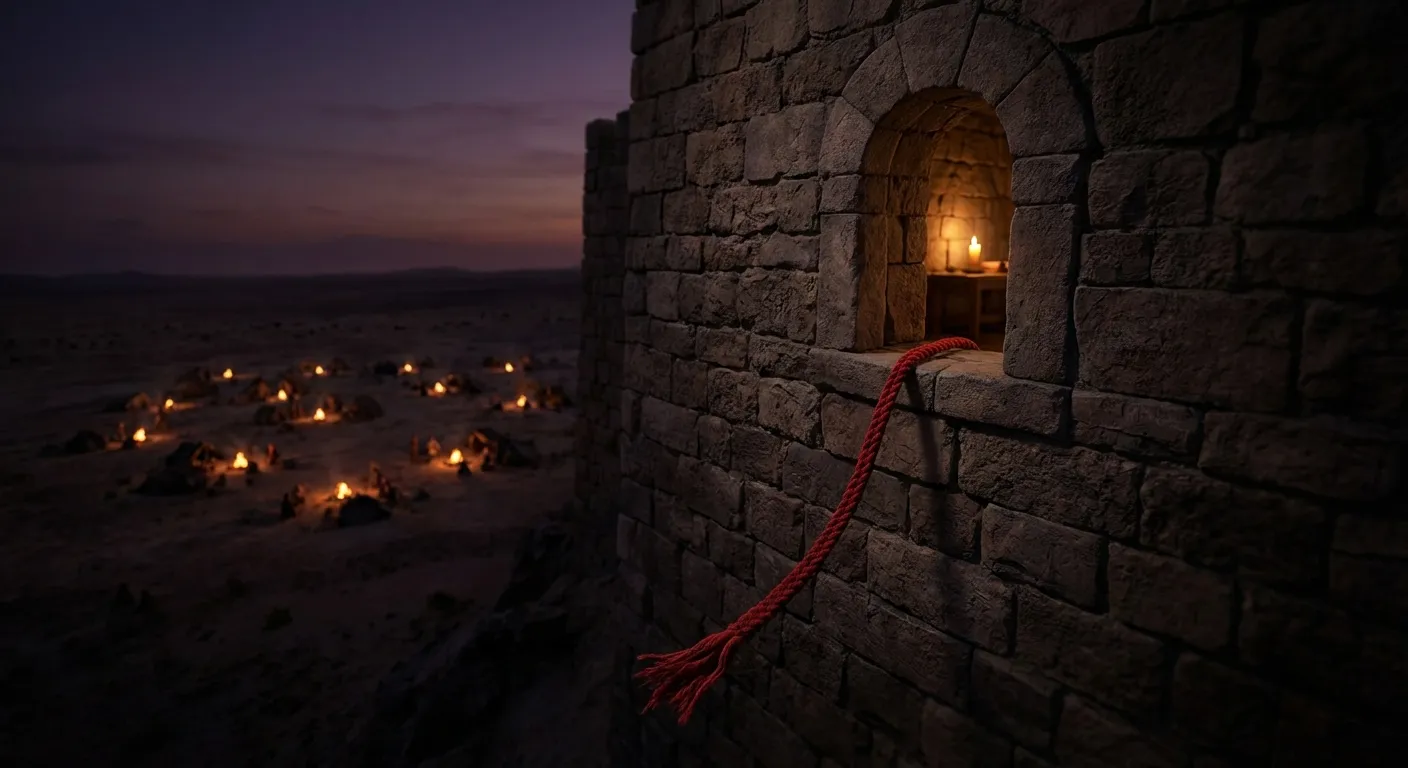
Behold, when we come into the land, tie this line of scarlet thread in the window which you used to let us down. Gather to yourself into the house your father, your mother, your brothers, and all your father’s household.
A scarlet cord. A red rope hanging from a window in the city wall.
Now, the text doesn’t make this connection explicitly, but every fiber of biblical theology vibrates when you see it. A scarlet cord. Red. The color of blood. Tied to a house to mark it for salvation while judgment falls all around.
Where have we heard that before?
Egypt. The Passover. The blood of a lamb painted on the doorframes of Israelite homes so the angel of death would pass over them (Exodus 12:7, 13). The same God. The same logic. The same crimson marker between death and deliverance.
The Israelites in Egypt were saved by blood on a doorframe. A Canaanite prostitute in Jericho was saved by a scarlet cord in a window.
And centuries later, a Man would hang on a cross — and His blood would become the scarlet cord for the entire human race.
The red thread that runs through the whole Bible starts in an Egyptian doorframe, passes through a prostitute’s window, and ends on a Roman cross. And in every case, it marks the same thing: This one is Mine. Judgment passes here. Grace lives here.
The Walls Came Down. Her House Didn’t.
You know the story. Israel marched around Jericho for seven days. On the seventh day, seven times. The priests blew trumpets. The people shouted. And the walls collapsed.
So the people shouted and the priests blew the trumpets. When the people heard the sound of the trumpet, the people shouted with a great shout, and the wall fell down flat, so that the people went up into the city, every man straight in front of him, and they took the city.
Every wall fell. The entire defensive structure of the city crumbled. Except one section.
Rahab’s house was built into the wall. The very structure that collapsed was the structure she lived in. By every law of physics, her house should have been the first to go. She was literally in the weakest, most vulnerable, most exposed position in the entire city.
And her section held.
The text doesn’t explain how. It doesn’t need to. When God makes a promise, the physics cooperate. The scarlet cord hung from a window in a wall that God decided wouldn’t fall, because the woman behind that window had placed her faith in a God she barely knew — and it was enough.
But Rahab the prostitute, her father’s household, and all that she had, Joshua saved alive. She lives in the middle of Israel to this day, because she hid the messengers whom Joshua sent to spy out Jericho.
“She lives among the Israelites to this day.” That’s the quiet revolution in a single sentence. The outsider became an insider. The Canaanite became an Israelite. The woman who had spent her life in the margins was grafted into the center of God’s people.
Not as a second-class citizen. Not as a tolerated exception. She was received, accepted, and — as we’re about to see — woven into the most important family tree in history.
From the Wall to the Bloodline
Here’s where Rahab’s story becomes almost unbelievable.
She didn’t just survive Jericho. She married an Israelite named Salmon. She had a son named Boaz — you know Boaz, the kinsman-redeemer from the book of Ruth, the man whose kindness to another outsider woman became one of the most beautiful love stories in Scripture. Boaz married Ruth. Ruth and Boaz had Obed. Obed had Jesse. Jesse had David.
David. The king. The greatest ruler in Israel’s history. The man after God’s own heart.
Rahab was David’s great-great-grandmother.
And through David’s line came Jesus of Nazareth. The Son of God. The Messiah. The Savior of the world.
Salmon became the father of Boaz by Rahab. Boaz became the father of Obed by Ruth. Obed became the father of Jesse. Jesse became the father of King David. David the king became the father of Solomon by her who had been Uriah’s wife.
Matthew could have left Rahab out. Ancient genealogies routinely skipped women, especially women with scandalous backgrounds. He included her on purpose. He wanted you to see her name there. He wanted you to notice that the bloodline of Jesus Christ passes directly through a Canaanite prostitute — and that God is not embarrassed by it.
In fact, Matthew highlights four women in Jesus’ genealogy: Tamar (who disguised herself as a prostitute), Rahab (who was one), Ruth (a Moabite outsider), and Bathsheba (identified only as “Uriah’s wife” — a reminder of David’s adultery). Every single one of them carries a scandal. Every single one of them is an outsider in some way. And every single one of them is essential to the coming of Christ.
God didn’t just allow broken people into the Messiah’s family tree. He chose them. Deliberately. As if to say: The story of salvation has never been about pristine résumés. It’s about scandalous grace.
What Rahab Teaches Us About Faith
James — the brother of Jesus — uses Rahab to make one of the most important theological points in the New Testament:
In the same way, wasn’t Rahab the prostitute also justified by works when she received the messengers and sent them out another way? For as the body apart from the spirit is dead, even so faith apart from works is dead.
James pairs Rahab with Abraham. Abraham, the father of the faith, and Rahab, the prostitute from the wall. Side by side. Equals. Both “considered righteous” — not because of their backgrounds, but because of what they did with their faith.
Abraham believed God and offered Isaac. Rahab believed God and hid the spies. Both of them took their invisible faith and made it visible through risk. Neither of them sat on the sidelines saying, “I believe, I believe” while doing nothing. They wagered everything on a God they couldn’t see.
That’s what real faith looks like. It’s not a feeling. It’s not an intellectual agreement. It’s not checking a box that says “I accept these propositions.” Real faith is Rahab on the roof, soldiers pounding on the door, two spies hidden under the flax, making a split-second decision to bet her life and her family’s life on a God she’s only heard rumors about.
And God honored it. Not because it was perfect — it came packaged in a lie, from a woman whose life was a mess, in a culture that was under judgment. But it was real. It was a genuine response to genuine revelation. Rahab heard about God, believed what she heard, and acted on it.
God doesn’t wait for your theology to be polished. He doesn’t wait for your life to be sorted. He doesn’t wait for you to have the right vocabulary, the right community, the right history. He looks for one thing: faith. Even messy faith. Even mustard-seed faith. Even faith that can barely articulate itself and comes wrapped in a life that looks nothing like a Sunday school flannel graph.
If Rahab’s faith was enough, yours is too.
The Scandal of Grace
Here’s what Rahab’s story really comes down to:
Grace is scandalous. It always has been. The Pharisees were scandalized that Jesus ate with sinners. The older brother was scandalized that the prodigal got a party. The workers who labored all day were scandalized that the latecomers got the same wage. And religious people in every generation are scandalized when God reaches past the “qualified” and picks up the broken, the stained, the wrong-side-of-the-wall people and says: “You’re Mine now.”
Rahab didn’t earn her way in. She couldn’t. There was no amount of good behavior that could undo her past or change her nationality or erase her profession. She was saved by grace through faith — the same way every person in the history of salvation has been saved.
for by grace you have been saved through faith, and that not of yourselves; it is the gift of God, not of works, that no one would boast.
Paul wrote those words centuries after Rahab. But Rahab lived them first. She didn’t come to God with a cleaned-up life. She came with a scarlet cord and a desperate prayer: Save me. Save my family. I believe You are who they say You are.
And God said yes.
Not “yes, but you need to do penance first.” Not “yes, but you’ll always be the outsider.” Not “yes, but we’ll keep this quiet.” Just — yes. Come in. You’re family now. And by the way, I’m putting your name in My Son’s genealogy. On the first page of the New Testament. Where everyone will see it. Because I want the whole world to know that this is the kind of God I am.
Your Scarlet Cord
Maybe you picked up this story thinking it was about someone else. An ancient woman in an ancient city with ancient problems.
But Rahab’s story is your story — or it could be.
Maybe you’re on the outside looking in. You don’t have the right background, the right upbringing, the right theological education. You’ve never felt like you belonged in church. You’ve walked past the doors and thought: That’s not for people like me.
Rahab was a Canaanite prostitute, and God put her in the bloodline of Jesus. There is no “not for people like me” in God’s economy.
Maybe your past haunts you. Decisions you made, things you did, a version of yourself you can’t un-become. You carry it like a weight, and every time you reach for God, something whispers: He knows what you did. He knows who you are.
He does know. He knew about Rahab too. And He chose her anyway — not in spite of her past, but as if to say that no past is beyond the reach of His grace.
Maybe you’re sitting in the wall right now. You can hear the marching. You can feel the tremors. Everything around you is about to collapse. And you’re wondering if there’s any way out, any rope to cling to, any hope that the God you’ve heard about might actually show up for someone like you.
Hang the scarlet cord. That’s all Rahab did. She took the rope, tied it to her window, gathered her family, and waited for the God of Israel to keep His word.
He did.
He always does.
Reflect
-
What’s your “wall”? What barrier — shame, background, identity, past choices — stands between you and believing God could actually use you? How does Rahab’s story challenge that barrier?
-
Rahab had almost no theological knowledge, but she acted on what she knew. Are you waiting until you understand everything before you trust God? What would it look like to act on the little you already know?
-
The scarlet cord saved everyone in Rahab’s house. Who are the people you would gather under the rope? Are you interceding for your family the way Rahab interceded for hers?
-
James says faith without action is dead (James 2:25-26). Rahab’s faith showed up in a concrete, risky decision. What does your faith look like in action? Is there a risk God is asking you to take?
-
God put Rahab — a Canaanite prostitute — in the genealogy of Jesus. What does that tell you about the kind of people God includes in His story? How does it change the way you see yourself? The way you see others?
A Prayer
God, I’ve been living like my past is my permanent address. I’ve been convinced that people like me don’t end up in Your story — that Your grace is for cleaner people, better people, people with more respectable résumés. But You put a prostitute in the bloodline of Your Son. You looked at a woman on the wrong side of the wall and said “You’re Mine.” So I’m hanging my scarlet cord today. I’m tying it to the window and gathering everyone I love inside. I don’t have perfect faith. I don’t have a perfect life. But I’ve heard about You, and I believe You are who they say You are — God in heaven above and on the earth below. That’s enough, right? You made it enough for Rahab. Make it enough for me. Amen.
This is Part 2 of “The Résumé God Threw Away.” If you missed Part 1, start with The Murderer Who Led a Nation Free — the story of how an 80-year-old fugitive with a body buried in the sand became the greatest liberator in the Old Testament.