

The Problem of Consciousness — Materialism's Hardest Problem
Science can map the brain down to individual neurons. But it still can't explain why you have subjective experience at all. The 'hard problem' of consciousness is materialism's deepest challenge.
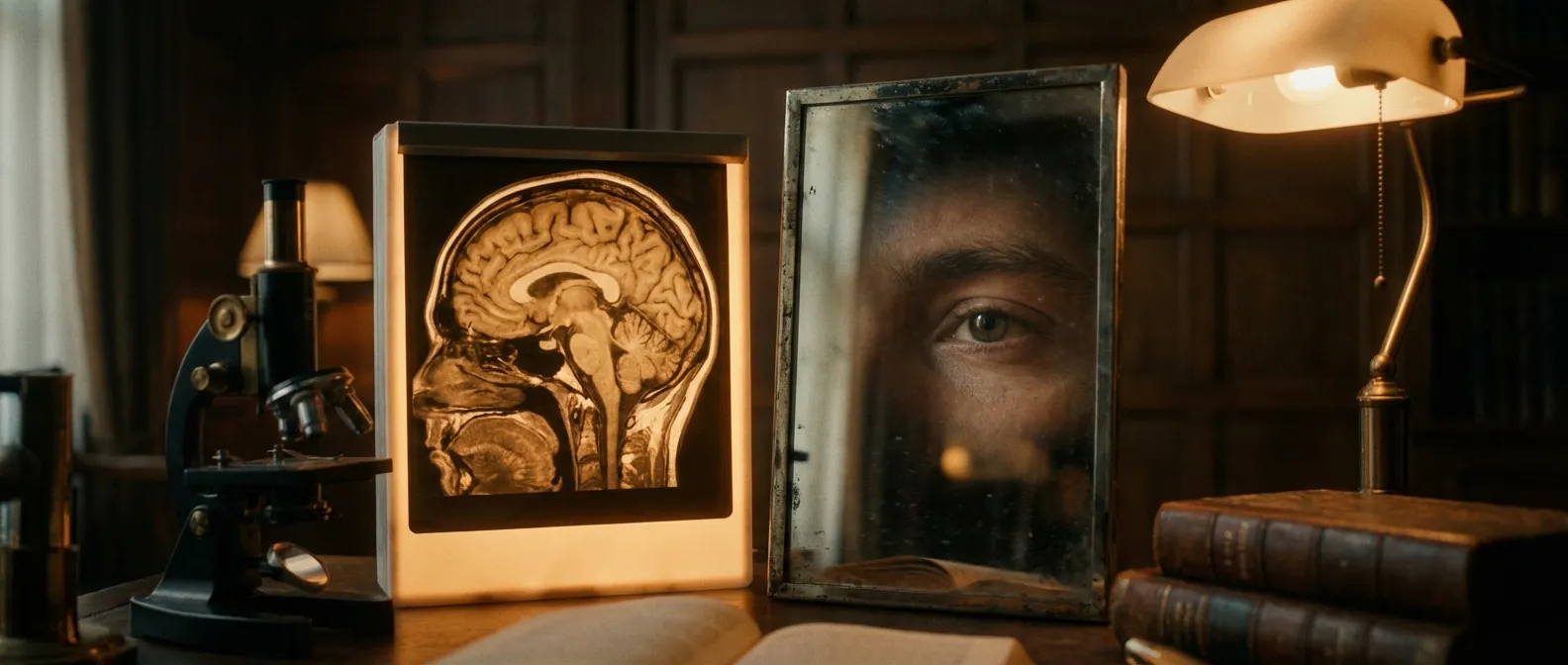
Close your eyes for a moment. Now open them.
You just experienced something. Not just “photons hitting retinas” and “electrical signals traversing neural pathways” — though all of that happened too. You experienced seeing. There was something it was like to open your eyes. A qualitative, subjective, first-person experience of light and color and form.
Now here’s the question that has baffled philosophers and neuroscientists for decades:
Why?
Why isn’t it all just processing? Why aren’t you a biological robot — taking in inputs, computing outputs, behaving appropriately — but with nobody home inside? Why is there an inner experience at all?
This is what philosopher David Chalmers calls the hard problem of consciousness. And it’s not just hard. It’s the deepest unsolved problem in all of science and philosophy — a problem that strikes at the foundations of materialism, the worldview that says physical matter is all there is.
The Easy Problems vs. The Hard Problem
In his landmark 1995 paper “Facing Up to the Problem of Consciousness,” Chalmers drew a distinction that reframed the entire field.
The easy problems of consciousness are about explaining cognitive functions and behaviors:
- How does the brain process visual information?
- How do we discriminate between stimuli?
- How does the brain integrate information from different senses?
- How do we focus attention?
- How do we report on our internal states?
These are “easy” not because they’re simple — they’re staggeringly complex — but because they’re the kind of problems that neuroscience is equipped to handle. They’re about mechanisms. Given enough time and technology, we can plausibly map every neural circuit involved in processing a visual scene. We can explain the behavior.
The hard problem is different in kind, not just degree. It’s the problem of subjective experience — what philosophers call qualia. Why does the brain’s processing of wavelengths around 700 nanometers produce the subjective experience of redness? Not the ability to discriminate red from blue — that’s an easy problem. The experience itself. The way red looks to you from the inside.
Chalmers put it this way:
“Even when we have explained the performance of all the cognitive and behavioral functions in the vicinity of experience — perceptual discrimination, categorization, internal access, verbal report — there may still remain a further unanswered question: Why is the performance of these functions accompanied by experience?”
This isn’t a gap in our current knowledge that more brain scanning will fill. It’s a conceptual gap. No amount of information about neural firing patterns, neurotransmitter levels, or brain architecture logically entails the existence of subjective experience. You could know everything about the physics and chemistry of a brain and still have no explanation for why there’s someone experiencing anything.
The Philosophical Zombie
To sharpen the point, Chalmers introduced a thought experiment: the philosophical zombie (or “p-zombie”).
Imagine a being that is physically identical to you in every respect — same atoms, same neural connections, same brain states, same behavior. It walks, talks, laughs, cries, claims to enjoy sunsets and dislike Mondays. From the outside, it’s indistinguishable from a conscious person.
But inside, there’s nothing. No experience. No inner life. No “what it’s like.” It’s a perfect behavioral replica with no one home.
The question is: Is such a being conceptually possible?
If materialism is true — if consciousness is nothing more than physical processes — then a p-zombie should be impossible. If consciousness is just brain states, then something with identical brain states must have identical consciousness. No exceptions.
But most philosophers (including many materialists) concede that p-zombies are at least conceivable. You can coherently imagine a being with all the same physical properties but no inner experience. And if that’s conceivable, then consciousness isn’t logically entailed by physical properties. There’s something extra — something that physical description alone doesn’t capture.
This doesn’t prove materialism is false. Some philosophers argue that conceivability doesn’t guarantee metaphysical possibility. But it reveals a deep tension at the heart of the materialist worldview: if the physical facts don’t logically necessitate consciousness, then consciousness seems to be something above and beyond the physical.
The Explanatory Gap
The philosopher Joseph Levine coined the term “explanatory gap” in 1983 to describe this problem. Even if we could correlate every conscious experience with a specific brain state — “this pattern of neural firing = the experience of tasting chocolate” — the correlation itself would remain unexplained. Why does that particular pattern produce that particular experience? Why doesn’t it produce the experience of smelling roses, or no experience at all?
Correlations aren’t explanations. We can map the brain with increasing precision — and neuroscience has made breathtaking progress in doing exactly that. But mapping is not the same as explaining. Knowing that brain region V4 is active when you see color doesn’t explain why seeing color feels like something.
Neuroscientist Christof Koch, who spent decades working with Francis Crick on the neural correlates of consciousness, has been refreshingly honest. In The Feeling of Life Itself (2019), he argues that consciousness cannot be reduced to neural activity alone.
Koch, one of the world’s leading consciousness researchers, eventually became an advocate of panpsychism (the view that consciousness is a fundamental feature of reality) precisely because he couldn’t find it arising from material processes alone.
Thomas Nagel: An Atheist’s Bombshell
Thomas Nagel is a philosopher at New York University. He’s an atheist — openly, clearly, with no religious agenda. In 2012, he published Mind and Cosmos: Why the Materialist Neo-Darwinian Conception of Nature Is Almost Certainly False.
The title alone caused an earthquake in philosophy. Here was a respected atheist philosopher arguing that materialism — the dominant worldview in contemporary science and philosophy — cannot account for three features of reality: consciousness, cognition, and value.
Nagel’s argument regarding consciousness builds on his famous 1974 paper “What Is It Like to Be a Bat?” In that paper, he argued that no amount of objective, physical description could capture what it’s like for a bat to experience echolocation. The subjective character of experience — the “what it’s likeness” — is irreducible to physical facts.
In Mind and Cosmos, Nagel extended this: if consciousness is a real feature of the universe (and denying your own consciousness is, to put it mildly, self-refuting), then any complete theory of reality must account for it. Pure materialism can’t. Therefore, materialism is incomplete at best and false at worst.
Nagel’s conclusion wasn’t theism — he explicitly resists that. He argued for some form of natural teleology: the idea that the universe has a built-in tendency toward the development of consciousness. But he was clear that the standard materialist picture is inadequate:
“The existence of consciousness is both one of the most familiar and one of the most astounding things about the world. No conception of the natural order that does not reveal it as something to be expected can aspire to be even a candidate for the truth.”
The philosophical establishment’s reaction was telling. Nagel was savaged in reviews — not primarily for logical errors, but for daring to challenge the materialist consensus. Philosopher Brian Leiter called the book “not worth taking seriously.” Scientist Steven Pinker tweeted it as the “silliest book.” Daniel Dennett dismissed it.
But the arguments remain. And the critics, notably, did not solve the hard problem. They just expressed displeasure that someone prominent had pointed it out.
The Self-Defeating Nature of Materialism
Here’s where the consciousness problem takes a devastating turn for pure materialism. If consciousness is troubling, reason is even more so.
If your mind is nothing but physical processes — neurons firing according to the deterministic (or indeterminate) laws of physics and chemistry — then your thoughts are just chemical reactions. They aren’t about anything; they just happen, like a stomach digesting or a volcano erupting. A chemical reaction isn’t “true” or “false” — it just occurs.
But if your thoughts are just chemical reactions, why trust them? Why believe that your reasoning about the universe accurately reflects reality? Your brain evolved to help you survive and reproduce, not to discover truth. Evolution selects for fitness, not accuracy. A belief that’s completely false could still be adaptive if it produces useful behavior.
This is Alvin Plantinga’s Evolutionary Argument Against Naturalism (EAAN), and it’s one of the most discussed arguments in contemporary philosophy of religion.
Plantinga’s argument runs:
- If naturalism (no God) and evolution are both true, then our cognitive faculties were shaped entirely by natural selection for survival.
- Natural selection doesn’t select for true beliefs — it selects for adaptive behavior. Many false beliefs could produce the same adaptive behavior as true ones.
- Therefore, if naturalism and evolution are both true, we have no reason to trust that our cognitive faculties produce reliable beliefs.
- But if we can’t trust our cognitive faculties, we can’t trust our belief in naturalism — because that belief was also produced by those same untrustworthy faculties.
- Therefore, naturalism is self-defeating. Believing it gives you a reason to doubt it.
C.S. Lewis made a similar argument decades earlier in Miracles (1947), calling it “the argument from reason”:
“If the solar system was brought about by an accidental collisions, then the appearance of organic life on this planet was also an accident, and the whole evolution of Man was an accident too. If so, then all our present thoughts are mere accidents — the accidental by-product of the movement of atoms. And this holds for the thoughts of the materialists and astronomers as well as for anyone else’s. But if their thoughts — i.e., of Materialism and Astronomy — are merely accidental by-products, why should we believe them to be true? I see no reason for believing that one accident should be able to give me a correct account of all the other accidents.”
This isn’t a proof of God. It’s a proof that pure materialism undermines itself. If the mind is nothing but matter in motion, then our confidence in reason — including the reasoning that led us to materialism — has no foundation.
The Theistic Alternative
Theism offers a straightforward answer to the hard problem of consciousness: subjective experience exists because the ultimate reality is itself a conscious mind.
If the universe was created by a personal, conscious God, then the existence of consciousness in the universe isn’t surprising — it’s expected. A conscious Creator producing conscious creatures makes perfect sense. The mind isn’t an bizarre accident of matter; it’s a feature of reality rooted in the nature of reality’s source.
This doesn’t explain the precise mechanism by which consciousness arises in the brain — that remains a scientific question. But it provides a metaphysical framework in which consciousness makes sense. Materialism doesn’t have such a framework. Consciousness is, on the materialist view, an inexplicable intruder — something that has no right to exist in a purely physical universe but stubbornly does anyway.
The Christian tradition goes further: it claims that human consciousness is specifically connected to being made in the image of God. Consciousness isn’t just a by-product of complexity; it’s a reflection of the ultimate Conscious Being.
God created man in his own image. In God’s image he created him; male and female he created them.
The imago Dei — the image of God — has been understood in various ways throughout Christian history, but one of its core meanings has always been this: we are conscious, rational, personal beings because we were made by a conscious, rational, personal Being. Our minds are not accidents. They’re echoes.
Yahweh God formed man from the dust of the ground, and breathed into his nostrils the breath of life; and man became a living soul.
Note the specific, intimate language: God “breathed into his nostrils the breath of life.” The Hebrew word for “breath” here (neshamah) carries connotations of consciousness and spirit. The text doesn’t describe a mechanistic process; it describes a personal endowment of life and awareness.
When I consider your heavens, the work of your fingers, the moon and the stars, which you have ordained, what is man, that you think of him? What is the son of man, that you care for him? For you have made him a little lower than the angels, and crowned him with glory and honor.
The psalmist looks at the cosmos and wonders at human consciousness — our ability to contemplate the stars, to ask questions, to be aware. And he connects this awareness to our special status as creatures made “a little lower than the heavenly beings.”
Counter-Arguments: Taken Seriously
Emergentism
The most popular materialist response is emergentism: consciousness “emerges” from complex physical systems the way wetness emerges from H₂O molecules or temperature emerges from molecular motion.
The problem with this analogy is that wetness and temperature are fully explainable in terms of the behavior of their constituent molecules. There’s no “hard problem of wetness.” We understand why collections of H₂O molecules behave the way they do. The macro-level properties are logically entailed by the micro-level physics.
Consciousness isn’t like that. There’s no logical bridge from “neurons firing in pattern X” to “the experience of seeing blue.” The emergence of consciousness from matter isn’t like the emergence of wetness from molecules — it’s a completely different category of phenomenon. Calling it “emergence” names the problem; it doesn’t solve it.
Philosopher Jaegwon Kim, one of the most rigorous analysts of emergence, argued in Physicalism, or Something Near Enough (2005) that strong emergence — the kind needed for consciousness — is essentially inexplicable on a materialist framework. He called it “a form of magic.”
Functionalism
Functionalism claims that consciousness is defined by functional roles — the causal relationships between inputs, internal states, and outputs. On this view, anything that processes information in the right way is conscious, regardless of what it’s made of (neurons, silicon chips, or beer cans connected by string).
The problem: functionalism explains the easy problems beautifully. It accounts for information processing, behavior, and cognitive function. But it doesn’t touch the hard problem. You can describe all the functional relationships in a system without explaining why any of it is accompanied by experience. A perfect functional replica of your brain (a sophisticated robot, say) would behave identically to you — but would there be someone home?
The Chinese Room argument (philosopher John Searle, 1980) illustrates this powerfully: a person in a room following English instructions to manipulate Chinese symbols can produce perfect Chinese output without understanding a single character. Function without understanding. Process without experience.
Promissory Materialism
The most common fallback position: “Science hasn’t explained consciousness yet, but it will eventually. Give it time.”
This is promissory materialism — philosopher Karl Popper’s term for the faith-based assumption that future science will fill the gap.
It might. But there’s no reason to assume it must. The hard problem isn’t a gap in our data; it’s a conceptual chasm between objective physical description and subjective experience. More data about neurons won’t bridge it, any more than more data about ink chemistry will explain the meaning of Shakespeare.
Promissory materialism is, ironically, a faith commitment. It’s a belief that the materialist framework will ultimately prove adequate, held in the absence of evidence and in the face of strong philosophical arguments to the contrary. If a theist made a structurally identical argument — “we don’t understand how God created the universe yet, but we’ll figure it out eventually” — materialists would rightly call it a cop-out.
As Nagel observed: “The existence of consciousness seems to imply that the physical description of the universe, in spite of its richness and explanatory power, is only part of the truth.”
What This Means for You
Here’s why this matters beyond philosophy seminars and academic journals.
If materialism is true, your conscious experience — your love for your children, your sense of beauty when you watch a sunset, your conviction that torturing innocents is wrong, your experience of reading these very words — is an illusion. Or at best, an inexplicable side effect of chemistry. It doesn’t mean anything because meaning requires a mind, and if minds are just matter, there’s nothing that “means” in the robust sense.
If theism is true — if the ultimate reality is conscious, personal, and purposeful — then your consciousness isn’t an accident. It’s a feature. Your ability to think, to reason, to experience beauty and love and moral conviction isn’t a bizarre by-product of blind evolution. It’s a reflection of the deepest reality there is.
The hard problem of consciousness doesn’t prove God exists. What it does is reveal that the materialist worldview — the assumption that matter is all there is — has a gaping hole at its center. The most fundamental feature of your daily experience — the fact that you’re experiencing anything at all — is the one thing materialism can’t explain.
That’s worth thinking about. And the fact that you can think about it — that you’re not just a philosophical zombie processing inputs — is itself part of the evidence.
Sources and Further Reading
- Chalmers, David. “Facing Up to the Problem of Consciousness.” Journal of Consciousness Studies 2.3 (1995): 200-219
- Chalmers, David. The Conscious Mind: In Search of a Fundamental Theory (1996)
- Nagel, Thomas. “What Is It Like to Be a Bat?” Philosophical Review 83.4 (1974): 435-450
- Nagel, Thomas. Mind and Cosmos: Why the Materialist Neo-Darwinian Conception of Nature Is Almost Certainly False (2012)
- Plantinga, Alvin. Where the Conflict Really Lies: Science, Religion, and Naturalism (2011)
- Lewis, C.S. Miracles (1947, revised 1960)
- Kim, Jaegwon. Physicalism, or Something Near Enough (2005)
- Searle, John. “Minds, Brains, and Programs.” Behavioral and Brain Sciences 3.3 (1980): 417-424
- Koch, Christof. The Feeling of Life Itself: Why Consciousness Is Widespread but Can’t Be Computed (2019)
- Levine, Joseph. “Materialism and Qualia: The Explanatory Gap.” Pacific Philosophical Quarterly 64 (1983): 354-361
- Moreland, J.P. Consciousness and the Existence of God (2008)
- Swinburne, Richard. The Evolution of the Soul (1986)