

Archaeology and the Bible — When the Stones Start Talking
For decades, critics claimed the Bible was myth. Then archaeologists started digging. What they found has consistently confirmed biblical accounts — and contradicted none.
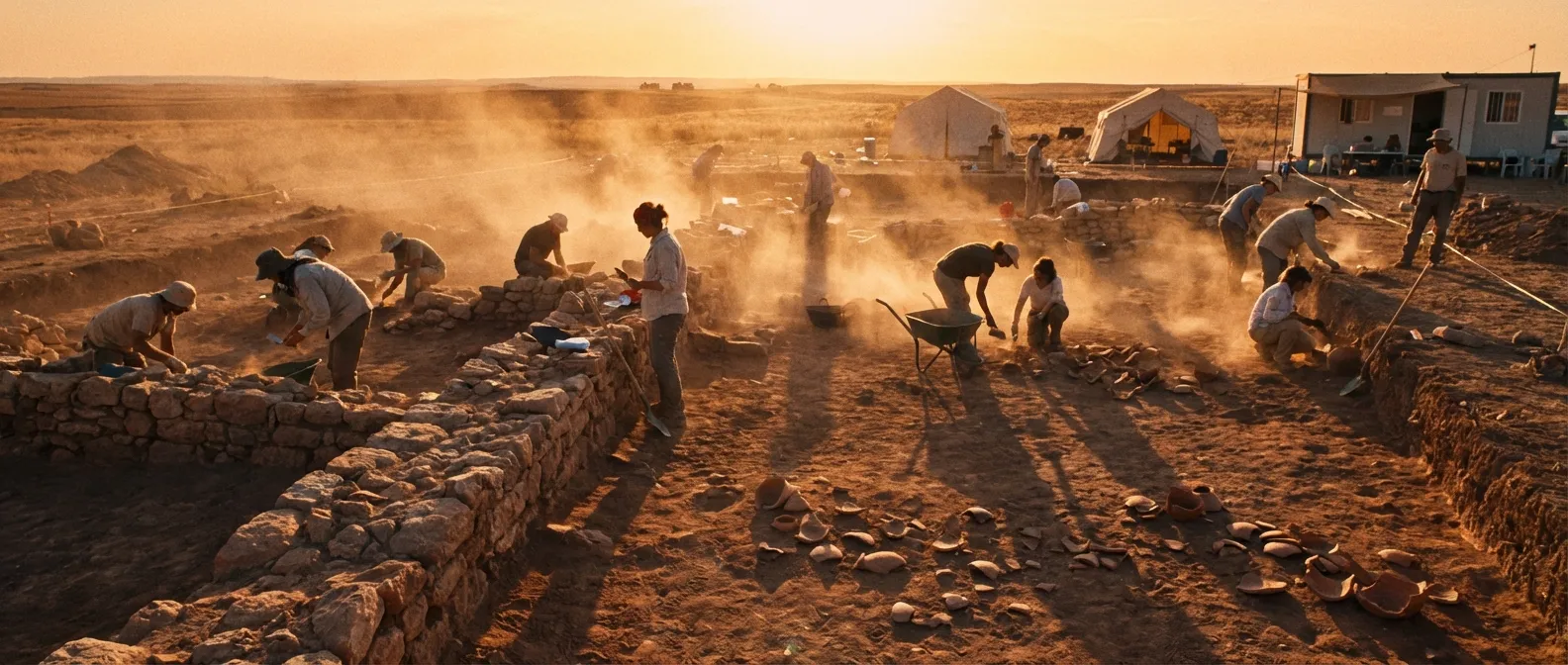
When the Stones Start Talking
There was a time — not that long ago — when mainstream scholarship treated much of the Bible as pious fiction. King David? Probably a legend. Pontius Pilate? Maybe a literary invention. The Pool of Siloam? A theological symbol, not a real place. The early Israelite kingdom? An exaggeration at best, a fabrication at worst.
Then archaeologists started digging.
What follows isn’t a faith argument. It’s a catalogue of physical evidence — artifacts, inscriptions, structures, and documents that have been excavated from the ground and analyzed by professional archaeologists, many of whom have no religious agenda whatsoever.
The pattern is striking: again and again, archaeological discoveries have confirmed biblical accounts that scholars had previously dismissed. And to date, no archaeological discovery has definitively disproven the core historical framework of the biblical narrative — though scholars continue to debate the interpretation of specific findings.
Let’s walk through the evidence.
Discovery 1: The Tel Dan Inscription (1993)
The Claim: King David was a real historical figure.
For most of the 20th century, a significant number of scholars — known as “minimalists” — argued that King David was either a mythical figure or, at best, a minor tribal chieftain whose story was wildly exaggerated by later biblical writers. The absence of any extra-biblical reference to David was cited as evidence.
Then, in 1993, archaeologist Avraham Biran and his team were excavating at Tel Dan in northern Israel. They found a broken basalt stele — an inscribed stone — dating to the 9th century BC.
The inscription, written in Aramaic by an Aramean king (likely Hazael of Damascus), described a military victory and included the phrase “House of David” (bytdwd in Aramaic). This was a reference to the royal dynasty of David — mentioned by a foreign king, in a non-biblical source, carved in stone approximately 100-150 years after David’s reign.
The Tel Dan Inscription didn’t just mention David. It confirmed that David’s dynasty was significant enough to be known by name to foreign powers — exactly as the Bible describes.
Minimalist scholars scrambled to reinterpret the inscription. Some suggested “dwd” referred to something other than David. But the scholarly consensus, including among non-religious archaeologists, is clear: “House of David” means the dynasty founded by King David.
As archaeologist William Dever wrote: “The Tel Dan inscription put to rest the notion that David was a purely legendary figure.”
Discovery 2: The Pilate Stone (1961)
The Claim: Pontius Pilate was a real Roman governor of Judea.
The Gospels present Pontius Pilate as the Roman prefect who presided over the trial and crucifixion of Jesus. For some scholars, the absence of archaeological evidence for Pilate’s existence was used to cast doubt on the Gospel accounts.
In 1961, Italian archaeologist Antonio Frova was excavating the ancient theater at Caesarea Maritima — the Roman administrative capital of Judea. His team discovered a limestone block that had been reused as a building stone. On it was a Latin inscription that read, in part:
[…]S TIBERIÉUM / [PON]TIUS PILATUS / [PRAEF]ECTUS IUDA[EA]E
Translation: “Pontius Pilate, Prefect of Judea” — with a dedication to the Emperor Tiberius.
This inscription — now housed in the Israel Museum in Jerusalem — confirmed several things:
- Pontius Pilate was a real historical figure.
- He served as the Roman authority in Judea.
- His title was “prefect” (not “procurator,” as Tacitus later wrote — the inscription is more contemporaneous and thus more accurate).
- He served during the reign of Tiberius — precisely when the Gospels say he did.
The Pilate Stone is a direct, contemporary, physical confirmation of a key figure in the Gospel narrative.
Discovery 3: The Pool of Siloam (2004)
The Claim: The Pool of Siloam described in John 9 was a real place.
In John chapter 9, Jesus heals a blind man and tells him to wash in the Pool of Siloam. For years, scholars debated whether this pool actually existed or was a literary device.
In 2004, during construction work to repair a sewage pipe in the Silwan neighborhood of Jerusalem, workers accidentally uncovered a set of stone steps. Archaeologists Ronny Reich and Eli Shukron were called in and excavated what turned out to be a large, stepped pool dating to the Second Temple period — exactly when Jesus would have lived.
Coins found in the plaster dated the pool to the Hasmonean and early Roman periods (1st century BC to 1st century AD). The pool measured approximately 225 feet long and featured three sets of five steps, consistent with a ritual immersion pool large enough for public use.
The location matched the biblical description. The dating matched the Gospel timeline. The Pool of Siloam was real.
Archaeologist James Charlesworth of Princeton Theological Seminary called it “one of the most significant archaeological discoveries in recent history” for its confirmation of the Gospel of John’s topographical accuracy.
Discovery 4: Hezekiah’s Tunnel
The Claim: King Hezekiah built a water tunnel exactly as described in 2 Kings 20:20.
The Bible describes how King Hezekiah, preparing for an Assyrian siege around 701 BC, had a tunnel carved through solid rock to bring water from the Gihon Spring into the city of Jerusalem:
“As for the other events of Hezekiah’s reign, all his achievements and how he made the pool and the tunnel by which he brought water into the city, are they not written in the book of the annals of the kings of Judah?” (2 Kings 20:20)
The tunnel exists. You can walk through it today.
Known as Hezekiah’s Tunnel (or the Siloam Tunnel), it stretches approximately 1,750 feet (533 meters) through solid limestone bedrock beneath the City of David. It channels water from the Gihon Spring to the Pool of Siloam — exactly as described in the biblical text.
In 1880, a boy playing in the tunnel discovered an inscription carved into the rock wall (now known as the Siloam Inscription, housed in the Istanbul Archaeology Museum). Written in ancient Hebrew, it describes the moment when two teams of tunnelers, digging from opposite ends, met in the middle:
“…while there were still three cubits to be cut through, [there was heard] the voice of a man calling to his fellow… And when the tunnel was driven through, the quarrymen hewed the rock, each man toward his fellow, axe against axe.”
The engineering, the location, the dating (late 8th century BC), and the inscription all match the biblical account precisely.
Discovery 5: The Dead Sea Scrolls (1947)
The Claim: The Old Testament text has been faithfully preserved over centuries.
In 1947, a Bedouin shepherd named Muhammed edh-Dhib was searching for a lost goat near the Dead Sea when he threw a rock into a cave and heard the sound of breaking pottery. Inside the cave, he found ancient clay jars containing leather scrolls wrapped in linen.
What followed was one of the greatest archaeological discoveries of the 20th century: the Dead Sea Scrolls, a collection of approximately 981 different manuscripts found in eleven caves near Qumran over the following decade.
Among them was a nearly complete scroll of the book of Isaiah (designated 1QIsa^a), dating to approximately 125 BC — over a thousand years older than any previously known Hebrew manuscript of Isaiah (the oldest was the Masoretic Text from approximately 1000 AD).
The question was obvious: after a thousand years of hand copying, how much had the text changed?
The answer: remarkably little.
When scholars compared the Dead Sea Scrolls Isaiah to the Masoretic Text, they found the two were virtually identical. Gleason Archer, a biblical scholar who examined the scrolls, reported:
“Even though the two copies of Isaiah discovered in Qumran Cave 1 near the Dead Sea in 1947 were a thousand years earlier than the oldest dated manuscript previously known (AD 980), they proved to be word for word identical with our standard Hebrew Bible in more than 95 percent of the text. The 5 percent of variation consisted chiefly of obvious slips of the pen and variations in spelling.”
Five percent variation — and almost all of it spelling differences — over a millennium of hand copying. This is extraordinary evidence of careful, faithful textual transmission.
The Dead Sea Scrolls didn’t just confirm the reliability of one book. They demonstrated that the Jewish scribal tradition preserved the Old Testament text with remarkable accuracy across centuries — exactly what that tradition claimed to do.
Discovery 6: The Cyrus Cylinder (539 BC)
The Claim: The Persian King Cyrus allowed exiled peoples, including the Jews, to return to their homelands.
The book of Ezra (1:1-4) records that Cyrus the Great, after conquering Babylon in 539 BC, issued a decree allowing the Jewish exiles to return to Jerusalem and rebuild their temple. Second Chronicles 36:22-23 records the same event. Isaiah even names Cyrus by name as God’s chosen instrument for this purpose — in a passage written (if the traditional dating is accepted) before Cyrus was born.
In 1879, archaeologist Hormuzd Rassam discovered a clay cylinder in the ruins of Babylon. Known as the Cyrus Cylinder, it contains a declaration by Cyrus himself describing his conquest of Babylon and his policy of allowing deported peoples to return to their homelands and rebuild their temples.
The cylinder reads, in part:
“I gathered all their former inhabitants and returned to them their habitations. Furthermore, I resettled upon the command of Marduk, the great lord, all the gods of Sumer and Akkad… in their former chapels, the places which make them happy.”
The cylinder doesn’t mention the Jews, Jerusalem, or Judah specifically — it’s a Babylonian-context building inscription describing a general policy. But Persian royal inscriptions like the Cyrus Cylinder show a pattern of restoring local cults and repatriating displaced peoples — a political context consistent with the biblical account in Ezra, though scholars note the Cylinder itself doesn’t directly confirm the Jewish return specifically.
The Cyrus Cylinder — now housed in the British Museum — demonstrates that the kind of decree described in Ezra and Chronicles was consistent with established Persian imperial policy.
The Expert Assessment
What do the archaeologists themselves say?
William F. Albright (1891-1971), widely regarded as the dean of biblical archaeology in the 20th century, wrote:
“There can be no doubt that archaeology has confirmed the substantial historicity of Old Testament tradition.”
Nelson Glueck (1900-1971), another leading archaeologist and president of Hebrew Union College, stated:
“It may be stated categorically that no archaeological discovery has ever controverted a biblical reference. Scores of archaeological findings have been made which confirm in clear outline or exact detail historical statements in the Bible.”
This is a remarkable claim — though it’s worth noting that Glueck was writing in the mid-20th century, and scholars continue to debate the interpretation of specific findings. The broader point stands: no archaeological discovery has definitively disproven the core historical framework of the biblical narrative, and many have confirmed it.
Millar Burrows of Yale University:
“Archaeology has in many cases refuted the views of modern critics. It has shown, in a number of instances, that these views rest on false assumptions and unreal, artificial schemes of historical development.”
Fair Balance: What Hasn’t Been Found
Intellectual honesty requires acknowledging what archaeology has not confirmed.
There is no direct archaeological evidence for the Exodus as described in the Bible — the departure of a large Israelite population from Egypt, the crossing of the Red Sea, or 40 years of wilderness wandering. This absence is frequently cited by skeptics.
However, several points are worth noting:
-
Absence of evidence is not evidence of absence. The Sinai desert is not kind to archaeological remains. Nomadic populations leave minimal traces. The fact that we haven’t found evidence doesn’t mean the event didn’t happen — it means we haven’t found evidence.
-
The route and dating are debated. If scholars are looking in the wrong place or the wrong century, they won’t find anything regardless.
-
Egyptian records rarely acknowledge defeats. It would be surprising for Egyptian scribes to record a humiliating loss of their slave labor force.
-
Some indirect evidence exists. The Merneptah Stele (1208 BC) is the earliest extra-biblical reference to “Israel” as a people group in Canaan — confirming that Israel existed as a recognized entity by the late 13th century BC.
Similarly, some specific details of the patriarchal narratives (Abraham, Isaac, Jacob) remain unconfirmed archaeologically, though the cultural and geographical details match what we know of the Middle Bronze Age.
The honest assessment: archaeology has confirmed a remarkable number of biblical claims, none has definitively disproven the core historical framework of the biblical narrative (though scholars continue to debate specific findings), and some claims remain awaiting confirmation.
What the Bible Claims About Itself
The biblical writers were conscious of writing history, not mythology:
Since many have undertaken to set in order a narrative concerning those matters which have been fulfilled among us, even as those who from the beginning were eyewitnesses and servants of the word delivered them to us, it seemed good to me also, having traced the course of all things accurately from the first, to write to you in order, most excellent Theophilus; that you might know the certainty concerning the things in which you were instructed.
Luke explicitly states his methodology: eyewitness sources, careful investigation, orderly writing. This is the language of a historian.
Therefore Jesus did many other signs in the presence of his disciples, which are not written in this book; but these are written that you may believe that Jesus is the Christ, the Son of God, and that believing you may have life in his name.
John acknowledges selectivity — he didn’t record everything — but frames his work as testimony to real events.
For we didn’t follow cunningly devised fables when we made known to you the power and coming of our Lord Jesus Christ, but we were eyewitnesses of his majesty.
Peter directly addresses the “cleverly devised stories” objection. He insists he is reporting what he witnessed.
These writers grounded their claims in observable history — events that happened in specific places, under specific rulers, at specific times. They invited investigation. And when investigation has occurred — when archaeologists have dug in the places the Bible describes — the stones have, time and again, confirmed the story.
The Cumulative Weight
No single archaeological discovery proves the Bible true. That’s not how evidence works. But the cumulative weight is significant.
Over and over, biblical accounts that were dismissed as legendary or fictional have been confirmed by physical evidence:
- David was real.
- Pilate was real.
- The Pool of Siloam was real.
- Hezekiah’s tunnel is exactly where the Bible says, built exactly as the Bible describes.
- The Old Testament text has been preserved with extraordinary fidelity.
- Persian royal inscriptions like the Cyrus Cylinder show a pattern of restoring local cults and repatriating displaced peoples — a political context consistent with the biblical account in Ezra, though the Cylinder itself doesn’t mention Jerusalem or Judah specifically.
Each discovery, taken alone, is interesting. Taken together, they establish a pattern: the Bible is a remarkably accurate historical document.
This doesn’t mean every biblical claim is automatically true. It means the Bible deserves the same serious historical treatment given to other ancient documents — and when it receives that treatment, it holds up remarkably well.
The stones are talking. The question is whether we’re listening.
Further reading: Randall Price, The Stones Cry Out (1997); K.A. Kitchen, On the Reliability of the Old Testament (2003); John McRay, Archaeology and the New Testament (2008); William Dever, What Did the Biblical Writers Know and When Did They Know It? (2001)