

DNA, Information Theory, and the Case for Design — The Code That Writes Itself?
DNA is the most complex information system known to science. In every other domain, complex specified information comes from intelligence. So where did the genetic code come from?
Let’s begin with something that isn’t controversial.
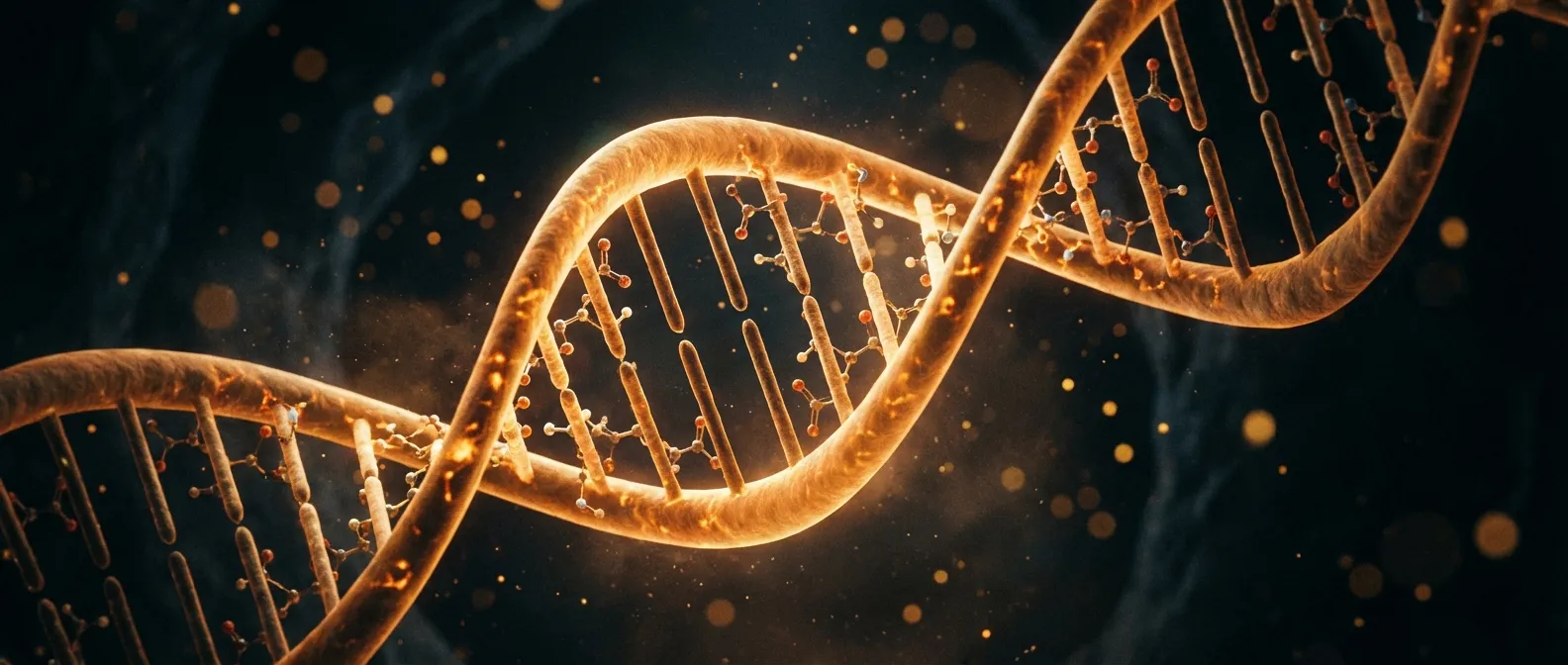
DNA is an information storage system. It uses a four-character chemical alphabet (adenine, thymine, guanine, cytosine — A, T, G, C) to encode instructions for building and operating living organisms. The human genome contains approximately 3.2 billion of these base pairs, arranged in precise sequences that specify roughly 20,000–25,000 protein-coding genes, plus vast regulatory regions that control when, where, and how those genes are expressed.
If you printed the information in a single human cell’s DNA, it would fill roughly 1.5 million pages of text. Every cell in your body contains this library. You have about 37 trillion cells.
This isn’t a metaphor. Biologists themselves use the language of information science to describe DNA: it has a code, it carries instructions, it gets read and transcribed and translated. Bill Gates famously said: “DNA is like a computer program but far, far more advanced than any software ever created.”
Here’s the question no one has satisfactorily answered: Where did this information come from?
The Information Problem
In every domain of human experience we’ve examined, complex, specified information traces back to an intelligent source.
When you see the words on this page, you don’t wonder whether wind erosion or chemical reactions arranged these letters. You infer a mind. When archaeologists discover inscriptions on ancient stones, they don’t attribute them to weathering. When SETI researchers scan the cosmos for radio signals, they look for patterns that indicate intelligence — because complex specified patterns are the hallmark of minds.
This isn’t a quirky observation. It’s a fundamental principle that philosopher and mathematician William Dembski has formalized: complex specified information (CSI) — information that is both highly improbable and conforms to an independently given pattern — invariably originates from intelligent agency. We have zero examples of CSI arising from purely undirected natural processes.
DNA qualifies as complex specified information by any reasonable definition. The sequences aren’t random (that would just be complexity). They’re specified — they conform to the functional requirements of protein folding, gene regulation, and cellular operation. And they’re complex — the number of possible arrangements of 3.2 billion base pairs dwarfs comprehension.
The question isn’t whether DNA contains information. That’s settled science. The question is whether undirected material processes are capable of generating this kind of information from scratch. And that’s where things get very interesting.
Stephen Meyer and the Signature in the Cell
Philosopher of science Stephen Meyer, director of the Discovery Institute’s Center for Science and Culture, made this argument the centerpiece of his 2009 book Signature in the Cell: DNA and the Evidence for Intelligent Design.
Meyer’s argument, stripped to its essentials:
- DNA contains complex specified information
- In our uniform and repeated experience, complex specified information always comes from an intelligent source
- Therefore, the best explanation for the information in DNA is an intelligent source
This is an argument by analogy — but it’s not a loose analogy. It’s based on what Charles Lyell and Charles Darwin themselves called “the vera causa principle”: explaining past events by causes that are known to be capable of producing the effect in question. We know intelligence produces complex specified information. We don’t know of anything else that does.
Meyer is careful to distinguish his argument from older “argument from ignorance” versions of design arguments. He’s not saying “we can’t explain DNA, therefore God.” He’s saying “we can explain DNA — the same way we explain every other information-rich system we’ve ever encountered.”
Critics have pushed back, and we’ll examine their objections shortly. But Meyer’s core insight is worth sitting with: the origin of biological information is a genuine scientific problem, and design is a genuine scientific hypothesis for solving it.
The Origin of Life Problem
The information question becomes most acute when we zoom in on the origin of life — the transition from non-living chemistry to the first self-replicating cell.
Here’s the challenge. The simplest known free-living organism, Mycoplasma genitalium, has a genome of about 580,000 base pairs encoding roughly 480 genes. But even this is a stripped-down parasite that relies on a host for many functions. Estimates for the minimum genome required for a genuinely independent, self-replicating cell range from about 250 to 400 functional proteins.
How hard is it to get even one functional protein by chance?
A typical functional protein is a chain of about 150–300 amino acids (drawn from a set of 20 types) that must fold into a precise three-dimensional structure to perform its function. Biochemist Douglas Axe, in research published in the Journal of Molecular Biology (2004), experimentally estimated the ratio of functional sequences to total possible sequences for a relatively short protein (150 amino acids). His result: approximately 1 in 10^77.
That’s for one protein. The simplest cell needs hundreds of specific proteins, all working together in coordinated systems — plus a membrane, an energy system, and the DNA/RNA machinery to replicate itself. The combinatorial improbability isn’t just large; it’s beyond anything we’d accept as plausible in any other context.
Origin-of-life researcher Robert Shapiro (an atheist) put it bluntly in Scientific American (2007): “The appearance of even the simplest cell without any precursor would be a miracle.”
And then there’s the chicken-and-egg problem. DNA stores information, but it needs proteins to be read. Proteins are built using the instructions in DNA. Each requires the other. Which came first?
Francis Crick and Directed Panspermia
Francis Crick won the Nobel Prize in 1962 for co-discovering the structure of DNA. He was a committed atheist and materialist. But the information problem in DNA staggered him.
In his 1981 book Life Itself: Its Origin and Nature, Crick proposed “directed panspermia” — the hypothesis that life on Earth was deliberately seeded by an advanced alien civilization. He wrote:
“An honest man, armed with all the knowledge available to us now, could only state that in some sense, the origin of life appears at the moment to be almost a miracle, so many are the conditions which would have had to have been satisfied to get it going.”
Let that land. One of the greatest biologists of the twentieth century — an outspoken atheist — looked at the information in DNA and concluded that the complexity was so great it might require an intelligent source. He just preferred aliens to God.
This is revealing. Crick didn’t dispute the inference to intelligence. He disputed the identity of the intelligence. The design inference itself was so strong that even a committed materialist couldn’t avoid it — he could only redirect it.
Counter-Arguments: Taken Seriously
Natural Selection
The most common response to the design argument is: “Evolution did it. Natural selection, operating on random mutations over billions of years, is capable of generating enormous complexity.”
This is a powerful argument — for the development of life. But it has a fatal limitation when applied to the origin of life: natural selection requires self-replicating systems to operate on. You can’t have survival of the fittest if nothing is replicating yet. Natural selection is the editor, not the author. It can refine and develop existing information, but it can’t create the first informational system from scratch.
As chemist Graham Cairns-Smith acknowledged in Seven Clues to the Origin of Life (1985): “The problem of the origin of life is not the same as the problem of evolution. The mechanisms that drive evolution — variation and selection — require a system that’s already replicating.”
The design argument for DNA’s origin is therefore compatible with accepting evolution as a mechanism for biological development. The question is about the starting point, not the subsequent process.
The RNA World Hypothesis
The leading scientific hypothesis for the origin of life is the “RNA world” — the idea that self-replicating RNA molecules preceded DNA and proteins, and that RNA served as both the information carrier and the functional catalyst in early life.
The RNA world hypothesis is creative and worth taking seriously. But it faces substantial challenges:
RNA is fragile. RNA molecules degrade rapidly in water and are highly sensitive to temperature. Maintaining stable RNA polymers in a prebiotic environment is extremely difficult.
Self-replication hasn’t been demonstrated. While ribozymes (catalytic RNA molecules) have been discovered and even engineered in labs, no one has demonstrated a fully self-replicating RNA system arising spontaneously. The gap between “RNA can do some chemistry” and “RNA can replicate itself from scratch” is enormous.
The information problem persists. Even if RNA could self-replicate, the specific sequences required for function are still a tiny fraction of the possible sequence space. The problem of generating complex specified information doesn’t disappear just because you switch from DNA to RNA.
The transition problem. Even if an RNA world existed, the transition from RNA-based life to the DNA-protein system used by all known life requires its own explanation. This is a non-trivial leap involving the origin of the genetic code, transfer RNA, ribosomes, and the entire translation machinery.
As origin-of-life researcher Eugene Koonin wrote in The Logic of Chance (2011): “The origin of life is the most difficult problem that faces evolutionary biology and, arguably, biology in general… no compelling scenarios currently exist for the origin of replication and translation.”
Emergent Complexity and Self-Organization
Some scientists appeal to principles of self-organization — the tendency of certain physical systems to spontaneously form ordered structures (crystals, snowflakes, convection cells). Could life have emerged through self-organizing chemistry?
The problem is that the kind of order in self-organizing systems is fundamentally different from the kind of information in DNA. A crystal has repetitive, periodic order — like a wallpaper pattern. DNA has aperiodic, specified complexity — like a written message. The laws of chemistry can explain why certain molecules form regular patterns. They cannot explain why a particular sequence of nucleotides encodes the instructions for hemoglobin.
As Michael Polanyi (chemist and philosopher) argued in Life’s Irreducible Structure (1968), the information in DNA is not determined by the chemical properties of its constituent molecules, just as the meaning of a sentence is not determined by the chemistry of ink. The chemical properties constrain what’s possible but don’t determine what’s actual. The information is imposed on the chemistry from outside.
An Important Caveat: Design ≠ God (Necessarily)
Let’s be intellectually honest about what this argument does and doesn’t establish.
The design inference in biology points to an intelligent source for biological information. It does not, by itself, identify that source. Logically, the designer could be:
- God (the theistic answer)
- An advanced alien civilization (Crick’s answer)
- A simulation programmer (the simulation hypothesis)
- Something else entirely
This is a genuine limitation of the design argument in biology, and it’s important to acknowledge it.
However, the design argument doesn’t exist in isolation. Combined with the cosmological evidence (the universe had a beginning), fine-tuning arguments (the constants are calibrated for life), and philosophical arguments about the nature of intelligence and consciousness, the cumulative case narrows the options considerably. An alien designer just pushes the question back: who designed the aliens? A simulation programmer raises the same regress. Eventually, the trail of design leads to something that is itself undesigned — a necessary, self-existent intelligence.
But that’s a further argument. For now, the biological evidence alone points to intelligence behind the code. Where you go from there is up to you.
What the Ancient Writers Saw
The biblical writers didn’t know about nucleotide sequences or protein folding. But they recognized the signature of design in the biological world — and they pointed to its source:
For you formed my inmost being. You knit me together in my mother’s womb. I will give thanks to you, for I am fearfully and wonderfully made. Your works are wonderful. My soul knows that very well.
The word “knit together” in Psalm 139 is striking in light of what we now know about embryonic development — a process guided by precisely sequenced genetic instructions. The psalmist perceived design in the womb; molecular biology has confirmed the mechanism.
Yahweh, how many are your works! In wisdom, you have made them all. The earth is full of your riches.
For by him all things were created in the heavens and on the earth, visible things and invisible things, whether thrones or dominions or principalities or powers. All things have been created through him and for him. He is before all things, and in him all things are held together.
The phrase “in him all things hold together” resonates with the information that holds biological systems in their functional states — the code without which molecules would be just molecules, chemistry without purpose.
The Honest Takeaway
Here’s what we know:
- DNA is an information system of staggering complexity and precision.
- In every other domain, complex specified information comes from intelligent sources.
- No naturalistic mechanism has been demonstrated to generate complex specified information from scratch.
- The origin of the first self-replicating cell remains one of the deepest unsolved problems in science.
- Even some of the strongest materialist thinkers (Crick, Shapiro, Koonin) have acknowledged the profound difficulty of the problem.
None of this proves God wrote the genetic code. But it points — firmly, persistently, and with increasing clarity — toward intelligence as the source of biological information.
The code that writes itself? After decades of research, we still have no evidence that it does. Every code we’ve ever encountered had a coder. The question is whether we’re willing to follow that inference wherever it leads.
Sources and Further Reading
- Meyer, Stephen C. Signature in the Cell: DNA and the Evidence for Intelligent Design (2009)
- Meyer, Stephen C. Darwin’s Doubt: The Explosive Origin of Animal Life and the Case for Intelligent Design (2013)
- Axe, Douglas. “Estimating the Prevalence of Protein Sequences Adopting Functional Enzyme Folds.” Journal of Molecular Biology 341.5 (2004): 1295-1315
- Crick, Francis. Life Itself: Its Origin and Nature (1981)
- Shapiro, Robert. “A Simpler Origin for Life.” Scientific American 296.6 (2007): 46-53
- Koonin, Eugene. The Logic of Chance: The Nature and Origin of Biological Evolution (2011)
- Polanyi, Michael. “Life’s Irreducible Structure.” Science 160.3834 (1968): 1308-1312
- Dembski, William. The Design Inference: Eliminating Chance Through Small Probabilities (1998)
- Tour, James. “An Open Letter to My Colleagues.” Inference: International Review of Science 2.1 (2016)
- Gates, Bill. The Road Ahead (1995)