

The Noise-Canceling Headphones
He bought them to block out the world. They worked perfectly — until the day he realized the voice he'd been drowning out wasn't noise. It was the only thing worth hearing.
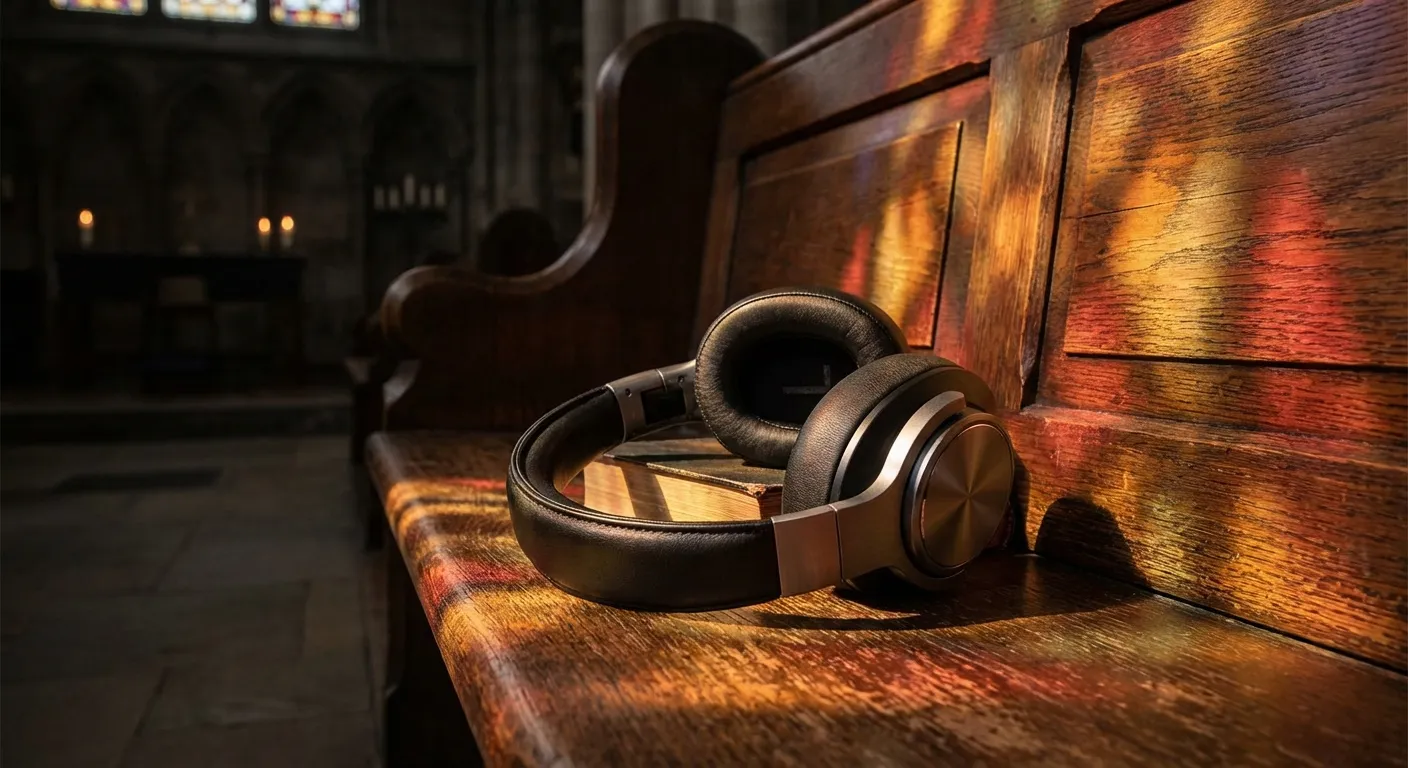
📖 Related Scripture: Psalm 46:10
Marcus bought the headphones on a Tuesday.
Not a special Tuesday. Not a crisis Tuesday. Just one of those Tuesdays where the noise had finally stacked high enough that something in him snapped — not violently, more like a twig underfoot. A small, clean break that you only notice because the forest goes quiet for half a second afterward.
The office was open-concept, which was a polite way of saying he could hear Kevin from Accounting chew his turkey sandwich from thirty feet away. The commute was forty-five minutes of talk radio and traffic reports and someone’s bass rattling his rearview mirror at every red light. Home was the TV Priya left on for “background” and the neighbor’s dog who treated 10 p.m. like a personal concert slot and the dryer that buzzed every forty-seven minutes because it was from 2009 and nobody had ever figured out how to turn the buzzer off.
None of it was loud. That was the thing. None of it crossed the threshold into what anyone would call unbearable. It was just… constant. A hum underneath everything, like tinnitus for the soul. And somewhere around 2:15 on that unremarkable Tuesday, Marcus looked up from his screen and realized he couldn’t remember what silence sounded like.
So he bought the headphones.
Not earbuds. Not the $30 kind you lose in your gym bag. These were the real thing. Over-ear, adaptive noise cancellation, thirty-eight hours of battery life, and a price tag that made Priya raise one eyebrow in the way that meant I’m not going to say anything, but I’m also going to remember this the next time you question my Target receipts.
He put them on in the store.
And the world… stopped.
Not literally. The fluorescent lights still buzzed. The mall was still a mall. But the headphones wrapped around his ears like two gentle palms and pressed mute on everything — the piped-in pop music, the toddler screaming near the fountain, the conversation between two employees about someone named Derek who was apparently the worst. Gone. All of it. Like someone had pulled the plug on the universe’s speaker system and left only Marcus, standing in the sudden cathedral of his own head, breathing.
He almost cried. He didn’t know why.
He bought them.
The first week was revelation.
He wore them on the commute. The honking dissolved. The bass disappeared. The talk radio hosts and their manufactured outrage — silenced. In their place: nothing. Beautiful, clean, uncluttered nothing. He could think entire thoughts without interruption. He could follow an idea from start to finish without something shattering it at the halfway point.
He wore them at the office. Kevin’s sandwich became a silent film. The ping-pong table in the break room — the one that management installed to prove they were “a fun place to work” — vanished from his awareness entirely. He was more productive in three days than he’d been in three weeks.
He wore them at home. On walks. At the grocery store. In the waiting room at the dentist. In line at the DMV. He wore them so consistently that Priya started texting him from across the living room because it was easier than waiting for him to take them off.
He wore them to bed.
That’s when Priya stopped finding it charming.
“You’re not even snoring anymore,” she said one morning, which wasn’t a compliment.
“I can’t hear myself snore,” Marcus said, confused.
“No,” she said. “I can’t hear you snore. Because you’ve got those things on. And you used to — Marcus, you used to roll over and say something in your sleep. Mumble something. Half the time it didn’t make sense, but it was… I don’t know. It was you. Being there. Now you just lie there like a mannequin with very expensive ears.”
He promised to take them off at night. He mostly kept the promise. But the pull was there. Because the silence wasn’t just silence anymore. It was control. It was the ability to edit his environment, to curate his inputs, to decide exactly what deserved access to his attention and what didn’t.
And once you’ve tasted that kind of control, noise becomes intolerable. Not just loud noise. All noise. The bird outside the window. The fridge cycling on. A child laughing two yards over.
It all sounded like static.
Marcus had grown up in church.
Not the kind of church where people fell down or spoke in tongues or waved flags — the kind where the sanctuary smelled like carpet cleaner and hymnals and the sermon was exactly twenty-two minutes long because Pastor Franklin believed that anything God wanted to say could be said in twenty-two minutes and anything longer was the preacher talking to himself.
He’d stopped going regularly around thirty. Not dramatically. No crisis of faith, no angry departure. Just… drift. Sunday became the one morning where he could sleep in, and sleeping in became habit, and habit became identity. He was “spiritual but not religious,” which was a phrase he’d never actually said out loud but had internalized so thoroughly that it functioned as a creed.
He still prayed, sometimes. Before meals if his mother was visiting. Before flights, because turbulence has a way of making theologians out of agnostics. In the shower, occasionally, when something — a worry, a gratitude, a question with no bottom — rose up in him like steam and needed somewhere to go.
But these prayers were short and formless. More reflex than conversation. He wasn’t sure anyone was listening. He wasn’t sure he wanted anyone to be.
The headphones didn’t change that. Not at first.
What they changed was the texture of his silence.
Before the headphones, silence had always been an absence. The gap between sounds. The pause before the next notification. It was nothing — and who pays attention to nothing?
But the headphones turned silence into a place. A room he could enter. And the more time he spent there, the more he noticed that the room wasn’t empty.
It started as a feeling. Not an emotion, exactly. More like a pressure — the way you can feel someone standing behind you in a quiet house. A presence in the stillness that was neither threatening nor comforting. It was just… there. Waiting. The way a lake waits at the bottom of a valley. Patient. Unhurried. Older than the mountains around it.
Marcus ignored it. Of course he did. He was a practical person. He’d bought the headphones for productivity, for sanity, for the basic human need to think without interruption. He wasn’t looking for a mystical experience in his Sony WH-1000XM5s.
But the presence didn’t leave. It didn’t intensify, either. It just… remained. Consistent as gravity. Every time he put the headphones on and let the world drop away, there it was. That pressure. That warmth. That sense of being observed — not watched, not surveilled, but seen. The way a father sees a child who thinks they’re hiding but whose feet are sticking out from under the curtain.
One night, three weeks after the purchase, Marcus was sitting on the back porch with his headphones on and his eyes closed and the October air sharp enough to taste, and a thought arrived that he didn’t generate.
He knew the difference. He’d been inside his own head long enough to recognize his own thoughts — their rhythm, their vocabulary, their slightly anxious cadence. This thought wasn’t his. It was quieter. Simpler. It had the quality of something placed rather than produced.
I’ve been here the whole time.
Marcus opened his eyes. The backyard was empty. The dog next door was, for once, silent. The sky was the color of a bruise healing.
He took the headphones off.
And the noise came back. The highway half a mile away. A plane overhead. Crickets. Priya’s show through the kitchen window. The dryer.
He put the headphones back on.
I’ve been here.
He sat there for a long time.
Marcus didn’t tell Priya. He wasn’t sure what he would say. Hey, so I think God might be using my noise-canceling headphones to talk to me? She’d call his mother. His mother would call the pastor. The pastor would say something about twenty-two minutes and leave it at that.
So he kept it to himself and kept putting on the headphones. Not for work anymore. Not for the commute. For this. For the room inside the silence where something waited.
And the strange thing was that the voice — if you could call it a voice, because it wasn’t really sound, it was more like meaning arriving without language, the way you understand a song in a foreign tongue — the voice never said much. Never lectured. Never condemned. Never delivered a sermon of any length, let alone twenty-two minutes.
It said things like:
You are not alone.
And:
You can stop performing now.
And:
I know about the thing you haven’t told anyone. I’ve always known. It didn’t change anything.
And once, on a morning when Marcus was sitting in his parked car in the office lot because he couldn’t face another open-concept Tuesday:
I made you for more than this. But not the “more” you’re imagining. A different more. A slower more. Come and see.
That one sat in his chest for three days like a coal that wouldn’t cool.
The problem was the headphones.
Not the voice. The voice was — he still didn’t have a word for it. Terrifying and tender in equal measure, like standing at the edge of an ocean that knows your name. No, the voice wasn’t the problem.
The problem was that Marcus had started believing the headphones were the source.
Like the voice lived in the noise cancellation. Like God had taken up residence in a circuit board in Shenzhen. He couldn’t hear the voice without them. He’d tried. He’d sit in the quietest room in the house — the guest bathroom, which Priya had decorated with seashells and a sign that said WASH YOUR HANDS AND SAY YOUR PRAYERS BECAUSE JESUS AND GERMS ARE EVERYWHERE — and he’d close his eyes and listen.
Nothing.
Just the plumbing. Just his heartbeat. Just the furnace clicking on.
But put the headphones on? There it was. The presence. The room. The voice like meaning without sound.
So the headphones became something else. Not a tool anymore. A talisman. A relic. He cleaned them every night. He bought a second pair — a backup, in case something happened. He tracked the battery level the way a diabetic tracks blood sugar. If the charge dropped below 20%, a low, irrational anxiety would settle in his stomach, as if God might run out of battery.
Priya noticed.
“You’re not wearing those things,” she said one evening, “you’re hiding in them.”
“I’m listening,” Marcus said.
“To what? There’s nothing playing. I checked.”
“I know.”
She looked at him for a long time. “Marcus. What’s happening?”
He almost told her. The words were right there. But they sounded insane even inside his own head, and Marcus was a man who preferred to sound reasonable, which is a polite way of saying he preferred to be in control, which is a polite way of saying he was terrified of being seen.
“Nothing,” he said. “Just thinking.”
She didn’t believe him. But she loved him, which meant she gave him the space to be wrong for a while longer.
The headphones broke on a Saturday.
Not dramatically. No drop, no crack, no catastrophic failure. He put them on, pressed the power button, and nothing happened. The little LED that usually blinked blue stayed dark. He tried the charging cable. Nothing. Tried a different outlet. Nothing. Held the button for fifteen seconds, thirty, a full minute.
Dead.
Marcus felt something crack in his chest that had nothing to do with warranty coverage.
He drove to the store. They were out of stock. He tried another store. Same. He went online. Backordered. Four to six weeks.
He sat in his car in the second parking lot and did something he hadn’t done since the headphones entered his life.
He panicked.
Not about the headphones. About the silence. About the voice. About losing access to the one place where the noise stopped and something holy began. He gripped the steering wheel and felt his breath go shallow and thought: I can’t hear You without them. I can’t find the quiet. There’s too much noise. There’s always too much noise.
And then — in a car that was not quiet, in a parking lot that was not sacred, with a highway overhead and someone’s car alarm two rows over and a child shrieking at a pitch that could etch glass — he heard it.
Not through the headphones.
Through the noise.
I was never in the headphones, Marcus.
He went very still.
I was in the silence. And the silence was never something you manufactured. It was something you finally stopped running from.
The car alarm stopped. The child kept shrieking. A truck downshifted on the highway above. None of it mattered. Because the presence was here — right here, in the middle of the chaos, as steady as it had ever been in the manufactured quiet of the headphones. It had always been here. He’d just been listening in the wrong direction.
The headphones didn’t give you access to Me. They gave you permission to stop. To be still. To shut up for five minutes and actually listen. You could have done that anytime. You can do it right now.
Marcus sat in the parking lot for forty-five minutes. He didn’t put anything on his ears. He didn’t need to.
The Hebrew word for it is damam.
It shows up in Psalm 46:10, the verse every Christian knows and almost nobody practices: “Be still, and know that I am God.”
But damam doesn’t mean “relax.” It doesn’t mean “take a deep breath” or “find your center” or “download a meditation app.” It means cease. Stop striving. Let your hands fall open. Surrender the illusion that your effort, your noise, your constant motion is what holds the universe together.
It’s the word used when the sea went flat after God rebuked the storm. It’s the word for what happens when armies lay down their weapons. It’s a violent stillness — the kind that comes not from the absence of conflict but from the arrival of someone so powerful that conflict becomes irrelevant.
Damam isn’t passive. It’s the most active surrender imaginable. It’s choosing, in a world that monetizes your attention and weaponizes your anxiety and profits from your inability to sit with three seconds of silence — choosing to stop.
And listen.
Not for a voice in your headphones. Not for a burning bush or a thunderclap or an angel with a flaming sword. For the still, small voice that Elijah heard after the earthquake, after the fire, after the wind that shattered rocks (1 Kings 19:11-13). The voice that didn’t shout over the noise.
The voice that waited until he was quiet enough to hear it.
Marcus started praying again.
Not the before-meals, before-flights kind. Real prayer. The kind where you sit down and shut up and don’t say anything for a while because you’ve spent thirty-seven years talking and maybe it’s time to try listening.
He did it in the mornings, before the alarm. In the car, engine off, radio off. On the back porch in October air that tasted like cold pennies. No headphones. No app. No ambient sounds or guided meditation or worship music in the background.
Just silence.
Just damam.
And the voice was there. Of course it was. It had always been there. Through every noisy commute and every open-concept office and every buzzing dryer and every barking dog and every single moment Marcus had been too distracted, too busy, too drowned in the reasonable ambient noise of a reasonable life to notice.
God doesn’t compete with noise. That’s the thing Marcus finally understood. God doesn’t raise His voice to be heard over your Spotify playlist or your podcast queue or your group chat or the twenty-three tabs open in your browser. He speaks in a whisper (1 Kings 19:12) — not because He’s quiet, but because He wants you close enough to hear.
A whisper requires proximity. You have to lean in. You have to be near.
The noise of the world doesn’t just distract you from God’s voice. It trains you to mistake intimacy for irrelevance. It teaches you that if something isn’t loud, it isn’t important. It conditions you to need volume, urgency, stimulation — and then calls the resulting emptiness boredom and sells you a solution.
But silence? Real silence? The kind you choose, the kind you fight for in a world engineered to prevent it?
That silence is a room. And in that room, someone is waiting. Has been waiting. Will keep waiting.
Patient as a lake at the bottom of a valley.
Marcus gave the headphones to Priya.
Not as a statement. Not as a grand gesture. They’d been repaired under warranty and returned three weeks after his parking-lot revelation, and he held them and felt… nothing. Gratitude, maybe. The way you feel grateful to training wheels after you’ve learned to ride.
“For me?” Priya said, surprised.
“You’ve been putting up with Kevin’s sandwich secondhand through me for months,” Marcus said. “Your turn to have some peace.”
She put them on. Her eyes widened. “Oh,” she said. “Oh, wow.”
Marcus smiled. He knew the feeling. The sudden absence of noise. The startling discovery that silence has a texture, a shape, a weight. That it isn’t nothing at all.
He hoped she’d find what he found, eventually. Not in the headphones — through them. Past them. Into the quiet beneath the quiet, where a voice older than sound says the only thing that’s ever mattered.
I’m here. I’ve always been here.
Be still.
And know.
“…But Yahweh is in his holy temple. Let all the earth be silent before him!”
He said, “Go out and stand on the mountain before Yahweh.” Behold, Yahweh passed by, and a great and strong wind tore the mountains and broke in pieces the rocks before Yahweh; but Yahweh was not in the wind. After the wind there was an earthquake; but Yahweh was not in the earthquake. After the earthquake a fire passed; but Yahweh was not in the fire. After the fire, there was a still small voice.
“Be still, and know that I am God. I will be exalted among the nations. I will be exalted in the earth.”
💡 The Moral
Silence isn't empty — it's where God speaks loudest. The noise of the world doesn't just distract you from hearing Him; it trains you to mistake His voice for background static. Be still, and know.