

The Influencer
He had 2.3 million followers. But on the night the lights went out, he discovered that not a single one of them knew his name.
📖 Related Scripture: Matthew 6:1-4
His name was Marcus — but nobody called him that anymore.
Online, he was @TheMarcusLee. Two-point-three million followers. Verified badge. Brand deals stacked in his inbox like love letters from a world that couldn’t get enough of him. His morning routine video had 14 million views. His “What I Eat in a Day” was trending for a week. He once posted a photo of his coffee — just his coffee — and 80,000 people pressed the heart.
Eighty thousand hearts for a latte.
And Marcus pressed his hand against his chest sometimes, late at night, just to make sure his own was still beating.
It started in college. A dorm room. A ring light. A thirty-second video about productivity hacks he’d read in a book he never finished. It hit 200,000 views overnight, and something chemical happened inside him — a rush, warm and electric, like being chosen at recess for the first time. Like the whole cafeteria turning to look at you, and for once, liking what they saw.
He chased that feeling the way some people chase a first love.
He dropped out sophomore year. His mother cried on the phone. “Marcus, a degree is something no one can take from you.” He told her she didn’t understand the algorithm. She said she didn’t need to understand the algorithm to understand her son. He posted a video about it — “When Your Family Doesn’t Support Your Dreams” — and 400,000 strangers told him he was brave.
Four hundred thousand strangers outweighed one mother.
Or so he thought.
By twenty-six, Marcus had everything the feed promised. The apartment with the floor-to-ceiling windows. The Tesla. The wardrobe curated not for comfort but for content — every shirt a potential thumbnail, every pair of sneakers an unboxing opportunity. He had a team: a videographer, an editor, a manager named Kelsey who spoke entirely in metrics.
“Engagement is up 12% this quarter,” she’d say, and Marcus would nod like a patient receiving good test results. Healthy. You’re healthy. The numbers say so.
But there were things Marcus didn’t post.
He didn’t post the panic attacks that woke him at 3 a.m., heart slamming against his ribs, certain — certain — that today was the day the audience would leave. He didn’t post the twenty-seven takes it took to get one “spontaneous” reaction video. He didn’t post the way he’d sit in his parked car for forty-five minutes after events, unable to move, drained in a way that sleep couldn’t touch.
He didn’t post that he hadn’t had a real conversation — one without an angle, without wondering how it would play on camera — in over a year.
He didn’t post that sometimes, in the space between uploading and refreshing, he forgot who he was.
Not @TheMarcusLee.
Marcus.
The kid who used to build model trains with his grandfather. The boy who cried at the end of Where the Red Fern Grows. The teenager who once sat on the roof of his parents’ house and talked to God like He was sitting right there — legs dangling, stars everywhere, no audience required.
That Marcus was buried somewhere beneath the ring lights and the metrics, and some nights, he almost mourned him like a death.
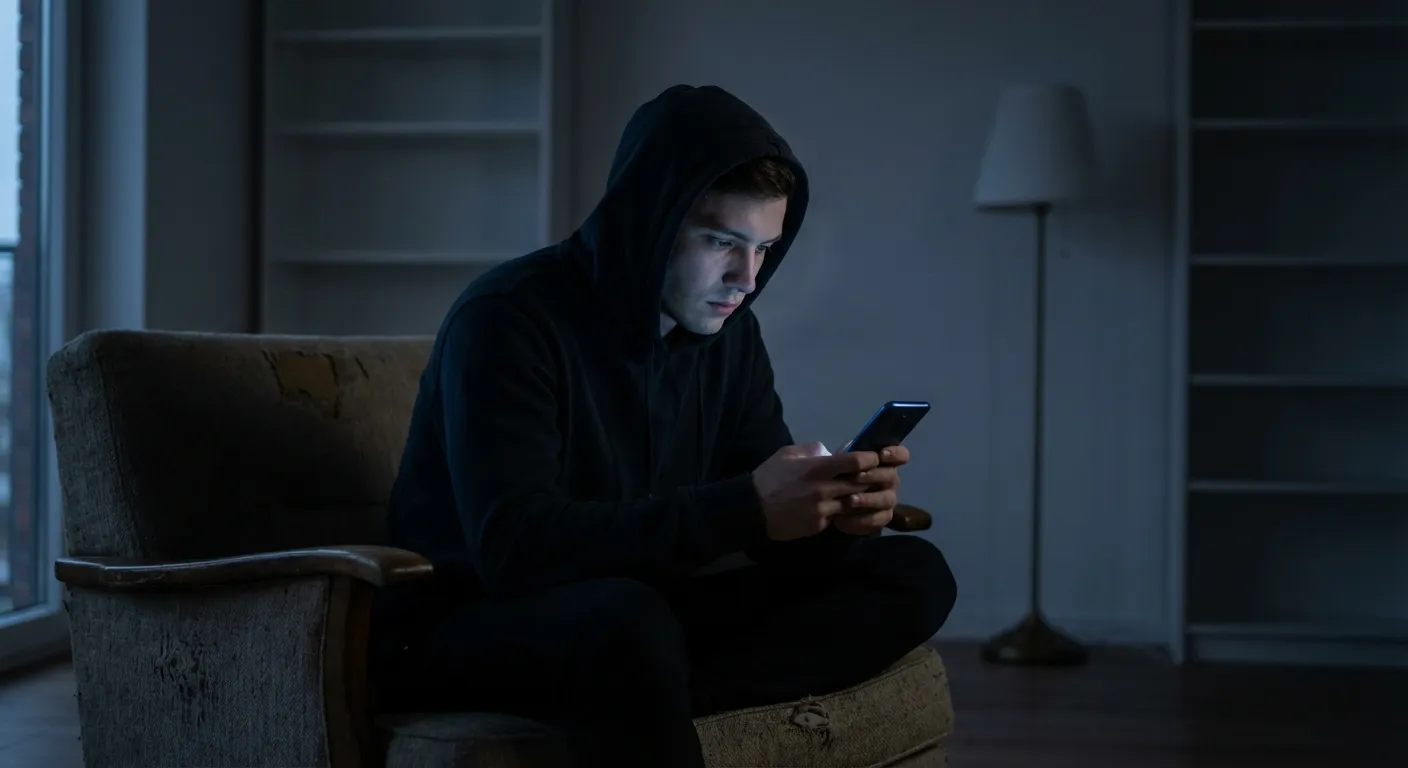
The power went out on a Thursday.
Not a flicker. Not a brownout. A full blackout — the whole grid, seventeen blocks in every direction. Marcus was mid-shoot when it happened. The ring light died. The camera went dark. His phone, at 11%, became a ticking clock.
He called Kelsey. Straight to voicemail.
He texted his editor. No response.
He opened Instagram — the loading wheel spun and spun like a prayer wheel with no prayer behind it — and then the screen went black.
Eleven percent. Seven. Three.
And then: nothing.
Marcus stood in his apartment, in the dark, in the silence, and realized something that dropped through him like a stone through still water:
He didn’t know what to do with himself when no one was watching.
He couldn’t sit still. He paced. He opened the fridge and stared into it like it held answers, but even the light in there was dead. He picked up a book from the shelf — a prop, if he was honest, bought for a “reading niche” video he never made — and couldn’t focus past the first paragraph.
The silence was deafening. Not peaceful. Deafening. Because silence meant no notifications. No comments. No proof that he existed.
He caught himself reaching for his dead phone four times in ten minutes. Each time, a small jolt of panic, like a limb that should be there and wasn’t.
This is withdrawal, he thought. I am withdrawing from being seen.
He sat on the floor — not for a photo, not for a “real talk” video, not for content — just because his legs gave out a little. And in the dark, with no lens pointed at him and no audience refreshing, a question surfaced that he’d been outrunning for years:
If no one is watching, do I still matter?
The tears surprised him.
They came without permission, without a script, without good lighting. Ugly, shaking, graceless tears — the kind he would never, ever post. He pressed his forehead against his knees and felt the full weight of a life built on being looked at by people who had never once seen him.
Two-point-three million followers, and not one of them knew that his middle name was James. That he was afraid of deep water. That his grandfather died on a Tuesday and he didn’t post about it because he couldn’t figure out the right caption. That he hadn’t prayed in years because prayer felt pointless when no one could like it.
He had been performing for so long that he’d forgotten there was someone underneath the performance.
And in that dark apartment, with the city silenced and every screen dead, he heard something. Not audibly. Deeper than that. In the place beneath the content and the metrics and the panic — in the place he’d been avoiding — a voice. Quiet. Patient. Like it had been speaking the whole time, drowned out by the noise he’d mistaken for a life:
I knew you before they did. I knew you before the ring light. Before the first video. Before the followers. Before you forgot your own name. I have always known your name.
You don’t have to perform for Me, Marcus.
You never did.
He sat there for a long time. Minutes. Maybe an hour. He wasn’t counting. For the first time in years, he wasn’t counting anything.
He thought about his mother. How she never watched his videos but called every Sunday. How she always said, “How are you, baby? Not the brand. You.” And how he always changed the subject.
He thought about his grandfather’s hands — scarred, oil-stained, gentle — and how the man had never been seen by more than a hundred people in his life but had been known by every single one of them. How at his funeral, grown men wept. Not because he was famous. Because he was real.
He thought about that night on the roof. Sixteen years old. Talking to God like a friend. No camera. No angle. No engagement strategy. Just a boy who believed he was heard.
When did I stop believing that was enough?
The power came back at 6:47 a.m.
Marcus knew because every device in his apartment surged to life at once — screens glowing, notifications cascading, the ring light flaring like a false sunrise. His phone, plugged in at some point during the dark hours, vibrated with 342 messages. Kelsey had texted seventeen times. His comment sections were flooded with “WHERE ARE YOU??” and “hope ur okay king 🙏” from people who would forget him inside a week.
He stared at the phone on the counter.
It glowed. It pulled. It promised the old rush — the numbers, the hearts, the proof of existence.
He picked it up.
He called his mother.
“Hey, Mom,” he said. His voice cracked on the second word, and he didn’t try to fix it. “It’s Marcus. Not the brand. Just… Marcus.” He paused. Swallowed. “I’m sorry I haven’t been… me. Can we talk? Not for a video. Just — can you tell me about Grandpa’s trains?”
She was quiet for a moment. Then, softly, the way only a mother can:
“Baby, I’ve been waiting for this call for five years.”
He didn’t post that day.
Or the next.
On the third day, he sat at his desk and opened the notes app — not for a script, but for himself. He wrote one line:
“Be careful that you don’t do your charitable giving before men, to be seen by them, or else you have no reward from your Father who is in heaven.” — Matthew 6:1
He read it three times. Then he added, in his own words:
I spent five years doing everything to be seen. And I have never been more invisible. God doesn’t need me to perform. He already sees. He already knows. And that — just that — is enough.
He closed the app. He didn’t share it.
Some things are too sacred for a feed.
Marcus still makes content. He’s not naive — he knows the platform isn’t inherently evil, the way a mirror isn’t evil just because you can stare into it too long. But something shifted in the dark that night. A recalibration. A remembering.
Now, before he films, he asks himself a question he never used to ask:
Am I doing this to be seen? Or because it’s worth doing even if no one ever sees it?
And when the numbers dip — because they do, because they always do — he doesn’t spiral. He calls his mom. He builds a model train. He sits on his balcony at night, legs dangling over the edge, and talks to God like He’s sitting right there.
No ring light.
No comments.
No audience.
Just Marcus, fully known.
And for the first time in years — enough.
“Be careful that you don’t do your charitable giving before men, to be seen by them, or else you have no reward from your Father who is in heaven. Therefore, when you do merciful deeds, don’t sound a trumpet before yourself, as the hypocrites do in the synagogues and in the streets, that they may get glory from men. Most certainly I tell you, they have received their reward. But when you do merciful deeds, don’t let your left hand know what your right hand does, so that your merciful deeds may be in secret, then your Father who sees in secret will reward you openly.…”
Reflect
- Where in your life are you performing for an audience instead of living for an audience of One?
- What would you do differently today if no one could see it, like it, or comment on it?
- Is there a relationship you’ve neglected — a mother, a friend, a version of yourself — because it didn’t “fit the brand”?
- When was the last time you talked to God without an agenda? Not asking for something. Not performing devotion. Just… talking?
The world will tell you that you are the sum of your visibility. That if no one sees it, it didn’t happen. But the God who formed you in the dark of the womb has always done His finest work where no one is watching. You were known before you were followed. You were loved before you were liked. And the One who sees in secret has a reward that no algorithm can deliver and no power outage can take away.
💡 The Moral
The applause of a million strangers will never satisfy what only the gaze of One who truly knows you can fill. Stop performing for the crowd. You are already seen.