

The GPS and the Map
She had every mile of her life mapped out — the degree, the career, the timeline. Then the voice on the dashboard said 'recalculating,' and she had to decide: trust the map she'd drawn, or the Guide who could see what she couldn't.
📖 Related Scripture: Proverbs 3:5-6
Rachel Park was a planner.
Not the kind who keeps a bullet journal with color-coded tabs — though she did that too. The deeper kind. The kind who carried a mental blueprint of her life so detailed it included contingency timelines, pivot strategies, and projected emotional states for each major milestone. At twenty-two, she’d known where she’d be at twenty-five (associate attorney at a mid-size firm in Charlotte), at twenty-eight (senior associate, maybe junior partner track), at thirty (married, ideally to someone in medicine or finance, someone whose schedule she could integrate with hers), and at thirty-two (first child, timed for summer so she could use the slower court season).
She didn’t think of this as controlling. She thought of it as responsible. Her mother — a single woman who’d raised three kids on a teacher’s salary in Greenville, South Carolina, working summers at a hardware store to make the math work — had told her once: “Baby, the world doesn’t hand you a life. You have to build one.” And Rachel had listened. Had internalized it so deeply it became architecture.
She built her life the way she built her legal arguments: every piece intentional, every transition planned, every variable accounted for.
She had a map. And the map was good.
The road trip was her idea.
June, the summer after her second year at the firm. She’d made senior associate — six months ahead of schedule, which pleased her in a way she knew was slightly pathological but chose not to examine. She had two weeks of banked PTO and a best friend, Danielle, who’d been saying “We need to do something before we’re thirty and too tired” since they were twenty-six.
So: a road trip. Charlotte to Savannah, Savannah to Tallahassee, Tallahassee across to New Orleans. Four cities, ten days, one rental car, a shared playlist they’d argue about, and a Google spreadsheet of restaurants, hotels, and estimated drive times that Rachel had built in forty-five minutes and that Danielle called “the most you thing I’ve ever seen.”
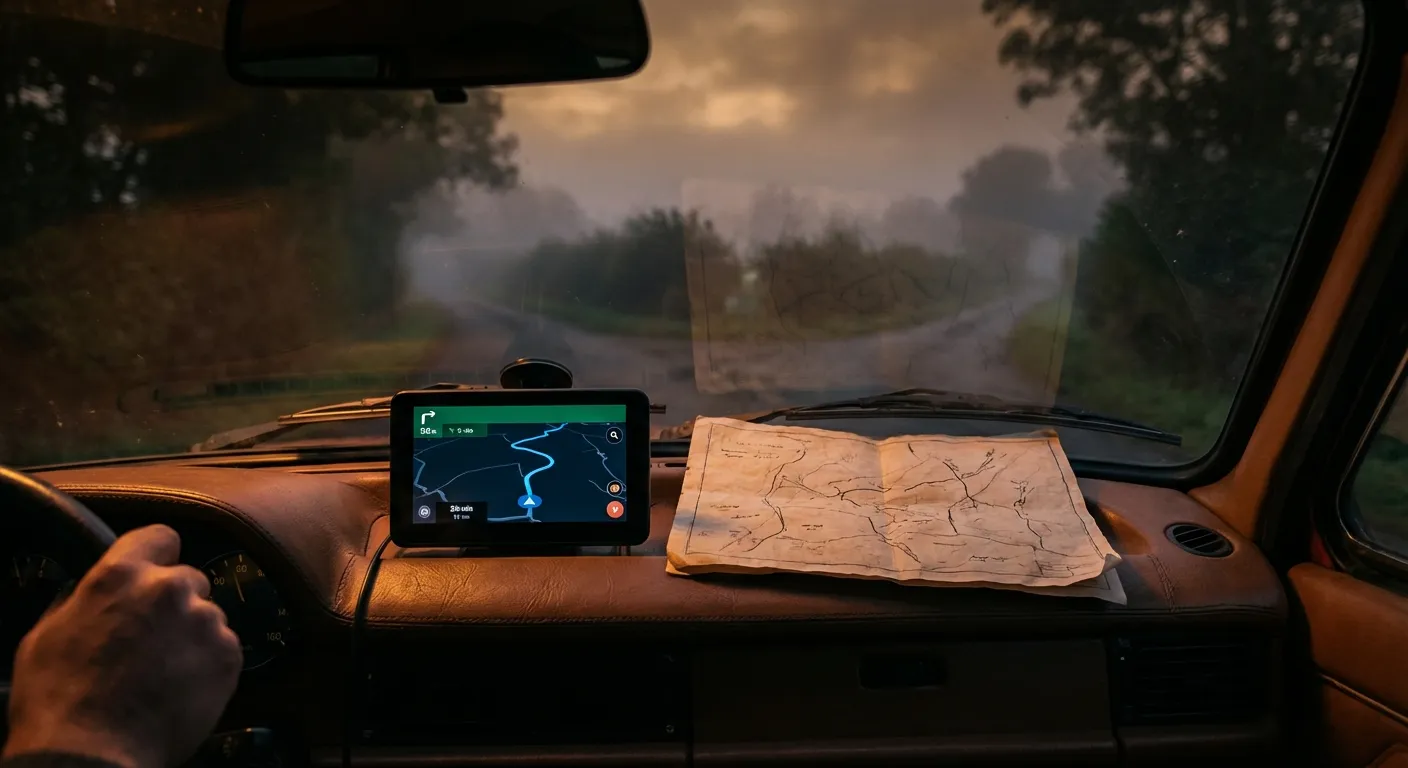
Rachel had printed a physical map, too. A real one, folded and refolded, Rand McNally, bought at a gas station. Not because she needed it — the rental car had GPS, and her phone had GPS, and honestly she could probably navigate by highway signs alone — but because she liked the weight of it. The tactile certainty. The ability to see the whole route at once, spread out on the hood of the car, her finger tracing the line from Point A to Point B like drawing a future into existence.
Danielle watched her unfold it at the first gas stop, thirty miles outside Charlotte, and said, “You know the GPS does that, right?”
“The GPS shows you one turn at a time,” Rachel said. “I want to see the whole thing.”
Danielle shrugged. “I’d rather be surprised.”
Rachel did not want to be surprised. That was, perhaps, the truest thing about her. Surprises were variables. Variables were risks. Risks were what happened to people who didn’t plan.
The GPS disagreed with her for the first time outside of Columbia.
Not dramatically — a quiet thing. Rachel had planned to take I-77 South to I-26, the obvious route, the route the map showed. Clean lines, major highways, predictable mileage. But the GPS — the car’s built-in system, a calm female voice that reminded Rachel of a dental hygienist — suggested a different route. State roads. A detour through a town called Prosperity, which sounded made up.
“In three miles, take exit 74 toward Prosperity,” the voice said.
“Ignore it,” Rachel said. “I have the route.”
“Maybe there’s traffic?” Danielle offered.
“I checked traffic before we left. I-26 is clear.”
“Then why is it —”
“It’s a GPS. They do this. They optimize for something, but it’s not always better. I know this route.”
Danielle held up her hands in surrender. They passed exit 74. The GPS said, “Recalculating,” in that mildly disappointed tone that all GPS voices share, as if it had expected better from you.
Rachel didn’t think about it again. The interstate was fine. They made Savannah in five hours and twelve minutes, exactly as the spreadsheet had predicted.
In Savannah, on the second night, they met a man named James.
Not romantically — Rachel was dating an orthopedic surgery resident named Kevin who fit the timeline nicely. James was sixty-something, Black, silver-bearded, sitting at the bar of the restaurant Rachel had researched (4.7 stars, James Beard semifinalist chef, reservation made three weeks in advance). He was eating shrimp and grits alone and reading a paperback with the spine cracked soft.
Danielle struck up a conversation. Danielle always struck up conversations. It was the fundamental difference between them: Danielle moved through the world like water, following gravity, pooling wherever there was a low spot and a story; Rachel moved through the world like a train, on tracks, on time, destination fixed.
James, it turned out, was a retired long-haul truck driver. Forty years on the road. He’d driven every state except Hawaii, which he thought was reasonable since he drove trucks and Hawaii was an island. He had a way of talking — slow, deliberate, warm — that made you stop checking your phone.
“You girls on a trip?” he asked.
“Road trip,” Danielle said. “Charlotte to New Orleans.”
“Taking the coast?”
“No,” Rachel said. “Interstate. Fastest route.”
James looked at her — really looked, the way older people sometimes do, as if they’re not seeing you but seeing someone they used to know. Then he smiled.
“I drove I-10 for twenty years,” he said. “Pensacola to El Paso, three times a week. Same road. Same exits. Same truck stops. I could’ve done it blindfolded.” He took a sip of sweet tea. “But the best thing I ever saw — the thing I still think about — was the day my GPS broke outside Mobile and I had to take back roads through Mississippi. Ended up in a town called Ocean Springs. Little art town. Had the best cup of coffee of my life in a shop the size of a closet, next to a woman who turned out to be a retired astronaut. We talked for three hours.”
He set down his glass.
“The interstate gets you there fast. But there isn’t always where you think it is.”
Rachel smiled politely and said, “I’ll keep that in mind,” and thought: That’s a lovely story, but I have a spreadsheet.
The GPS and Rachel disagreed again outside Jacksonville.
More insistently this time. Rachel’s route went I-95 South to I-10 West — clean, fast, four-lane, the arterial highways of the American South, built for speed and efficiency. The GPS wanted her on A1A, the coastal road. Then off A1A onto something called County Road 13. Then through St. Augustine — which wasn’t on the itinerary, and Rachel’s itinerary was not a suggestion.
“The GPS is being weird again,” she said.
Danielle, who’d been napping, opened one eye. “Maybe let it be weird?”
“We’ll lose an hour.”
“We have an hour.”
“We have a schedule.”
Danielle closed her eye. “Rach. It’s a vacation.”
“A vacation with a schedule.”
“That’s called a work trip.”
Rachel stayed on I-95. The GPS said “Recalculating” and Rachel felt a small, irrational surge of satisfaction at overruling it. She was driving. She had the map. She could see the route. The GPS could only see the next turn, and the next turn was wrong.
The interstate was fine. Tallahassee arrived on time, within the margin of error. Rachel checked them into the hotel, checked the spreadsheet, and felt the specific pleasure of a plan executing as designed.
She didn’t find out until later — weeks later, scrolling Instagram — that A1A through St. Augustine passes through a stretch of road so beautiful that travel magazines have called it one of the most scenic drives in America. Marshland and live oaks and a sky so wide it makes you forget you have a body.
She didn’t know. She’d been on I-95, in the left lane, going seventy-three miles per hour, watching the highway median blur past and calling it progress.
The fight happened in Tallahassee.
Not between Rachel and Danielle — between Rachel and Kevin. A phone call at 10 p.m. in the hotel room while Danielle was in the shower.
Kevin had been offered a fellowship. A good one. Johns Hopkins. Pediatric orthopedics. The kind of thing you don’t say no to.
“That’s amazing,” Rachel said, and meant it. Then: “When would it start?”
“September.”
“This September? Kevin, that’s — that’s in Baltimore.”
“I know where Johns Hopkins is, Rachel.”
“We just talked about the timeline. You were going to finish residency in Charlotte. I was going to make partner in two years. We said —”
“I know what we said. But this is Hopkins.”
Silence. The kind that hums.
“So what does this mean for us?” Rachel asked, and heard her own voice go thin and clinical, the way it did in depositions when she was losing the thread.
“It means I move to Baltimore in September. And we figure it out.”
“Figure it out” was not on the spreadsheet. “Figure it out” was a variable, an open-ended, undefined, terrifying variable, and Rachel’s entire life was built on eliminating variables.
“I need to think about this,” she said.
“You need to think about me taking a once-in-a-career opportunity?”
“I need to think about how it fits.”
“Fits into what? The five-year plan? The spreadsheet?” His voice had that edge now. The edge that meant they were no longer arguing about Baltimore.
“I just like to know where things are going, Kevin.”
“Yeah,” he said quietly. “I know. That’s — I know.”
They hung up without resolving anything. Rachel sat on the hotel bed and stared at the wall and felt, for the first time in her adult life, the sickening vertigo of a plan that wouldn’t hold.
The GPS made its third suggestion outside of Pensacola.
Rachel’s route: I-10 West, straight through to New Orleans. Four hours and change. The fastest line between two points.
The GPS: Exit onto US-98. Follow the coast. Through a place called Navarre. Through a place called Destin. Along the Gulf.
“Recalculating,” it murmured when she missed the exit. Then again, five miles later, when a second exit came. “Recalculating.”
“Shut up,” Rachel said. Not to Danielle. To the voice.
Danielle looked at her. “You okay?”
“Fine.”
“You’ve been fine since Tallahassee. Which means you’re not fine.”
Rachel drove. The interstate stretched ahead, gray and straight and certain. She gripped the wheel at ten and two and felt a sudden, overwhelming need to know exactly how many miles were left. She glanced at the map on the passenger seat. Unfolded it with one hand. Found the route. Traced the line.
There. New Orleans. 266 miles. She could calculate the ETA in her head. She could see the whole thing. The map showed her everything.
Except what was wrong.
“Kevin got a fellowship at Hopkins,” she said. “He’s moving to Baltimore.”
Danielle sat up. “Oh.”
“In September.”
“Oh, Rach.”
“I had a plan. We had a plan. Charlotte. Partnership. The — the whole thing.”
“Maybe the plan changes.”
“I don’t change plans.”
“I know.”
“I build plans. I follow plans. That’s — that’s what I do. My mom didn’t have a plan and she worked at a hardware store every summer for twenty years. I’m not — I’m not going to —”
She stopped. Swallowed. The interstate blurred slightly, not from speed.
“In one mile, take exit 31 toward Navarre Beach,” the GPS said.
“Shut up,” Rachel whispered.
But Danielle, very gently, said, “Take the exit.”
“We’ll lose time.”
“Rachel. Take the exit.”
She took the exit.
She didn’t know why. Later, she’d try to reconstruct the decision, trace the exact neural pathway that made her hands move the wheel to the right, and she couldn’t. It wasn’t logic. Logic said I-10 West. It wasn’t the plan. The plan said straight through. It was something else — something deeper than logic, quieter than planning, more like an exhale than a decision.
She turned onto US-98, and the world opened.
The interstate had been walls. Concrete barriers, overpasses, billboards, the tunnel vision of four lanes and a median. But here — here the road narrowed to two lanes and the walls fell away and suddenly there was sky. A ludicrous amount of sky. Pale blue overhead, deepening toward the horizon, where it met the Gulf of Mexico in a line so clean it looked drawn by a ruler held by God.
The water was turquoise. Not the postcard turquoise that looks filtered. Real turquoise. The color of something so pure it hurts to look at. White sand beaches unspooled to the left like a scroll being unrolled by invisible hands. Sea oats bent in the breeze. A pelican dove — tucked its wings and dropped like a stone, hit the water, came up with a fish, and the whole thing took three seconds and was the most beautiful thing Rachel had seen in months.
She pulled over.
Not at a designated stop. Just — pulled over. Onto the sandy shoulder. Killed the engine. Sat there with her hands on the wheel and her eyes on the water and felt something crack inside her chest like ice breaking on a river in spring.
“Rach?” Danielle said.
Rachel didn’t answer. She got out of the car. Walked to the edge of the road where the sand began. Took off her shoes. Stood there, barefoot, the Gulf breeze in her hair and the sun warm on her arms and the impossible blue water doing what it had been doing for millennia — existing, beautifully, without a plan.
She started crying.
Not the pretty kind. The ugly kind. The kind where your face twists and your shoulders shake and sounds come out that you didn’t authorize. She stood on the edge of the Gulf of Mexico, barefoot, weeping, and she couldn’t have told you exactly why except that it had something to do with the beauty and something to do with Kevin and something to do with the fact that she’d almost missed this.
She’d almost driven past. She’d almost stayed on I-10, eyes on the road, hands at ten and two, hitting her ETA, following the map — and she would have arrived in New Orleans on schedule and never known that this existed. This beach. This sky. This moment.
And she thought — not in words, not in a sentence, but in the deep, pre-verbal way that the most important thoughts arrive — How many exits have I blown past?
How many times had the voice said turn here and she’d said I have the map and kept driving, eyes fixed on the destination, never knowing what she’d missed? Not just on this trip. In her whole life. In her whole, meticulously mapped, ruthlessly scheduled, contingency-planned life.
Danielle came and stood next to her. Didn’t say anything. Just stood there, letting the silence do what silence does when someone is falling apart in a way that might actually be falling together.
They sat on the beach for two hours.
Rachel Park — the woman who budgeted her time in fifteen-minute increments, who had once described an unstructured afternoon as “a failure of planning” — sat on a beach with sand in her hair and no agenda and watched the waves.
And somewhere in the second hour, she thought about a verse.
Not one she’d gone looking for. One that surfaced on its own, like a message in a bottle that had been floating in her memory since Sunday school, waiting for the tide to bring it in.
Trust in Yahweh with all your heart, and don’t lean on your own understanding. In all your ways acknowledge him, and he will make your paths straight.
Proverbs 3:5-6. She’d known it since she was a kid in Mrs. Jeffers’ Sunday school class at New Hope AME. She’d memorized it for a candy bar. She’d quoted it in college applications and cross-stitched versions of it hung in her mother’s hallway.
But she’d never heard it. Not really. Because hearing it — actually hearing it — would have required her to reckon with the second half. Don’t lean on your own understanding. Which meant: your map isn’t enough. Your spreadsheet isn’t enough. Your five-year plan, your contingency strategies, your projected emotional states — they are not enough. Because you are drawing a map with a pencil, on paper, at ground level, and you cannot see what’s around the next bend.
But someone can.
She thought about the GPS. The stupid car GPS that she’d been arguing with for a thousand miles. And she saw it — suddenly, sharply, the way you see a hidden image in a pattern when your eyes finally relax — as the most obvious metaphor she’d ever lived through.
The GPS could see the whole map. She could only see the road ahead. The GPS knew about the traffic jam on I-26 that she’d never encountered because she didn’t take exit 74. The GPS knew about the beautiful stretch of A1A that she’d driven past in pursuit of efficiency. The GPS knew about this beach — this precise, heartbreaking, glorious beach — and had been trying to bring her here since Pensacola.
And every time, she’d said: I have the map. I know the route. I don’t need you.
The GPS had said “Recalculating” each time. Not angry. Not punishing. Just… adjusting. Finding a new way to get her where she needed to go, even as she refused to listen. Patient in a way that was almost absurd. Almost divine.
In all your ways acknowledge him, and he will make your paths straight.
The verse didn’t say he’d make her paths short. Or efficient. Or according to the spreadsheet. It said straight. True. Aligned. Going where they were supposed to go. And sometimes the straight path looked, from ground level, like a detour. Like a coastal road when you’d planned for the interstate. Like a fellowship in Baltimore when you’d planned for Charlotte.
She called Kevin from the beach.
He picked up on the second ring. “Hey.” Cautious.
“Hey.” She dug her toes into the sand. “I’m sitting on a beach in Navarre, Florida.”
“That’s not on your itinerary.”
“I know.”
Pause. “Are you okay?”
“I don’t know. Maybe. I think I might be figuring something out.”
“That sounds terrifying for you.”
She laughed. A real laugh, with tears still on her face. “Kevin. Take the fellowship.”
“Rach —”
“Take it. It’s Hopkins. It’s — I don’t know what it means for us yet. I don’t have a plan for it. That’s the thing. I don’t have a plan. And I think — I think maybe that’s okay.”
Silence. But a different kind this time. Not the humming, fractured silence of the Tallahassee call. A listening silence. A held-breath silence.
“Who are you and what have you done with Rachel Park?” he said.
“She’s sitting on a beach she didn’t plan to visit, having a spiritual crisis over a GPS. It’s fine. She’s fine.”
“That doesn’t sound fine.”
“It’s a new kind of fine.”
She thought about her mother on the drive to New Orleans.
Not the hardware store story. A different one. The one her mother never told in the same way, because it didn’t fit the narrative of control and bootstrapping and building your own life. The one about how she’d moved to Greenville.
Her mom hadn’t planned Greenville. She’d planned Atlanta. Had a job lined up, an apartment deposit down, a life to build. But a friend called from Greenville and said there was a teaching position open, and her mother — a woman who planned, who budgeted, who mapped things out — had felt something. Not a voice. Not a sign. A pull. A quiet, inexplicable sense that she was supposed to go to Greenville instead.
She went. Took the job. And three months later, in the hardware store where she was working summers to make the math work, she met a man named David Park. They married a year later. Had Rachel. Had her brothers.
Her mother’s entire life — Rachel’s entire existence — was the result of a detour. An exit she hadn’t planned to take. A recalculation.
Rachel had always heard the story and focused on the hardware store, on the struggle, on the lesson about working hard because the world doesn’t hand you things. But driving along US-98 with the Gulf glittering to her left and the sun going golden, she heard the other lesson — the one hiding underneath.
Her mother had taken the exit.
Her mother — the planner, the builder, the woman who mapped her life and her budget and her children’s futures — had, at the crucial moment, listened to a voice that wasn’t on her map. Had turned the wheel toward Greenville when everything said Atlanta. Had trusted something she couldn’t see and couldn’t prove and couldn’t spreadsheet.
And the life that followed — imperfect, difficult, beautiful — was the fruit of that trust.
She thought about another verse. One she liked less.
“For my thoughts are not your thoughts, and your ways are not my ways,” says Yahweh. “For as the heavens are higher than the earth, so are my ways higher than your ways, and my thoughts than your thoughts.”
Isaiah 55:8-9.
She’d always heard this as vaguely comforting — a nice way of saying God’s smarter than you, so relax. But sitting in a car on a road she hadn’t planned to be on, heading toward a future she couldn’t see, she heard it as something more specific. More confronting.
It wasn’t just saying God’s thoughts are different. It was saying they’re higher. As the heavens are higher than the earth. That’s not a small difference. That’s not you think A and God thinks B. That’s the gap between a pencil sketch and a satellite image. Between a folded map and a view from space.
She was drawing routes at ground level. She could see a hundred miles in any direction on a clear day. God saw the whole map. Every road. Every closure. Every back route. Every beach that would break you open at exactly the right moment. Every fellowship in Baltimore that would rearrange everything and, somehow, build something better than the spreadsheet had imagined.
A man’s heart plans his course, but Yahweh directs his steps.
Proverbs 16:9. She hadn’t planned to remember that one either. It just showed up, like the GPS suggesting an exit — unsolicited, persistent, patient.
A man’s heart plans his course. She could almost hear God’s voice — not audible, not dramatic, just the warm, amused tone of someone watching their child insist on doing it herself. Go ahead. Draw the map. Make the spreadsheet. I’m not offended by your planning. I made you a planner. I love that about you.
But Yahweh directs his steps.
So when I say “take the exit” — maybe take the exit.
They arrived in New Orleans at sunset instead of 2 p.m.
Four hours behind schedule. Rachel’s itinerary was in shambles. They’d missed the restaurant reservation. They’d missed the walking tour. They’d missed the precisely timed arrival that would have allowed them to check in, shower, and be at Café Du Monde by three.
Instead, they rolled into the city as the sun turned the Mississippi River into liquid copper, and Danielle said, “Holy —” and didn’t finish the sentence because she didn’t need to.
They parked. Walked to the river. Stood on the bank as the sky did things that no spreadsheet could predict and no itinerary could schedule and no map could prepare you for.
“I need to tell you something,” Rachel said.
“You’re going to Baltimore.”
Rachel looked at her. “How did you —”
“Rach. I’ve known you since we were eighteen. You’ve been on the interstate your whole life. Today you took the exit. That’s not a GPS thing. That’s a Kevin thing.”
“It’s a God thing.”
Danielle raised an eyebrow.
“I’ve been driving the whole time,” Rachel said. “My whole life. My hands on the wheel. My map on the seat. My route, my timeline, my plan. And I think — I think God’s been saying ‘take the exit’ for years. And I keep saying ‘I have the map.’ And He keeps saying ‘Recalculating.’ Not angry. Just… patient. Waiting for me to take my hands off the wheel long enough to realize I don’t know where I’m going. I know where I think I’m going. But I can’t see what He sees.”
Danielle was quiet for a moment. Then: “So what do you do?”
Rachel looked at the river. At the city behind them, glowing and chaotic and completely unplanned. At the sky, which was doing something with pink and gold that no one had scheduled.
“I think I stop arguing with the GPS,” she said.
She moved to Baltimore in October.
Not recklessly — she was still Rachel Park. She negotiated a remote arrangement with the firm. Found an apartment in Federal Hill with a bay window and a view of the harbor. Made a new spreadsheet, because she couldn’t help it, but left gaps in it. White spaces. Rooms with no furniture. She didn’t know what would fill them, and for the first time in her life, she let that be okay.
She started going to a church in Fells Point — a small one, diverse, a little chaotic, not at all the kind of church she’d have chosen from a list. She’d found it by accident. By GPS, actually. She’d typed in the address of a bigger church she’d researched online, and the GPS had routed her to the wrong street — one block over, where a storefront church with a hand-painted sign was holding a Wednesday night prayer service.
She almost drove past. Almost said I have the address, this isn’t right, recalculating.
She went in instead.
And it was there — in a folding chair in a room that smelled like coffee and old carpet, surrounded by strangers who raised their hands when they sang and said “Amen” out loud and prayed for each other with a ferocity that made her chest ache — that she heard the voice again. Not the GPS. The real one. The one underneath. The one that had been saying turn here, turn here, turn here her whole life, through circumstances and strangers and nudges and a detour through Navarre Beach that broke her open just enough to let the light in.
I will instruct you and teach you in the way which you shall go. I will counsel you with my eye on you.
Psalm 32:8. And she understood, finally, what it meant.
Not that God had a spreadsheet for her life. Not that somewhere in heaven there was a divine five-year plan with her name on it, every variable controlled, every milestone mapped. That was just her own image projected onto God — her planning, her control, her need to see the whole route before she’d agree to drive.
What the verse meant was simpler. And scarier.
It meant someone was watching the road. Someone who could see the traffic jam she couldn’t. The road closure she’d hit in three miles. The beach that would change her life. The church on the wrong street that was actually the right one. The man in Baltimore who would become not just her boyfriend but her partner, her co-laborer, her fellow stumbler through a life that looked nothing like the spreadsheet and was, somehow, more than the spreadsheet had ever imagined.
Someone was watching the road. And He was saying — gently, persistently, without coercion, respecting her hands on the wheel while whispering directions she was free to ignore: Turn here. Trust me. I can see what you can’t.
She kept the map.
It’s in a frame now, on the wall of the apartment in Federal Hill — the old Rand McNally, folded and refolded until the creases are soft, with the original route highlighted in yellow: Charlotte to Savannah to Tallahassee to New Orleans. A straight line. An efficient line. A line that made perfect sense at ground level.
Next to it, in red — added later, from memory — the route she actually took. The detour through Navarre. The coastal road she hadn’t planned. The exit she almost missed.
Visitors sometimes ask about it.
“It’s a reminder,” she says.
And if they ask what it reminds her of, she tells them about a road trip and a GPS and a beach in Florida and a verse from Proverbs that she’d known since she was seven but didn’t understand until she was twenty-eight, barefoot and weeping at the edge of the Gulf of Mexico, finally letting go of the map long enough to look up and see where she actually was.
And where she actually was — where she’d always been, though she couldn’t see it from the interstate — was exactly where she was supposed to be. Not because she’d planned it. But because someone had been guiding her the whole time.
Someone who could see the whole map.
Someone who whispered recalculating every time she veered, not with judgment but with patience, not with punishment but with redirection, because the destination was never in question — only the route. And the route, it turned out, was the point. The route was where the living happened. The route was where the beaches were.
The map was her plan.
The GPS was His grace.
And the exit — the terrifying, unscheduled, unspreadsheetable exit — was where she finally learned the difference.
Trust in Yahweh with all your heart, and don’t lean on your own understanding. In all your ways acknowledge him, and he will make your paths straight.
A man’s heart plans his course, but Yahweh directs his steps.
“For my thoughts are not your thoughts, and your ways are not my ways,” says Yahweh. “For as the heavens are higher than the earth, so are my ways higher than your ways, and my thoughts than your thoughts.…”
I will instruct you and teach you in the way which you shall go. I will counsel you with my eye on you.
The Moral:
Your plans are a pencil sketch. God’s guidance is a satellite view. You can see the road ahead; He can see the road closure around the bend, the shortcut through the valley, and the destination you didn’t know you were driving toward. Planning isn’t the problem — idolizing the plan is. The spreadsheet isn’t sin — refusing to let God edit it is. The question was never whether you’d arrive. The question is whether you’ll trust the Guide enough to take the exit you didn’t plan for. Because the exits — the detours, the recalculations, the moments when the map fails and you have to drive by faith instead of sight — those are where the living happens. Those are where the beaches are. And the Voice saying “recalculating” isn’t angry. It’s patient. It’s kind. It can see what you can’t. And it has never, not once, been wrong.
For Reflection
- Where in your life are you gripping the map so tightly that you can’t hear the GPS? What “plan” have you built that might be keeping you from a detour God has in mind?
- Has there been a time when something went “wrong” — an unexpected change, a disrupted plan — that turned out to lead somewhere you needed to be? What did that teach you about God’s guidance?
- Proverbs 3:5 says “don’t lean on your own understanding.” That doesn’t mean stop thinking. It means stop trusting your thinking more than God’s leading. What’s the difference between wise planning and white-knuckled control?
- Rachel’s mother took the exit to Greenville and it changed everything. Is there an “exit” in your life right now — a decision, a move, a change — that feels risky but might be God redirecting your route?
- The GPS never stopped recalculating. It never said, “Fine, do it your way.” It patiently offered a new route every time. How does this picture of God’s patience change the way you think about times you’ve ignored His leading?
Next time: A noise-canceling headphone, a silent room, and the voice he’d been drowning out for years.
💡 The Moral
Your plans are a pencil sketch. God's guidance is a satellite view. You can see the road ahead; He can see the road closure around the bend, the shortcut through the valley, and the destination you didn't know you were driving toward. The question was never whether you'd arrive. The question is whether you'll trust the Guide enough to take the exit you didn't plan for.