

Can't Science Explain Everything? — Why You Don't Have to Pick Between Faith and a Lab Coat
The war between science and faith is mostly a myth. Here's why you don't have to choose — and why some of history's greatest scientists didn't.
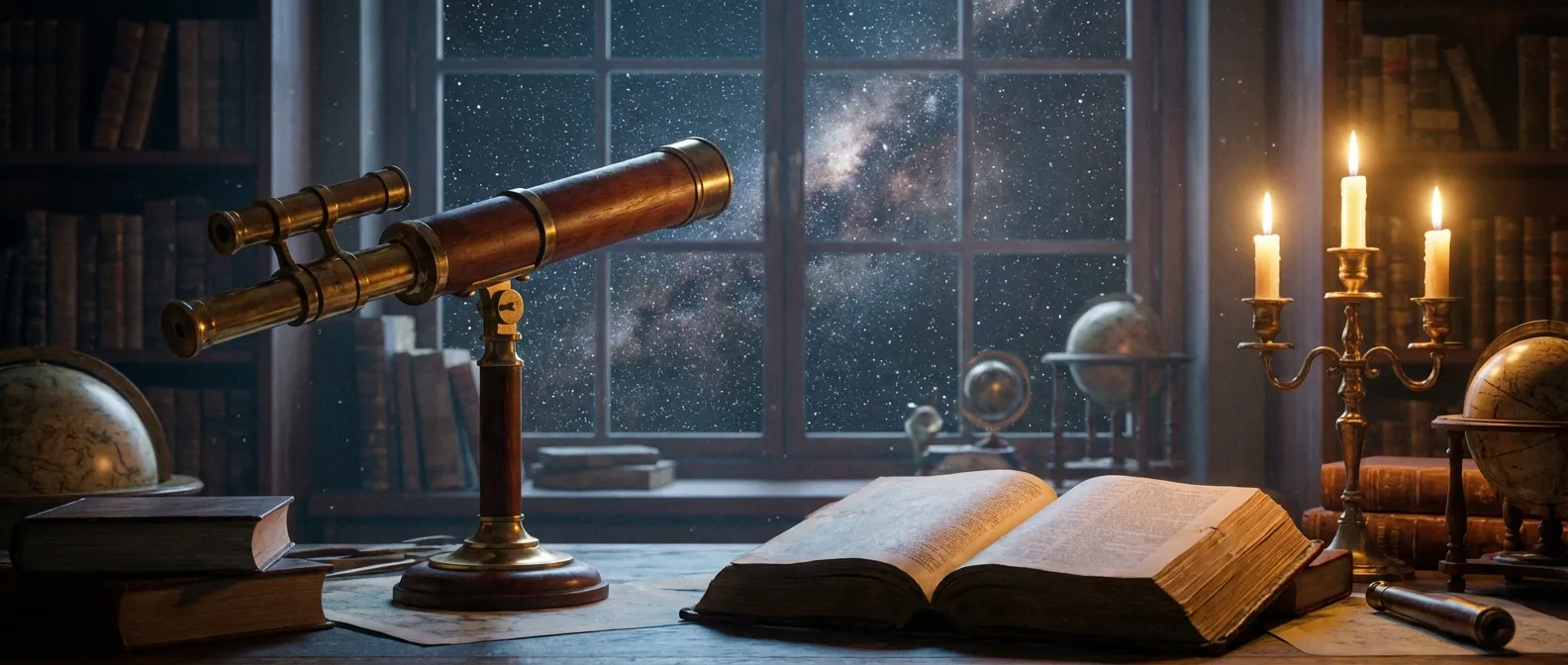
Here’s how the story usually goes:
Science is about evidence, reason, and progress. Religion is about faith, tradition, and superstition. They’re fundamentally incompatible, and as science advances, religion retreats. Eventually, science will explain everything, and God will have nowhere left to hide.
It’s a clean narrative. It’s a compelling narrative. And it’s mostly wrong.
The “Warfare” Myth
The idea that science and religion have been locked in mortal combat throughout history is itself a product of the 19th century — popularized by two books, John William Draper’s History of the Conflict Between Religion and Science (1874) and Andrew Dickson White’s A History of the Warfare of Science with Theology in Christendom (1896).
Modern historians of science have largely demolished this narrative. It’s not that there were no conflicts — the Galileo affair was real, though far more complicated than the popular version suggests. But the overall picture is one of deep entanglement, not warfare.
Here’s what actually happened: science as we know it grew out of religious institutions and religious convictions. The medieval universities where modern science was born were founded by the Church. The assumption that the universe is orderly, rational, and discoverable — the foundational assumption of all science — came directly from the theological conviction that the universe was created by a rational God.
As the mathematician Alfred North Whitehead argued, modern science could only have arisen in a culture shaped by Christian theology, because only that worldview provided the assumption that nature follows consistent, discoverable laws rather than operating by the whims of capricious gods.
The Scientists Who Believed
If science and faith are incompatible, somebody forgot to tell the scientists.
Isaac Newton — the man who formulated the laws of motion and universal gravitation, who invented calculus, who arguably did more to create modern physics than any other human being — wrote more about theology than science. He saw his scientific work as revealing the mind of God.
Michael Faraday — the pioneer of electromagnetism whose work underlies all modern electrical technology — was a devout member of the Sandemanian church. He saw no conflict between his faith and his science.
Georges Lemaître — the physicist who first proposed the Big Bang theory (yes, the Big Bang) — was a Catholic priest. When people tried to use the Big Bang to “prove” God’s existence, Lemaître cautioned against it. He understood the distinction between physics and theology better than most.
Francis Collins — the geneticist who led the Human Genome Project, one of the most ambitious scientific endeavors in history — is an evangelical Christian who wrote The Language of God about how his scientific work deepened his faith. He came to faith from atheism, as an adult, while studying medicine.
Rosalind Franklin, Werner Heisenberg, Max Planck, Robert Boyle, Gregor Mendel (an Augustinian friar who founded genetics)… the list goes on. And on. And on.
These aren’t fringe figures. They’re the people who built modern science. If faith is incompatible with rigorous scientific thinking, these people apparently didn’t notice.
The Limits of Science (And Why That’s Okay)
Science is an extraordinarily powerful tool. It has given us medicine, technology, and an understanding of the physical world that would have seemed miraculous to our ancestors. I’m not here to diminish science. I love science.
But science has limits, and being honest about those limits isn’t anti-science. It’s good philosophy of science.
Science answers how questions magnificently. How does gravity work? How do cells divide? How do stars form? It traces mechanisms, identifies patterns, and makes predictions.
What science doesn’t — and can’t — answer are why questions of a certain kind. Not “why does water boil at 100°C?” (science handles that fine). But “why is there something rather than nothing?” “Why does the universe follow mathematical laws at all?” “What makes human life valuable?” “What should we do with our knowledge?”
These are philosophical and existential questions. They’re not scientific failures — they’re outside science’s job description.
The philosopher asking “why is there something rather than nothing?” is not in competition with the physicist describing how things work. They’re asking different questions about the same reality. A complete explanation of a kettle includes both the physics of heat transfer and the fact that someone wanted a cup of tea. The physical explanation doesn’t eliminate the personal one.
Methodological vs. Philosophical Naturalism
Here’s a distinction that matters enormously and is almost never made in popular conversation:
Methodological naturalism says: when doing science, we look for natural causes. We don’t invoke God as an explanation in our equations. This is a method — a practical approach that has been spectacularly productive.
Philosophical naturalism says: natural causes are all there is. There is nothing beyond the physical. No God, no soul, no transcendent reality.
These are very different claims. The first is a scientific method. The second is a philosophical worldview. You can fully embrace methodological naturalism (as most believing scientists do) while rejecting philosophical naturalism.
When someone says “science explains everything,” they’re almost always smuggling philosophical naturalism in under the guise of methodological naturalism. They’re taking a method and turning it into a metaphysics — and that’s a philosophical move, not a scientific one.
For the Chief Musician. A Psalm by David. The heavens declare the glory of God. The expanse shows his handiwork.
The heavens declare the glory of God. Not instead of declaring physics. Through physics. The psalmist sees the same sky as the astronomer. They’re just seeing different dimensions of it.
The Evolution Question
Let’s address the elephant in the room, because this is where a lot of people think the faith-science conflict is sharpest.
Many Christians accept evolution — including evolutionary biologists who are serious, practicing believers. Francis Collins does. So does the entire BioLogos organization, founded by Collins and staffed by working scientists who are Christians. So did B.B. Warfield, one of the theologians who formulated the doctrine of biblical inerrancy. So did C.S. Lewis, more or less.
The idea that you must choose between evolution and Christianity is a false dilemma promoted by people on both extremes — young-earth creationists on one side and militant atheists on the other. Both have a vested interest in making evolution and faith incompatible. But the actual history is more nuanced.
When Darwin published On the Origin of Species, the reaction from the Church was not monolithically hostile. Some Christians objected. Others — including the Harvard botanist Asa Gray, who was both a devout Christian and one of Darwin’s strongest scientific supporters — saw no conflict. The “evolution vs. faith” war is partly a 20th-century American invention, not an inevitable theological conclusion.
Can Christians disagree about evolution? Absolutely. Some hold to a literal six-day creation. Others accept an old earth with special creation of humans. Others accept common descent guided by God’s providence. The range of legitimate Christian positions is wider than most people — on either side — realize.
What I want you to know is this: evolution is not the faith-killer it’s often presented as. If you accept evolutionary science, you can still be a fully orthodox Christian. If you don’t, that’s your conviction. But don’t let anyone tell you this is the question that decides everything. It isn’t.
For the invisible things of him since the creation of the world are clearly seen, being perceived through the things that are made, even his everlasting power and divinity, that they may be without excuse.
Paul says God’s nature is evident from what He’s made. Whether “what He’s made” came about through six days of fiat creation or 13.8 billion years of cosmic evolution — either way, it points to a Creator.
The Design Question
There’s a deeper question underneath the science-faith debate, and it’s this: does the universe look like it was designed?
The fine-tuning of the universe’s physical constants — the cosmological constant, the strong nuclear force, the ratio of matter to antimatter — is so precise that even tiny variations would make life, chemistry, and even complex matter impossible. Physicists across the spectrum acknowledge this. Roger Penrose calculated that the odds of the universe’s initial conditions arising by chance are 1 in 10^(10^123) — a number so large it dwarfs anything in human experience.
There are responses to this — the multiverse hypothesis (there are countless universes, and we happen to be in the one that works) and the anthropic principle (of course we observe a life-permitting universe; we couldn’t observe one that wasn’t). These are serious proposals.
But they’re also, notably, not scientific in the traditional sense. Nobody has observed another universe. The multiverse is a theoretical construct — arguably as much a faith commitment as theism.
We’ve explored the fine-tuning question in much more depth in our skeptics’ corner series, so I’ll leave the detailed argument there. But here’s the bottom line: the universe doesn’t look like what you’d expect from blind chance. It looks like what you’d expect from intention.
It is the glory of God to conceal a thing, but the glory of kings is to search out a matter.
“It is the glory of God to conceal a matter; to search out a matter is the glory of kings.” Science is the search. Faith is the framework that makes the search meaningful.
What Science Can’t Give You
Here’s what I want to leave you with.
Science can tell you what a human being is made of — carbon, oxygen, hydrogen, nitrogen, calcium, and trace elements. It can map every neuron in your brain, sequence every gene in your DNA, and describe every chemical process that keeps you alive.
What it cannot tell you is whether your life matters.
Science can describe how the universe began, how stars form and die, how planets coalesce from cosmic dust. What it cannot tell you is why — or whether the whole magnificent show means anything at all.
Science can explain the mechanism of suffering — nerve signals, inflammation, pain receptors. What it cannot do is comfort you when your child is sick, or tell you that the suffering is not the end of the story, or promise that something better waits on the other side.
These aren’t failures of science. They’re reminders that science was never designed to answer every question. It’s the most powerful tool in the human toolkit. But a hammer, however magnificent, is not a screwdriver.
The Partnership Model
The real history of science and faith isn’t a war story. It’s a partnership story — messy, complicated, sometimes contentious (as all good partnerships are), but fundamentally collaborative.
Science explores God’s creation. Faith provides the framework of meaning in which that exploration matters. You don’t have to pick between the lab coat and the prayer book. You can wear both.
The greatest scientists in history did.
And the universe they discovered — elegant, mathematically precise, fine-tuned for complexity, breathtaking in its beauty — looks, to many of them, far more like a creation than an accident.
You’re allowed to follow their lead.