

Can We Trust the New Testament? — The Manuscript Evidence Is Actually Wild
How do we know the New Testament we read today reflects what was originally written? The manuscript evidence is stronger than most people — including most Christians — realize.
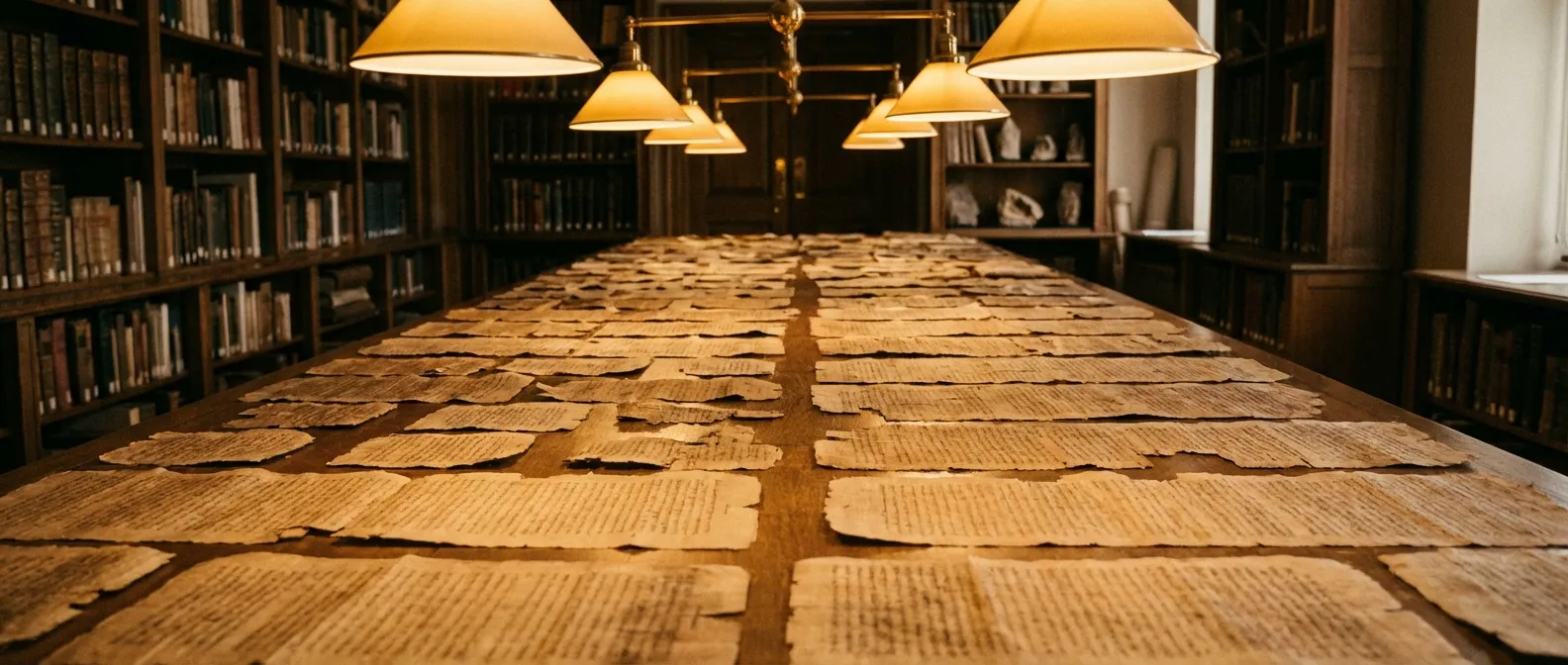
The Manuscript Evidence Is Actually Wild
Here’s a question that matters: How do we know that the Bible we read today is anything like what was originally written?
It’s a fair question. The New Testament was written nearly 2,000 years ago, in an era before printing presses, copy machines, or cloud storage. Every copy was made by hand. Surely, over centuries of manual copying, errors crept in. Surely the text was corrupted, edited, and manipulated beyond recognition.
That’s the assumption. Let’s look at the evidence.
What we’re about to walk through isn’t theology. It’s textual criticism — the academic discipline of analyzing ancient manuscripts to reconstruct original texts. It’s the same methodology scholars use for Homer, Plato, Tacitus, and every other ancient document. And when you apply it to the New Testament, the results are, frankly, astonishing.
The Manuscript Mountain
Let’s start with raw numbers.
The New Testament is preserved in approximately:
- 5,856 Greek manuscripts (the original language of the NT)
- 10,000+ Latin manuscripts
- 9,300+ manuscripts in other ancient languages (Syriac, Coptic, Armenian, Georgian, Ethiopic, Gothic, Slavic)
That’s over 25,000 manuscript copies of the New Testament or portions thereof. And the number keeps growing — new manuscripts are discovered regularly.
To appreciate what this means, you need to compare it to other ancient texts that no one questions.
The Comparison
| Ancient Work | Author | Date Written | Earliest Copy | Time Gap | Number of Copies |
|---|---|---|---|---|---|
| Iliad | Homer | ~800 BC | ~400 BC | ~400 years | ~1,800 |
| History of the Peloponnesian War | Thucydides | ~400 BC | ~900 AD | ~1,300 years | 8 |
| The Republic | Plato | ~380 BC | ~900 AD | ~1,200 years | ~200 |
| Gallic Wars | Caesar | ~50 BC | ~900 AD | ~950 years | ~10 |
| Annals | Tacitus | ~100 AD | ~1100 AD | ~1,000 years | 2 (partial) |
| New Testament | Various | ~49-95 AD | ~125 AD | ~25-50 years | 25,000+ |
Read that chart again.
We have 2 partial copies of Tacitus’s Annals, written roughly 1,000 years after the original. No historian doubts we can reconstruct what Tacitus wrote. We have 25,000+ copies of the New Testament, some written within decades of the originals. And people claim we can’t know what the original said?
As scholar F.F. Bruce wrote in The New Testament Documents: Are They Reliable? (1943):
“There is no body of ancient literature in the world which enjoys such a wealth of good textual attestation as the New Testament.”
This isn’t a Christian making a faith claim. It’s a statement of bibliographic fact.
The Time Gap: Closer Than You Think
The number of manuscripts matters, but so does the time gap between the original writing and our earliest surviving copies. A shorter gap means less time for corruption to accumulate.
Here’s what we have for the New Testament:
Papyrus 52 (P52): A fragment of the Gospel of John (18:31-33, 37-38), dated to approximately 125 AD — roughly 25-30 years after John was written. This is housed in the John Rylands Library in Manchester, England.
Papyrus 66 (P66): Contains most of the Gospel of John, dated to approximately 200 AD.
Papyrus 46 (P46): Contains major Pauline epistles, dated to approximately 175-225 AD.
Papyrus 75 (P75): Contains large portions of Luke and John, dated to approximately 175-225 AD.
Codex Sinaiticus and Codex Vaticanus: Complete (or nearly complete) New Testaments, dated to approximately 325-350 AD — about 250 years after the originals.
For comparison: our earliest substantial manuscript of Plato’s works comes from about 1,200 years after he wrote. Our earliest copy of Thucydides is about 1,300 years removed from the original.
The New Testament’s earliest fragments are within a single generation of the original authors. The complete manuscripts are within 250 years. In the world of ancient manuscript studies, this is extraordinarily close.
Daniel B. Wallace, one of the world’s leading New Testament textual critics and founder of the Center for the Study of New Testament Manuscripts, puts it this way:
“We have more than 1,000 times the manuscript data for the New Testament than we do for the average Greco-Roman author. Not only this, but the extant manuscripts of the New Testament were written much closer in time to the originals than is the case for almost any other ancient literature.”
The “400,000 Variants” Objection
Here’s where skeptics often pounce. Bart Ehrman, in Misquoting Jesus (2005), popularized the claim that there are “more variants among our manuscripts than there are words in the New Testament.” The number frequently cited is around 400,000 textual variants.
That sounds devastating. Until you understand what “variant” means in textual criticism.
A “variant” is any difference between any two manuscripts. If one manuscript spells a name “John” and another spells it “Jon,” that’s a variant. If one manuscript has “Jesus Christ” and another has “Christ Jesus,” that’s a variant. If a scribe accidentally wrote a word twice, that’s a variant. And that single variant is counted once for every manuscript that contains it.
When you actually categorize the variants, here’s what you find:
-
Spelling differences and nonsense readings: ~70-75% of all variants. These include misspellings, accidental word duplications, and errors that don’t even produce real words. No one thinks these are meaningful.
-
Minor differences that don’t affect meaning: ~20-24%. Word order variations (Greek is flexible about word order, unlike English), synonyms, the presence or absence of articles (“the Christ” vs. “Christ”), etc.
-
Meaningful but not viable: ~1-2%. Variants that would change meaning but are found in only one or two late manuscripts and clearly aren’t original.
-
Meaningful and viable: Less than 1%. These are variants where scholars genuinely debate which reading is original.
And even in this last category — the less-than-1% — not a single core Christian doctrine is affected. Not the deity of Christ. Not the resurrection. Not salvation by grace. Not one.
Bruce Metzger, widely considered the greatest textual critic of the 20th century (and Bart Ehrman’s own doctoral supervisor), was asked in an interview with Lee Strobel whether the variants shook his confidence in the New Testament. His response:
“It actually increased my confidence in the text. The more evidence we find, the more we can be sure of the original reading.”
When Strobel asked Metzger directly if scholarship had shaken his faith, the aging scholar — who had spent his entire career examining these manuscripts — replied:
“It has built it. I’ve asked questions all my life, I’ve dug into the text, I’ve studied this thoroughly, and today I know with confidence that my trust in Jesus has been well placed.”
The Telephone Game Myth
You’ve probably heard this objection: “The Bible is like a game of telephone — one person whispers to the next, and by the end, the message is completely garbled.”
This analogy fails for several important reasons:
1. Manuscripts were copied, not whispered. In a telephone game, each person hears the message once and passes it on from memory. In manuscript transmission, scribes were looking at a written text and copying it carefully. The written word doesn’t degrade the way whispered oral messages do.
2. The chain isn’t linear — it’s a web. In the telephone game, there’s one chain: A → B → C → D. Lose one link, and the message is gone. Manuscript transmission works differently. One manuscript gets copied multiple times, creating independent branches. If a scribe in Egypt makes an error, the copies being made simultaneously in Syria, Rome, and Greece don’t have that error. Scholars can compare across branches to identify and eliminate mistakes.
3. We have manuscripts from multiple points in the chain. We don’t just have the “end” of the telephone line. We have manuscripts from the 2nd century, 3rd century, 4th century, and every century after that. We can compare earlier copies with later ones directly.
4. Scribes were often trained professionals. While some manuscripts were clearly copied by amateurs (and show it), many were produced by trained scriptoria — professional copying centers — where accuracy was valued and checked.
The telephone game analogy isn’t just inaccurate — it demonstrates a fundamental misunderstanding of how textual transmission works.
The Church Fathers: A Second Witness
Here’s a piece of evidence that often gets overlooked: the writings of the early church fathers.
The early Christian leaders — Clement of Rome (96 AD), Ignatius of Antioch (107 AD), Polycarp of Smyrna (110 AD), Justin Martyr (150 AD), Irenaeus of Lyon (180 AD), and many others — quoted the New Testament extensively in their letters, sermons, and theological works.
How extensively? This observation has led scholars to suggest that if every manuscript of the New Testament were destroyed, you could reconstruct virtually the entire text from the quotations of the church fathers alone — a claim often attributed to Sir David Dalrymple (18th century), though its exact provenance is debated.
More recently, scholars have cataloged over 36,000 quotations from the New Testament in the writings of the church fathers from the first three centuries. This provides an independent check on the manuscripts: if the manuscripts say one thing and the church fathers consistently quote something different, we’d know there was a problem. In fact, they line up remarkably well.
This means we don’t just have manuscript evidence for the New Testament. We have a parallel witness in the form of thousands of quotations from writers who lived within decades of the apostles themselves.
What the Experts Actually Say
It’s worth hearing from the scholars who spend their careers in this field.
Bruce Metzger (1914-2007), Professor at Princeton Theological Seminary, author of The Text of the New Testament:
“The New Testament has been preserved in more manuscripts than any other ancient work, having over 5,800 complete or fragmented Greek manuscripts, 10,000 Latin manuscripts and 9,300 manuscripts in various other ancient languages.”
F.F. Bruce (1910-1990), Rylands Professor of Biblical Criticism at the University of Manchester:
“The evidence for our New Testament writings is ever so much greater than the evidence for many writings of classical authors, the authenticity of which no one dreams of questioning.”
Daniel B. Wallace, Professor of New Testament Studies at Dallas Theological Seminary:
“The wealth of material that is available for determining the wording of the original New Testament is staggering… scholars are virtually certain of the original wording in about 99% of the New Testament.”
Sir Frederic Kenyon (1863-1952), director of the British Museum, in The Bible and Archaeology (1940):
“The interval then between the dates of original composition and the earliest extant evidence becomes so small as to be in fact negligible, and the last foundation for any doubt that the Scriptures have come down to us substantially as they were written has now been removed.”
Even Bart Ehrman, who is frequently cited by skeptics, has acknowledged in public debates (including with William Lane Craig) that the core narrative of the New Testament — including the crucifixion and the disciples’ belief in the resurrection — is historically reliable.
The New Testament’s Own Claims
It’s worth noting that the New Testament writers themselves were aware of the importance of accurate transmission. Luke opens his Gospel with an explicit statement of historiographical method:
Since many have undertaken to set in order a narrative concerning those matters which have been fulfilled among us, even as those who from the beginning were eyewitnesses and servants of the word delivered them to us, it seemed good to me also, having traced the course of all things accurately from the first, to write to you in order, most excellent Theophilus; that you might know the certainty concerning the things in which you were instructed.
Luke describes a process of careful investigation, eyewitness interviews, and orderly composition. This isn’t the language of myth-making. It’s the language of historical research.
Peter makes a similar claim:
For we didn’t follow cunningly devised fables when we made known to you the power and coming of our Lord Jesus Christ, but we were eyewitnesses of his majesty.
And Paul, writing what many scholars consider the earliest New Testament document (1 Thessalonians, ~49 AD), treated his words as carrying divine authority:
Every Scripture is God-breathed and profitable for teaching, for reproof, for correction, and for instruction in righteousness,
Whether or not you believe these claims, they demonstrate that the early Christian community understood themselves to be transmitting something of supreme importance — something worth preserving accurately.
What This Means (And What It Doesn’t)
Let’s be clear about what the manuscript evidence proves and what it doesn’t.
It does prove that the New Testament text we read today is an extraordinarily faithful representation of what was originally written in the 1st century. The science of textual criticism — using the same methods applied to all ancient literature — confirms this.
It does prove that the New Testament has more manuscript support, by orders of magnitude, than any other ancient text. If we can trust our copies of Homer, Plato, and Tacitus, we can trust our copies of the New Testament with even greater confidence.
It does prove that the “corrupted over centuries” narrative doesn’t hold up under scrutiny. The evidence points overwhelmingly in the opposite direction.
It does NOT prove that what the New Testament says is true. A perfectly preserved text could still contain false claims. But it removes one of the most common objections: “We can’t even know what the original said.”
We can. With remarkable precision.
The question isn’t whether we have what the original authors wrote. The evidence overwhelmingly says we do. The question is whether what they wrote is true. And that’s a different investigation — one that involves examining the historical claims on their own merits.
But you can’t dismiss the New Testament by claiming the text is unreliable. That argument has been weighed against the manuscript evidence and found wanting.
Further reading: Bruce Metzger, The Text of the New Testament (2005, 4th ed.); F.F. Bruce, The New Testament Documents: Are They Reliable? (1943); Daniel B. Wallace, “The Reliability of the New Testament Manuscripts” in Evidence for God (2010); Lee Strobel, The Case for Christ (1998), ch. 3